
House Republican leadership on Thursday unveiled its latest proposal to extend a key spy powers authority that does not contain many of the demands listed by conservatives to reform Section 702 of FISA.
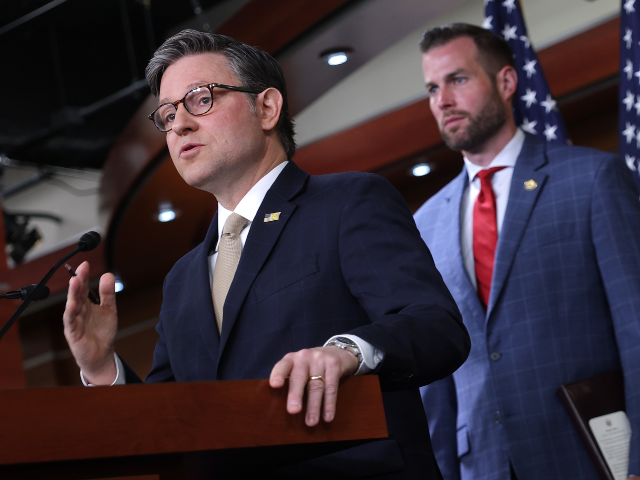
Speaker Mike Johnson (R-LA) unveiled the text of a three-year extension of Section 702 of the Foreign Intelligence Surveillance Act (FISA) as lawmakers try to extend the law ahead of the April 30 deadline.
Section 702 is a surveillance authority meant to be used to spy on foreign adversaries. However, Americans’ private communications incidentally get surveilled without a warrant — contrary to the Fourth Amendment protections against warrantless surveillance.
Conservatives have said they would not sign onto voting for reauthorizing Section 702 if it does not contain a warrant requirement for searches of Americans’ communications and provisions barring law enforcement and federal agencies from purchasing Americans’ data through third-party data brokers.
The latest proposal would, instead, include additional oversight and audits, including of the FBI’s ability to search Section 702-collected data. Some lawmakers have panned the bill’s language, believing that it amounts to merely restating current statutory language.
One major privacy advocate believes that this is a win.
“Collectively, this set of reforms provides robust privacy protections for American citizens,” Rep. Warren Davidson (R-OH), said.
“Congress should bank this win and reauthorize Section 702,” Davidson added. “Then, we should swiftly begin gutting the unmitigated surveillance state left growing unchecked during these 702 fights.”
Not all privacy hawks are convinced, however.
Sen. Ron Wyden (D-OR) said that “the latest House FISA bill is a rubber stamp for Trump and [FBI Director] Kash Patel to spy on Americans without a warrant.”
“Don’t fall for fake reforms. Tell anyone who will listen Americans need to stop warrantless surveillance. Instead of ending warrantless surveillance or creating more transparency about government spying, this bill only requires a few more Trump administration officials to check a box. That always leads to more abuses, not less,” he added.
Patrick Eddington, a senior fellow analyst at the Cato Institute and former CIA analyst, said in a statement, “Over the last two weeks, the House GOP leadership has introduced two FISA Section 702 reauthorization bills. Both bills marginally reform the compliance and oversight apparatus while leaving the core Fourth Amendment violation — warrantless access to collected U.S. person communications — structurally intact. This is an HPSCI, SSCI, IC Trojan Horse bill masquerading as something Fourth Amendment compliant.”
Elizabeth Goitein, the co-director of the Liberty and National Security Program at the Brennan Center for Justice, said, “Not only does this bill fail to include a warrant requirement for backdoor searches, it makes no changes AT ALL to either the standard or the procedures currently in place for conducting these searches. I’ll have a longer thread coming soon.”
Reps. Lauren Boebert (R-CO) and Eric Burlison (R-MO) on Thursday wrote in an op-ed for Breitbart News about how federal agencies’ purchase of Americans’ data rivals a “formal [gun] registry.” They also wrote about the need to have a warrant requirement and to close the data broker loophole:
First, require a warrant before the FBI searches an American’s private communications. This failed by a single vote in 2024. The government now claims it conducts only a few thousand such searches a year. Great, the courts can handle that load. If the real number is higher, that proves exactly why the warrant requirement is necessary.
Second, close the data broker loophole. The bipartisan Wyden-Lee-Davidson bill, Rep. Andy Biggs’s Protect Liberty Act, and the Durbin-Lee SAFE Act would all reauthorize FISA while banning the federal government from buying Americans’ data without court orders. If collecting your location data directly would require a warrant, buying it from a broker should too.
Many House Republicans continue to push for upholding the Fourth Amendment.
On Thursday, Reps. Boebert and Thomas Massie (R-KY) introduced H.R. 8470, the Surveillance Accountability Act, a bill that would require a warrant for searches of Americans. It would also create a private cause of action to allow individuals whose Fourth Amendment protections that were violated by the government to sue for damages.
“Our bill forces the government to obey the Fourth Amendment in the digital age,” Boebert said in a press release. “No more warrantless searches of your phone, cloud data, bank records, or internet history. No more hiding behind the ‘third-party doctrine.’ No more creepy warrantless facial recognition or tracking. If feds violate your rights? You can sue them for damages. The Bill of Rights isn’t a suggestion — it’s the law. Time to make Big Brother get a warrant.”
“The Bill of Rights is not a suggestion, and Fourth Amendment protections against warrantless searches conducted by the government are not optional,” Massie said in a written statement. “The Surveillance Accountability Act requires government employees to first obtain a warrant based on probable cause before searching Americans’ personal information — even if the information sought is stored on a phone, in the cloud, or held by a third party. Warrantless searches are unconstitutional, and this does not change when the data the government seeks is in digital formats or held by a third party.”
COMMENTS
Please let us know if you're having issues with commenting.