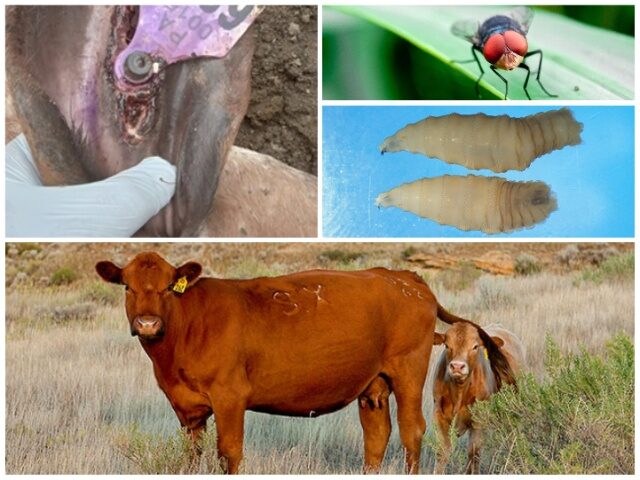

The U.S. Department of Agriculture’s (USDA) Animal and Plant Health Inspection Service confirmed the detection of New World Screwworm larvae in a calf less than 50 miles inland from the Texas-Mexico border. The flesh-eating screwworm maggots were found in the umbilical area of a 3-week-old calf in Zavala County, Texas.
The reintroduction of the New World Screwworm has been feared by authorities in Texas for some time. The discovery in Zavala County poses a serious threat to livestock producers within the state and nationwide should the screwworm migration spread. As reported by Breitbart Texas’ Bob Price, officials in the state have braced for the threat as the pest’s northward migration progressed through Mexico towards the Lone Star State.
At the San Jacinto County Republican Party Reagan/Trump Dinner in February, Texas Agriculture Commissioner Sid Miller delivered his bluntest warning yet, telling ranchers, hunters, and pet owners that the parasite is far closer — and far more active — than it should be this time of year.
“We’ve got swarms of screwworm flies 187 miles south of the Rio Grande, and it’s winter,” Miller told the audience. “We shouldn’t have any active flies right now, but it’s been a mild winter. If they’re active in the middle of winter, look out when spring or early summer gets here.”
“This will impact everybody in some form,” Miller told Breitbart Texas in an exclusive interview. “Livestock, wildlife, pets — even people. Ranchers, deer hunters, pet owners — get ready.”
In August 2025, the threat prompted Texas Governor Greg Abbott to issue a rare statewide disaster declaration and activate emergency powers in anticipation of the flesh-eating parasite crossing the border. The devastating parasite makes its first appearance in the United States since its eradication in 1966.
In a Wednesday press release confirming the discovery, the USDA warns the New World Screwworm is a serious pest that affects livestock, pets, wildlife, and, less commonly, people and birds. The larvae (maggots) enter the living host by burrowing into the flesh, causing serious damage to livestock and resulting in economic losses for producers.
The entry of the pest from Mexico has long been anticipated by U.S. authorities who have braced for the impact with a prepared response plan. Dudley Hoskins, Under Secretary for Marketing and Regulatory Programs for the USDA, commented on the discovery, saying, “Protecting our livestock industry is a national security issue of the utmost importance, and USDA is wasting no time in taking action. USDA invested heavily in the tools needed to eliminate NWS ever since cases started increasing in Central America and Mexico. The United States has defeated this pest before, and we will do it again.”
The USDA has outlined the strategies it is employing to combat the parasite, including establishing an infested zone around the detection area, quarantines, movement controls, and surveillance. The agency will also roll out sterile screwworm fly release chambers to complement the 4 million sterile flies currently being released aerially near the detection site.
Authorities hope the sterile insect technique (SIT), which involves releasing sterile flies, will result in a repeat of the eradication success achieved in 1966. According to a report by the Texas A&M University (TAMU) AgriLife Extension, the SIT method is effective in neutralizing the flesh-eating screwworm but is not instantaneous.
According to TAMU, frequent herd and flock surveillance is critical for preventing screwworm infestations. The monitoring of herds is critical as geographic spread of the parasite is mostly attributed to the movement of infested animals by humans and less frequently by fly mobility.
The financial losses that Texas cattle producers and the state’s hunting/wildlife industry could suffer from the spread of the New World Screwworm are conservatively estimated at $2.1 billion, according to TAMU AgriLife.
As in the case of the Zavala County discovery, the experts at Texas A&M indicate the screwworms are especially lethal to newborn livestock as wet navels provide optimum egg-laying sites for the New World Screwworm flies. Livestock management procedures routinely conducted during the early months of life, such as castration, ear tagging, branding, dehorning, and tail docking, also create suitable wounds that can serve as entry points for fly larvae.
Although not common, New World Screwworms can pose a risk to humans. According to the U.S. Centers for Disease Control and Prevention (CDC), as of June 2, 2026, cases of flesh-eating parasites in Central America and Mexico have been detected in 171,700 animals, compared with just 2,070 cases in humans.
According to a CDC report, only one confirmed human case of the New World Screwworm has been detected in the United States since its reemergence in Central America. The case was determined to be travel-related and was discovered in August 2025 in Maryland in a person who traveled to El Salvador.
Randy Clark is a 32-year veteran of the United States Border Patrol. Before his retirement, he served as the Division Chief for Law Enforcement Operations, directing operations for nine Border Patrol Stations within the Del Rio, Texas, Sector. Follow him on X (formerly Twitter) @RandyClarkBBTX.
COMMENTS
Please let us know if you're having issues with commenting.