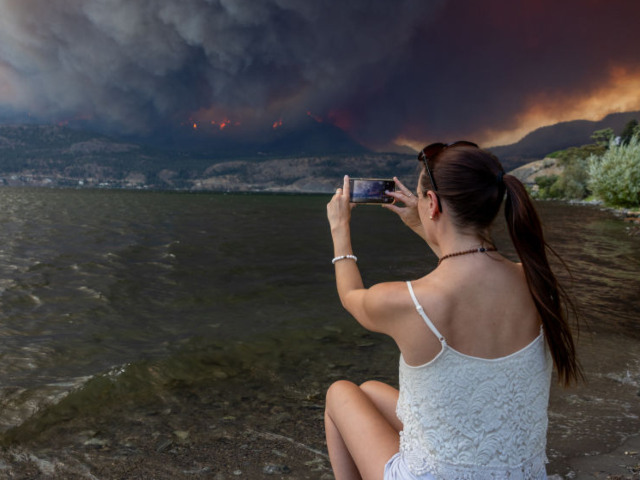

Canada is facing hundreds of “out of control” fires this week, prompting tens of thousands of evacuations from British Columbia to Newfoundland and Labrador — but climate change “experts” say the government can do nothing to stop the fires and locals should abandon dreams of mitigation protocol.
Critical context to these calls to let the fires burn out is the fact that Canada has no national-level emergency management agency, such as the Federal Emergency Management Agency (FEMA) in the United States, or a national firefighting agency. Provinces must scramble to share resources such as firefighting aircraft and firefighters trained to handle wildfires, often leaving burgeoning fires to spread for days with minimal response. Canada has an agency called “Natural Resources,” which is tasked with an expansive list of responsibilities including managing mineral resources, fossil fuels, and indigenous territories, as well as forest management.
Contrary to academics specializing in climate change, some of Canada’s top firefighting officials are demanding Ottawa establish these agencies — even if only manned by one or two people — to facilitate more rapid responses to the fires when they begin, typically in the spring season.
According to the left-wing British newspaper The Guardian, the 2025 wildfire season is Canada’s second-worst on record, trailing only the disastrous 2023 season that affected over 100 million Americans with plumes of dangerous wildfire smoke reaching as far south as New York City. Canadian authorities have documented the burning of 7.3 million hectares of land in 2025 as of this week.
The fires are affecting both the east and west coasts of the country. In Newfoundland and Labrador, 20,000 people have been placed on evacuation alert as of Wednesday, told to be ready to leave their homes in an instant.
“Nine wildfires are burning in the province, including at least four that are classified as out of control,” the Canadian Press detailed on Wednesday.
In British Columbia, meanwhile, one fire near Port Alberni doubled in size between Monday and Tuesday, threatening tens of thousands in the local population. Many of those not evacuated have lost access to electricity due to the fires. Nationwide, droughts fueling the flames have severely depleted the water supply, leaving homes dependent on wells with no water for cooking, bathing, or other necessities.
“7,318,421 hectares of land in Canada have burned due to wildfires this year — close to 78% more than the five-year average of 4,114,516 hectares,” the Guardian reported.
Outside of Canada, the fires have blanketed much of the United States in dangerous smoke, particularly Midwestern states such as Minnesota, Wisconsin, and Michigan. Lawmakers from the region have repeatedly demanded that Canada clarify exactly what its government is doing to limit the widespread impacts of these fires, with minimal response. In July, a group of Republican Congressmen led by Rep. Tom Tiffany (R-WI) sent a letter to Canadian Ambassador to Washington Kirsten Hillman requesting such information, emphasizing the significant negative effects of Canadian wildfire smoke on their constituents.
“As we are entering the height of the fire season, we would like to know how your government plans on mitigating wildfire and the smoke that makes its way south,” the lawmakers requested. “While we know a key driver of this issue has been a lack of active forest management, we’ve also seen things like arson as another way multiple large wildfires have ignited in Canada.”
“With all the technology that we have at our disposal, both in preventing and fighting wildfires, this worrisome trend can be reversed if proper action is taken,” Republicans emphasized.
The premier of Manitoba, Wab Kinew, angrily responded to the letter by calling the American lawmakers “ambulance chasers.”
Wildfires have continued to burn with minimal effective intervention, leading other lawmakers in America to follow suit. In early August, Reps. Elise Stefanik (R-NY) and Nick Langworthy (R-NY) sent a letter to leftist Prime Minister Mark Carney similarly urging Canada to take more action to limit the devastating impacts of the fires.
“We write to you today on behalf of our constituents in New York especially in Upstate communities near the Canadian border who are again dealing with unacceptable levels of smoke from Canadian wildfires,” the lawmakers noted. “The scale and severity of these fires continues to raise concerns about forest mismanagement and lack of effective deterrence of human-caused fire.”
On Monday, another group of four Midwest Republican lawmakers led by Rep. Elliott Engen (R-MN) sent a letter to the International Joint Commission, an agency facilitating cooperation between America and Canada.
“We are concerned that insufficient forest management and wildfire mitigation strategies may constitute negligence, exacerbating the transboundary impact on our states,” the lawmakers wrote. “The 2023 Canadian wildfire season, the worst on record, burned seven times the long-term average, and 2025 is projected to be among the most severe.”
“Factors such as inadequate active forest management and delays in response to remote wildfires have been cited as contributors to the scale and intensity of these fires,” they noted.
Climate change experts have reacted with outrage to the suggestion that the government of Canada, which has been under Liberal control for over a decade, could do more to contain the fires. In a cynical, defeatist opinion piece for The Globe and Mail, professor Glenn McGillivray of York University declared that the fires were “quite likely to be unsolvable,” mocking American lawmakers for suggesting action.
“We have to do a better job of raking the forest floor, I guess,” he joked.
“Along with managing our forests better, the letter also seems to imply that we can suppress our way out of the issue. Without saying it outright, the lawmakers appear to hint that we can put these fires out. We can’t,” McGillivray claimed.
“The way to fix it would have been to address climate change 30 years ago, but we failed to do that,” Lee Frelich, the director of the University of Minnesota’s Center for Forest Ecology, told Minnesota’s KARE 11. “And there’s actually not a way to fix it at this point. We should still try to limit the amount of climate warming in the future and do a much better job than we have, but there’s basically no fix for this, other than for the forest to burn until it comes to a new equilibrium.”
Contrary to these opinions, Canadian firefighting experts have repeatedly demanded the federal government establish an agency dedicated to addressing this problem.
“There’s just too many fires. There’s not enough resources. We call on help from around the world and some of the Canadian Armed Forces, but we should be able to handle this on our own,” Mike Flannigan, a wildfire expert with Thompson Rivers University, said in an interview with CTV News this week, describing years of advocacy for better coordination among provinces led by Ottawa. Flannigan explained that it often takes days for provinces to deploy resources to each other, allowing the rapid growth of fires, and that having leadership at the federal level could significantly boost response speed.
Ken McMullen, president of the Canadian Association of Fire Chiefs, also supported the idea of a national agency in remarks to CTV.
“The benefit of a national administration is really around coordination and the reallocation of resources all across Canada in times when they need it the most,” he explained. “That’s really a position within the federal government that allows fire chiefs to have the right place, at the right time, to have conversations on fire-related policy at the federal level.”
The Canadian Association of Fire Chiefs has repeatedly called for the Canadian government to establish a federal fire agency, noting that America has one operating under FEMA. In a similar interview with the Canadian Press last week, McMullen said that a federal agency even “staffed by one or two people” could dramatically improve fire response, lamenting that the election of Carney in April had “caused delays” in the establishment of such an agency.
Also contrary to the climate experts warning nothing can stop wildfires, the Canadian government finally announced a new series of initiatives on Tuesdays to expand its ability to respond to fires. The initiatives, requiring $45.7 million (Canadian) in funding, would go into regional projects meant to “reduce fuel loading on the landscape through utilization of dead and damaged forest fibre… reduce wildfire risk through forest harvesting and fuel treatment methods,” and implement fire education for indigenous communities, among other projects. At least one province, British Colombia, will bring back “cultural burning,” an indigenous practice meant to alleviate wildfire risk by reducing the available amount of deadfall for fires to burn.
COMMENTS
Please let us know if you're having issues with commenting.