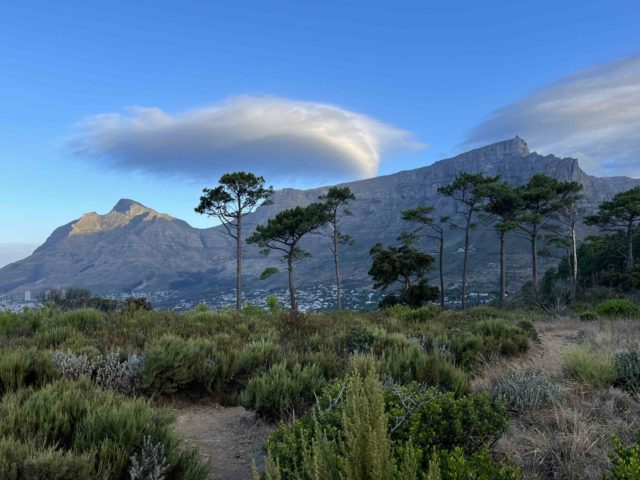

I recently concluded a 14-day visit to South Africa, the country where I was born and where I worked for several years after college as a journalist and speechwriter.
The country has been through a difficult decade and-a-half, with the ruling African National Congress (ANC) enriching party leaders while mismanaging the state. The leading opposition party, the Democratic Alliance (DA), for which I worked, has been through its own ups and downs as it struggles to attract elusive black voters.
There are signs of hope, but also of despair.
I had the opportunity to visit four of the country’s nine provinces — Gauteng, the major economic hub; Limpopo, a largely agricultural province bordering Zimbabwe; the Eastern Cape, which is the ANC’s traditional home base; and the Western Cape, home to the spectacularly beautiful city of Cape Town.
My overall impression was that the Western Cape is looking better than I remembered it, and that everything else is looking worse to some extent.
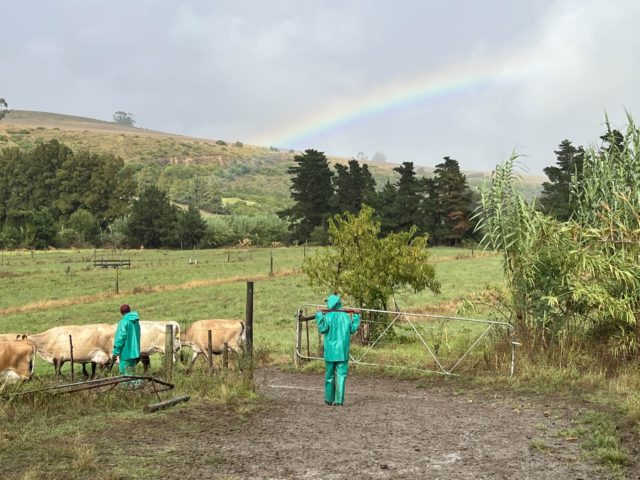
Rainbow in rural Western Cape (Courtesy of Joel Pollak)
One ought to be careful making any sort of judgment of any country as the world emerges from a pandemic that damaged nearly everyone’s economy. But there are a few fair indicators of administrative health, such as the quality of the roads.
In the Western Cape, I found the roads, even small rural ones, to be well-maintained — perhaps even in better condition than our (admittedly bad) roads in California. Everywhere else, I had to dodge massive potholes and navigate busted traffic lights.
The Western Cape has been governed by the DA for more than a decade, and Cape Town has enjoyed sixteen years of DA governance. While the results have not been flawless, they have set the province and the city apart from the rest of South Africa.
Whereas the ANC is focused on economic redistribution — often into its own pockets — under the DA, provincial and local governments have tried to create the conditions for economic growth that will improve life for residents of all races.
The ANC continues to govern in a schizophrenic fashion, posturing as the voice of South Africa’s Third World majority, while adopting the policy priorities of First World elites.
While I traveled the countryside, I listened to a puzzling debate about whether South Africa should transition away from coal as an energy source as a way of fighting climate change. The country depends on coal for energy and jobs, and its giving up coal would have a negligible effect on global temperatures.
Meanwhile, the national electricity utility, Eskom, struggles to provide enough power to keep the economy going. While ANC-governed municipalities founder in the dark, Cape Town’s new mayor, Geordin Hill-Lewis, has invited bids from independent electricity suppliers.
The city could soon become a “green” hub for Africa — and the world. With abundant sunshine and strong seasonal winds, the Western Cape could become a global laboratory for renewable energy technology.
While it has the climate of California, the Western Cape is the political equivalent of Florida, the one place that is willing to depart from the statism of the central government. And while there was mass looting in Gauteng and in the Indian Ocean province of KwaZulu-Natal last year, the Western Cape remained calm, thanks in large part to the province’s emphasis on law enforcement, including local police forces. South Africans are voting with their feet, moving to the province in droves.
International investors are still wary of South Africa as a whole, from which the Western Cape cannot completely detach itself. And even the Western Cape has challenges: the local Internet infrastructure is stuck on 3G.
But the country’s most beautiful province is also its best chance of success. It will not be the declining gold fields of Gauteng, but the future solar fields and technology incubators of the Western Cape, that lead South Africa into a brighter future of shared prosperity.
Joel B. Pollak is Senior Editor-at-Large at Breitbart News and the host of Breitbart News Sunday on Sirius XM Patriot on Sunday evenings from 7 p.m. to 10 p.m. ET (4 p.m. to 7 p.m. PT). He is the author of the recent e-book, Neither Free nor Fair: The 2020 U.S. Presidential Election. His recent book, RED NOVEMBER, tells the story of the 2020 Democratic presidential primary from a conservative perspective. He is a winner of the 2018 Robert Novak Journalism Alumni Fellowship. Follow him on Twitter at @joelpollak.
COMMENTS
Please let us know if you're having issues with commenting.