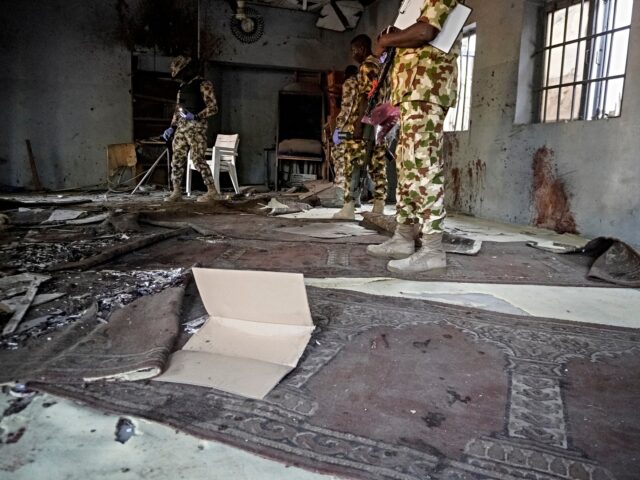

Locals in multiple communities throughout Nigeria reported a wave of violence believed to be attributed to jihadist actors over the weekend, including a particularly deadly suspected Boko Haram attack leaving at least 25 dead.
Reports of such attacks surfaced in northwest Borno state, the traditional stronghold of the jihadist terrorist organization Boko Haram, and in Benue state, a Middle Belt state that has in recent years seen an eruption of attacks targeting Christians by jihadist Fulani “herdsmen” terrorists. Another attack also appeared in reports in Nigerian media occurring in Niger state, in the country’s northwest.
Nigeria has consistently ranked the world’s deadliest place to practice Christianity for nearly a decade as a result of the wide variety of Islamic threats present. The Fulani herdsman and Boko Haram remain the largest and most dangerous groups, though the government often also laments the presence of unspecified “bandits” that target Christian communities for destruction. The Nigerian government under the past three presidents – Goodluck Jonathan, Muhammadu Buhari, and incumbent Bola Tinubu – has faced global condemnation for doing little to protect the nation’s ethnic minorities and its vast Christian population. President Donald Trump placed Nigeria on the State Department’s list of Countries of Particular Concern for religious freedom in October.
Reuters reported on January 30 that a wave of Boko Haram attacks on the town of Sabon Gari, in Borno, resulted in at least 25 deaths.
“The victims were labourers who had travelled to Sabon Gari town in northeastern Nigeria’s Borno State to work at a construction site, when gunmen swept in on Thursday and opened fire,” according to the outlet. Reuters had already reported a separate attack the day before on Sabon Gari targeting its Nigerian army base and killing “several” soldiers.
The previous attack, while believed to be less deadly, raised alarm as it reportedly involved terrorists using drones to target army assets at the base. Reuters attributed the attack to the Islamic State West Africa Province (ISWAP). Boko Haram renamed itself “ISWAP” in 2015, pledging allegiance to then-Islamic State chief Abu Bakr al-Baghdadi. Some of its terrorists members refused to merge with ISIS, however, effectively creating two operating jihadist cells.
The “ISWAP” bombing of the Sabon Gari army base last week reportedly “destroyed several military vehicles, including an excavator and a low-bed trailer,” local sources told Reuters.
The Nigerian Daily Trust newspaper reported on Monday that another 17 people were killed in a Boko Haram attack in Guzamala, Borno, but that it was not possible at the moment to know how many people were killed as local officials kept finding new bodies.
“The Speaker of the Borno State House of Assembly, Rt. Hon. Abdulkarim Lawan, confirmed the incident and sympathised with the families of the victims,” Daily Trust reported. “The Speaker, who represents the constituency, said 12 bodies were recovered and given a mass burial according to Islamic rites in Monguno.”
Elsewhere in the country, the Nigerian newspaper Punch reported on Monday that at least one person had been killed in the burning of a church and village siege in Niger state. The incident reportedly occurred in Agwara and began as a looting effort.
“The attackers reportedly looted foodstuffs and other valuables before killing an elderly woman in Kabe town and abducting five residents,” Punch reported, identifying the church burned down as the United Missionary Church of Africa. Punch identified the attackers as “bandits,” a catch-all term that Nigerian media uses to refer to Islamic terrorists.
“People were even warned not to say they are Fulani herdsmen who have been causing these atrocities such that when you open the general media they are talking about bandits — bandits or they say ‘unknown gunmen’ or things like that,” Father Remigius Ihyula, a Catholic priest, explained in an interview with Breitbart News in 2023. “So you read about bandits. It’s rubbish: They are Fulani men going about with cattle and with guns and killing people and the government won’t do anything about it.”
Murtala Dantoro, a member of the Borgu Royal Family of the state, told Punch that these attacks were not random lootings and urged government to stop treating them as such.
“These attacks are not isolated incidents; they are persistent and escalating. The absence of a permanent and well-equipped military formation in Agwara has left the people vulnerable and exposed,” he was quoted as saying. “The state and federal governments must come to our aid urgently before these suspected bandits chase us out of our homeland.”
Dantoro has previously blamed “banditry migration,” in which terrorists move into “soft target” areas known to have little security presence to operate, for the growth in terrorism in Niger, demanding the Nigerian government fix the “systematic failure” that allows this violence to persist.
Similarly, Punch cited the Catholic Bishop of Kontagora Diocese Most Rev. Bulus Yohanna, who demanded the government in Abuja establish a “visible and stationed military presence” to discourage attacks.
“These suspected bandits now move freely without challenge. Presently, the rule of law no longer functions effectively in Borgu and its surrounding axis, as criminals operate freely both day and night,” the bishop asserted.
In Benue, the heart of central Nigeria, “waves of attacks” by “suspected armed herdsmen” targeted Christians over the weekend, according to the newspaper Vanguard. These attacks allegedly killed at least five people, but forced the displacement of an entire community that feared the return of the terrorists to eliminate them. The attack allegedly began with a terrorist ambush of a group of women at a local pond attempting to clean their clothes.
This wave of violence is believed to be one of the largest since Christmas, when President Donald Trump approved airstrikes on jihadist targets in Sokoto state, in the northwest of the country. Trump explained in a message to the public that the strikes targeted “ISIS terrorist scum” who were “viciously killing, primarily, innocent Christians at levels not seen for many years, and even centuries.”
Tinubu, the Nigerian president, confirmed that the airstrikes were conducted with the support of the Nigerian government and boasted about them in his New Year address.
“In collaboration with international partners, including the United States, decisive actions were taken against terrorist targets in parts of the Northwest on December 24. Our Armed Forces have since sustained operations against terror networks and criminal strongholds across the Northwest and Northeast,” Tinubu said.
“In 2026, our security and intelligence agencies will deepen cooperation with regional and global partners to eliminate all threats to national security. We remain committed to protecting lives, property, and the territorial integrity of our country,” he added.
COMMENTS
Please let us know if you're having issues with commenting.