
Thailand launched airstrikes against Cambodian positions along the border on Monday, ostensibly because Cambodian troops opened fire and killed at least one Thai soldier.
The Cambodian military denied those claims and insisted the Thai attack was unprovoked.
Thailand and Cambodia have quarreled over their border for more than a century. In July 2025, a skirmish in the disputed border region brought the neighboring countries to the brink of war. President Donald Trump was able to broker a ceasefire, prompting Cambodia to nominate him for a Nobel Peace Prize.
Talks began for a more durable peace agreement, but Thailand withdrew from those talks in November after two Thai soldiers were injured by a land mine in the border region. Cambodia denied having laid any new land mines, but Thailand insisted the incident proved it was still “dealing with an adversary.”
Tensions flared again on Monday when Thailand struck Cambodian positions along the border with American-made F-16 fighters. As with the July conflict, each side accused the other of shooting first.
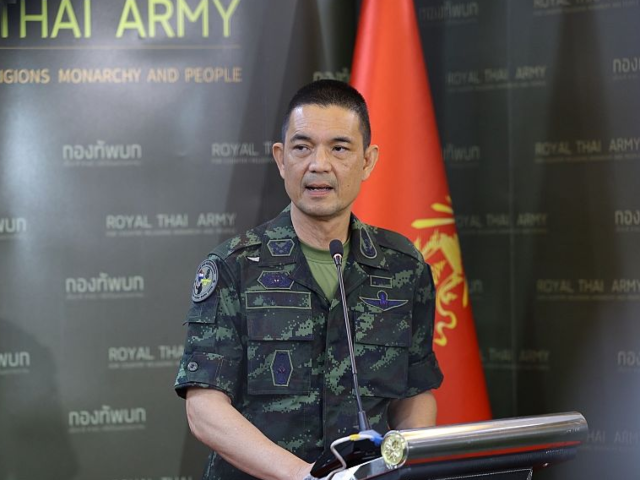
The Thai military claimed its forces came under attack from Cambodia, with at least one fatality and several injuries. Thai Army Chief of Staff Chaiyapruek Duangprapat said on Monday the retaliatory strikes were intended to “cripple Cambodia’s military capability for a long time to come, for the safety of our children and grandchildren.”
A spokesman for the Thai defense ministry said the targets included Cambodian facilities housing Chinese-made PHL-03 rockets and Soviet-designed BM-21 Grad multiple rocket launchers, which could be used to attack vulnerable targets in Thailand, including the Buriram provincial airport and hospital near the border. Thai military officials said another of their targets on Monday was a casino in Cambodia that was being used as a base for drone operations.
The Thai defense ministry said there have been “attempts” by the Cambodian side to “lock on the coordinates of these facilities.” Thailand accused Cambodia of using its BM-21s to attack civilian targets during the July conflict.
There was a brief exchange of fire between Thai and Cambodian ground forces on Sunday, involving mostly small arms and mortars, with each side again accusing the other of shooting first. The Cambodian defense ministry accused Thai forces of opening fire without provocation, and claimed Cambodian forces did not shoot back.
Thailand insisted the Cambodians fired first on Sunday and even used their BM-21 rocket launchers to attack Thai civilian areas in the province of Buriram. Thailand said this was the reason for Monday’s airstrikes against Cambodia’s long-range weapons, the first time Thailand has used its F-16s in combat in 30 years.
“These developments prompted the use of air power to deter and reduce Cambodia’s military capabilities to the minimum level necessary to safeguard national security and protect civilians,” the Thai air force said on Monday.
“Cambodia had mobilized heavy weaponry, repositioned combat units, and prepared fire support elements,” charged Thai Air Marshal Jackkrit Thammavichai.
Cambodian Senate President Hun Sen, the influential father of current Prime Minister Hun Manet, claimed on Monday that Thai Prime Minister Anutin Charnvirakul was deliberately provoking a conflict to “gain votes.”
“We understand the love of the nation, but we should not declare war on those who do not retaliate,” said Hun Sen, meaning the Thai leader should not be attacking peaceful Cambodians to further his own political ambitions by rallying Thai nationalists.
Anutin released a statement on Monday in which he insisted Thailand “has not initiated or carried out any aggression,” but it will “not tolerate any violation of its sovereignty,” and is “prepared to take all necessary measures to protect national security.”
Both Thailand and Cambodia said on Monday that thousands of people living in the border region have fled their homes for shelters outside the conflict zone.
COMMENTS
Please let us know if you're having issues with commenting.