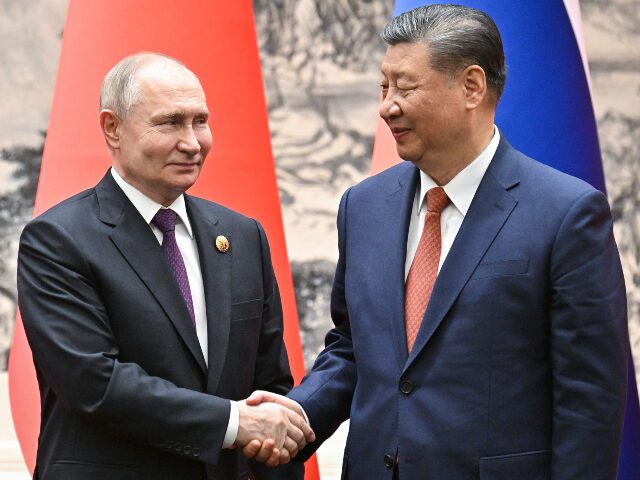
Chinese dictator Xi Jinping and his Russian counterpart, Vladimir Putin, held a “virtual meeting” on Wednesday in which they celebrated their countries’ close bonds and vowed to expand “high-level exchanges,” trade, and diplomacy.
The meeting occurred within hours of Xi phoning President Donald Trump and on the eve of the expiration of the Obama-era “New START” agreement between America and Russia, which was meant to govern the development of nuclear weapons. Putin dramatically declared he would violate New START indefinitely in 2023, following his invasion of Ukraine, but the Kremlin nonetheless claimed to be “disappointed” that Putin and Trump had not agreed to an extension of the agreement or its replacement with a more detailed document.
President Trump has refused to sign another nuclear development treaty with Russia, arguing that the Chinese government should be brought in for a trilateral agreement given Beijing’s rapid and unchecked nuclear weapons development. The Chinese Communist Party has reacted with outrage to the invite to be included in such an agreement, while Russia has largely avoided addressing the issue with any substance.
The majority of the Chinese government readout about Xi and Putin’s conversation did not address nuclear weapons development but, rather, bilateral ties. The meeting, taking place shortly before the Lunar New Year, has become a tradition between Moscow and Beijing to allow for communication of topics of mutual importance.
“President Xi expressed his readiness to work with President Putin on this auspicious day to draw a new blueprint for China-Russia relations,” according to the Chinese Foreign Ministry. Xi told Putin that his regime would “expand high-standard opening up in a more proactive manner and share new development opportunities with all countries including Russia.”
Xi also insisted China and Russia should jointly “carry out closer high-level exchanges, strengthen practical cooperation across the board, deepen strategic coordination, actively shoulder responsibilities as major countries, and ensure continued development of China-Russia relations along the right track.” The Chinese dictator also claimed that 2026 had “witnessed increasing turbulence around the world,” apparently a reference to the arrest of Venezuelan socialist dictator Nicolás Maduro, who was extradited to the United States on narco-terrorism charges. Maduro was a close ally of both Russia and China, and his demise has significantly jeopardized the relationships both countries developed with his regime.
“As responsible major countries and permanent members of the U.N. Security Council, China and Russia are duty-bound to pool global efforts to firmly uphold fairness and justice,” Xi allegedly said, “firmly defend the victorious outcomes of WWII, firmly safeguard the U.N.-centered international system and the basic norms of international law, and jointly maintain global strategic stability.”
None of these suggestions apparently involved limiting nuclear weapons development. The Chinese Foreign Ministry did not mention the New START Treaty in its readout. Top Kremlin spokesman Dmitry Peskov did confirm to reporters on Thursday, however, that Xi and Putin addressed the matter.
“Indeed, this issue was raised yesterday with regard to its negative consequences for the international system of nuclear arms control and strategic stability,” Peskov said, according to the Russian news agency Tass. He did not clarify if Putin discussed bringing China into the fold for any future nuclear weapons containment agreements, a possibility that has made Beijing bristle for years. Peskov did state that the formal position of the Russian government is to perceive the end of the treaty “negatively” and “express … regret.”
The New START Treaty was initially set to expire in February 2021. In January of that year, newly inaugurated former President Joe Biden offered Russia a five-year extension on the treaty with no plans to include China in the negotiations – far more than the Russians were asking for during the Trump administration. Trump had repeatedly refused to extend the agreement on the grounds that Russia regularly violated it and that a nuclear weapons agreement not including China, given the military strength of that country, was meaningless.
“It’s a one-sided deal like all other deals we make. It’s a one-sided deal,” Trump said in 2017. “It gave them things that we should have never allowed. … Just another bad deal that the country made, whether it’s START, whether it’s the Iran deal, which is one of the bad deals ever made.”
In 2019, Trump told reporters he was seeking to involve China in a new agreement.
“We’re talking about a nuclear agreement where we make less and they make less and maybe even where we get rid of some of the tremendous firepower that we have right now,” he explained at the time. “And China is frankly also – we discussed the possibility of a three-way deal instead of a two-way deal. And China, I’ve already spoken to them. They very much would like to be a part of that deal.”
The Chinese government has repeatedly and vocally denied any such interest, though the state-run Global Times propaganda newspaper boasted on Thursday that Trump’s hope to include China was a sign of the country’s global influence.
“All parties including the US and Russia have realized that the constructive settlement of these issues is inseparable from China’s participation and must involve full communication, exchanges and dialogue with China,” the state outlet claimed, citing a regime-approved “expert.” “This has made China a core and critical connecting point in current international relations, and an important pillar for countries to strengthen their own development and resolve practical challenges.”
Russia formally declared its intention to disregard the agreement in February 2023, a year after the launch of the full-scale invasion of Ukraine, to protest Western support for the victimized country. During his remarks on Thursday, Peskov, the Kremlin spokesman, did not reconcile Putin’s publicly declared intention to ignore the treaty with the alleged “regret” felt by Putin’s regime upon its official expiration.
Follow Frances Martel on Facebook and Twitter.
COMMENTS
Please let us know if you're having issues with commenting.