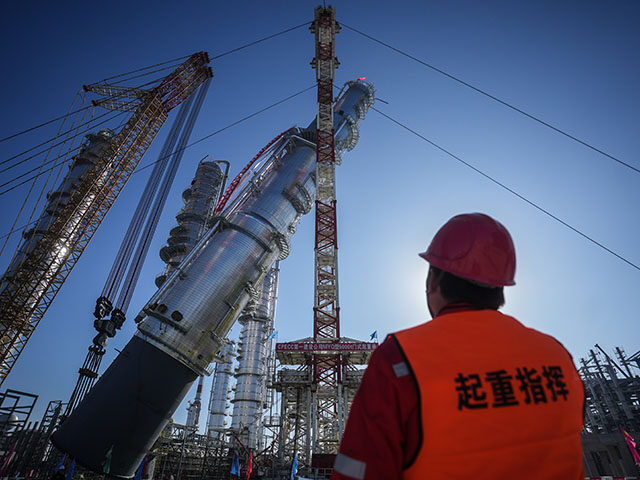

Chinese companies have reportedly delayed two major refinery projects, capable of producing 500,000 barrels per day (bpd) combined, due to the shortage of crude oil from the Middle East after Iran closed the Strait of Hormuz.
Reuters on Monday quoted sources who identified the two projects as a 300,000 bpd refinery in the northeastern Chinese city of Panjin and a 200,000 bpd in the southern city of Dalian. Both refineries were planned with a heavy flow of Middle Eastern crude oil in mind.
The Panjin refinery is a joint venture between China’s state-owned Panjin Xincheng Industrial Group, China’s state-owned defense company Norinco Group, and Saudi Arabia’s state oil company Aramco. The three massive corporations created a new entity called Huajin Aramco Petrochemical Company (HAPCO) to manage the project.
The new refinery was originally slated to come online by the end of June, but will reportedly be delayed until at least September, depending on how long it takes Middle Eastern oil flows to return to normal.
The Dalian refinery is a project from China’s state oil firm PetroChina, and was originally planned to exploit cheap crude oil from Russia.
The Hormuz crisis did not directly cut off the flow of oil to the Dalian project, but it increased demand for Russian oil with a commensurate boost in prices, making the new refinery superfluous. Reuters noted that China’s refineries are currently running at around 69 percent of capacity, so there is no need to bring a new facility online. The Dalian refinery has therefore been delayed indefinitely.
CNBC noted on Monday that China has acted as a “key pressure valve on energy markets,” cutting imports from 11.7 million to 9 million bpd since the Hormuz crisis began in early March, which eased the “supply shock” to the rest of the global marketplace.
According to industry analysts, China is responsible for 74 percent of the reduction in worldwide oil imports since March.
Reduced imports are a major reason why oil prices have not soared as much as feared. In the current crisis, global oil supply is down 14 percent but prices have only increased by 30 percent – whereas during the notorious 1973 OPEC oil embargo, supply only dropped by seven percent but prices exploded by 134 percent.
COMMENTS
Please let us know if you're having issues with commenting.