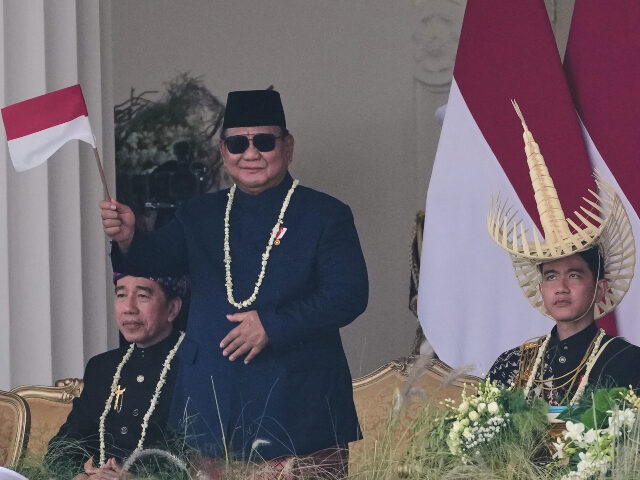

Indonesian President Prabowo Subianto led the 81st commemoration of his country’s independence in the capital of Jakarta on Monday, even as Indonesia grappled with the aftermath of a devastating earthquake in the east and rumblings of political unrest in the west.
President Prabowo donned traditional garb and a garland of jasmine – a flower that symbolizes peace, love, and good fortune – for a flag-raising ceremony at his official residence, the Merdeka Palace in Jakarta.
Indonesia declared independence from Dutch colonial rule and Japanese military occupation on the morning of August 17, 1945, soon after Japan’s surrender in World War II was confirmed. A few years of unrest followed, until the Netherlands finally signed the agreement to make federal Indonesia sovereign on March 25, 1947, but August 17 is commemorated as the day of national independence.
The Jakarta Post reported that the colorful ceremony had solemn undertones, as the people of Flores Island are still recovering from an earthquake on Saturday that killed at least 68 people:
The event began with a series of arts performance, a parade and a gilded carriage carrying the replica of the national red-and-white flag and the original Proclamation text from the National Monument (Monas) to the Merdeka Palace, escorted by 114 cavalry troops and 45 military police officers on motorcycles from the presidential security detail.
A solemn atmosphere followed as Prabowo led a moment of silence to commemorate the services and sacrifices of the country’s national heroes and called on attendees to pray for Indonesians affected by disasters.
The island of Flores was struck by an earthquake of magnitude 7.7 on Saturday, followed by almost a thousand aftershocks. The quake drove 12,800 people from their homes and caused over 200 serious injuries, in addition to the fatalities.
Rescuers were still combing through the rubble on Monday, raising the death toll as bodies were discovered in the ruins. Survivors are mostly living in tents outside homes they are afraid to enter, fearing more aftershocks. Another shock of 5.6 magnitude was reported on Monday.
Many locals complained of a slow disaster response from the provincial and national governments.
“We’re on our own here. As for help from the government, there hasn’t been any – no tents, no medicine, no food, no drinking water, nothing,” a Flores resident told Al Jazeera News on Monday.
The Indonesian military said it was airlifting 13 metric tons of emergency aid to the island on Monday, with some shipments to be delivered directly to survivors by helicopter.
Deputy Health Minister Benjamin Paulus Octavianus said emergency field hospitals would be constructed to replace the hastily improvised tent hospitals thrown up by the locals, and more medical equipment would be delivered to the earthquake region.
The Jakarta Post noted that the quake caused landslides and blocked roads across East Nusa Tenggara (NTT) province, making it difficult for relief workers and disaster supplies to enter the area. The health ministry said neurosurgeons and orthopedic surgeons were vitally needed to treat head trauma and broken bones from the quake.
U.S. Secretary of State Marco Rubio included “deepest condolences to those who lost loved ones in the devastating earthquake” in his message of congratulations to Indonesia for its independence day.
“Our thoughts are with those who were injured and all communities affected by this tragedy,” Rubio said.
Meanwhile, in the western province of Aceh, scuffles broke out between security forces and thousands of demonstrators on Saturday.
Saturday was the 21st anniversary of Aceh Peace Day, when an agreement called the Helsinki Memorandum of Understanding was signed to end a 30-year civil war between the Indonesian federal government and the Free Aceh Movement, a separatist group also known as the Aceh-Sumatra National Liberation Front.
The Acehnese are a distinct ethnic group with their own language who live in the northern part of Sumatra. Their region was an independent Islamic sultanate before the Dutch colonial era.
Many Acehnese felt the early Indonesian government broke promises to afford them special status and recognition, including for their practice of fundamentalist Islamic law, which is much stricter than the rest of Indonesia. The Free Aceh Movement fought a three-decade guerrilla war for independence that ended with the 2005 Helsinki agreement.
The unrest on Saturday reportedly began when some of the pro-Aceh protesters hoisted their own revolutionary flag over the Baiturrahman Grand Mosque in Banda Aceh City, the regional capital.
Some of the protesters said the flag was raised as an expression of “gratitude” for peace and hope for justice, but other observers did not take it that way, especially since the Indonesian national flag was pulled down during the demonstration – a particularly unwelcome action so close to Indonesian Independence Day.
Indonesia’s Tempo newspaper reported:
Moments after someone climbed the flagpole, gunfire began to be heard, provoking a crowd reaction. The crowd immediately moved toward the sound and threw stones at several police officers on guard. Several cars parked around the mosque were also damaged.
Police officers urged the crowd to stop throwing objects and disperse – but were ignored. Police eventually fired water cannons and tear gas to force the crowd to disperse.
Some of the protesters also waved white flags to symbolize their complaints about natural disasters in Sumatra, which they blame on excessive deforestation.
COMMENTS
Please let us know if you're having issues with commenting.