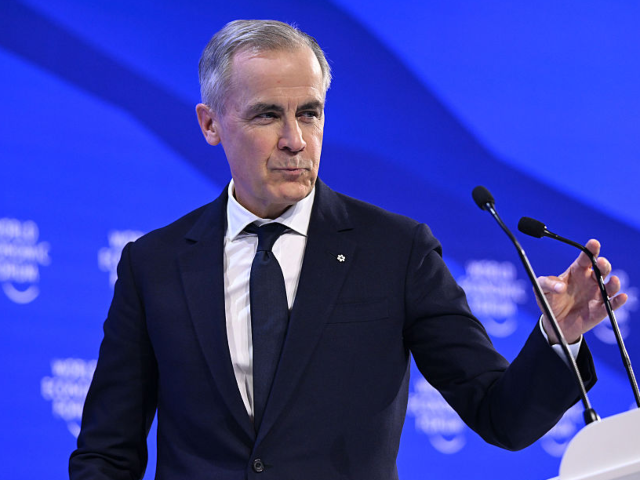

Canadian Prime Minister Mark Carney, fresh from toadying to the Communist dictatorship of China, slammed the United States in his address to the globalist World Economic Forum (WEF) in Davos, Switzerland on Tuesday.
Carney, whose extensive business ties to China were overlooked by Canadian voters in his run for prime minister, traveled to Beijing last week for an obsequious meeting with dictator Xi Jinping. Ostensibly eager to prove that Canada doesn’t have to rely on American trade, Carney abandoned Canada’s protections against Chinese electric vehicle (EV) dumping and agreed to swallow his criticisms of China’s human rights abuses to cut deals with a country he formerly described as the greatest threat to Canadian national security.
Carney sounded like he was reading a few lines from Beijing’s playbook in his address to the WEF, complaining that “great powers have begun using economic integration as a weapon” and “tariffs as leverage.”
China has persistently directed both of those complaints against the United States since President Donald Trump returned to office even though China’s entire geopolitical strategy is premised on using economic integration as a weapon and tariffs as leverage. Canadians will receive a rude reminder of this if a future prime minister takes a position Beijing disapproves of and China cuts off Canada’s supply of critical minerals to bring Ottawa back in line.
Carney began his speech on a dramatic note, decrying “the rupture in the world order, the end of a nice story, and the beginning of a brutal reality where geopolitics among the great powers is not subject to any constraints.”
“But I also submit to you that other countries, particularly middle powers like Canada, are not powerless. They have the capacity to build a new order that embodies our values, like respect for human rights, sustainable development, solidarity, sovereignty, and territorial integrity of states,” said the man who just agreed to stop criticizing China for using forced labor.
“It seems that every day we are reminded that we live in an era of great power rivalry. That the rules-based order is fading. That ‘the strong do what they can, and the weak suffer what they must,’” Carney said, quoting Thucydides’ History of the Peleponnesian War.
Carney, like many others who have dragged out the Thucydides quote often enough to turn it into a cliche, sought to build his speech into an inspirational call to create an international order that would prove the fabled Athenian historian wrong. The problem is that the entire history of postwar international relations supports the much-derided aphorism, especially when considering the part Carney did not bother to quote, where Thucydides observed that “right is only in question between equals in power.”
Even at its most aspirational heights, the “rules-based international order” has existed for only so long as the great powers found it useful. Carney proved this last week, currying favor with a brutal dictatorship that spent the past decade meddling in Canadian elections and taking Canadians hostage. He would not have been so eager to cut deals with Xi Jinping’s empire of slavery if the Chinese did not have enough money and power to purchase his allegiance.
The interesting thing about Carney’s speech is that he acknowledged all of this, waving aside past notions of the “international rules-based order” as “partially false” and a “useful” fiction supported by American hegemony. He bemoaned the collapse of the “multilateral institutions on which middle powers relied,” creating a new impulse toward “greater strategic autonomy,” which he saw as “understandable” but unfortunate.
Carney spent much of his speech congratulating Canada for having an epiphany about “values-based realism,” an approach that would supposedly help middle powers become both “principled and pragmatic.”
“Principled in our commitment to fundamental values: sovereignty and territorial integrity, the prohibition of the use of force except when consistent with the U.N. Charter, respect for human rights,” he said – a line that should have come with a laugh track in light of his pilgrimage to Beijing last week. He proceeded to declare Canada’s commitment to Greenland and Denmark against President Trump’s ambitions, without mentioning Chinese aggression in the South China Sea at all.
The sad thing about Carney’s long speech is that it could be taken as a powerful argument against doing exactly what he just did with China, while “values-based realism” is not a bad summary of the “America First” philosophy that Carney complained at such great length about.
What has changed over the past few years — beginning with the Wuhan coronavirus pandemic, and accelerating with the re-election of Donald Trump, who tends to phrase his geopolitical strategy in the bluntest possible terms — is that Americans are no longer willing to pick up 90 percent of the tab for a “rules-based international order” that is easily gamed and manipulated by powers like China for their own ruthless advantage, while America’s interests always come dead last. The very notion that the United States has legitimate interests was considered an unacceptable topic for polite conversation.
Trump has called a great many bluffs from Europe and Canada over the past year, demanding they put their money where their mouths are, and his track record at puncturing their empty bluster has been pretty solid. Globalism fell flat on its face after Russia invaded Ukraine in 2022, and when Hamas attacked Israel in 2023, and when Iran murdered its own people on an industrial scale last week — exactly as Thucydides would have expected.
The only hope for ever building a world different than the one Thucydides saw from Athens is for Carney’s “middle countries” to get serious about defending their own civilization by rallying around the one and only power that has the strength to build a multilateral order that is not based on fragile illusions: the United States of America. Mark Carney just signed on to Beijing’s alternative vision of ugly despotisms doing whatever it takes to stay in power, while their elites get rich from global trade without conscience.
COMMENTS
Please let us know if you're having issues with commenting.