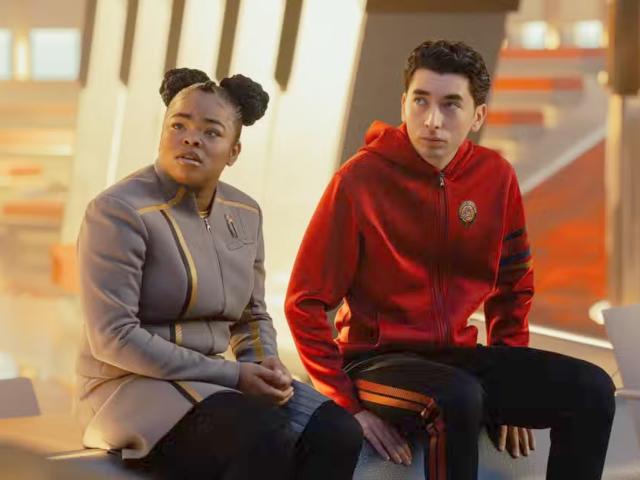

The bubbled morons at Paramount were so certain Star Trek: Starfleet Academy would be a hit that the show was renewed, and the second season was already shot before the first season ended.
The show just got canceled.
And that’s the only reason Starfleet Academy will have a second season. If the bubbled morons at Paramount had any brains, they would have done the prudent thing, which would’ve been to gauge the reaction of season one before greenlighting season two. Now they’ve already spent tens of millions on a show everyone hates.
Tee hee.
“The first season of ‘Starfleet Academy’ reached an 87 percent critical approval rating on Rotten Tomatoes, with Variety‘s Aramide Tinubu describing it as a ‘delightful entry point’ into the franchise,” reports Variety.
But of course it did. The show made a Klingon a gay pacifist and put him in a skirt. There is no easier way to earn a an 87 percent fresh rating from the loser hiveminds at Rotten Tomatoes than to trash a beloved franchise with sexual perversion aimed at young people.
“But the show failed to find a significant audience,” Variety laments. “Across its 10-episode first season, it has failed to rank on the Nielsen Top 10 streaming viewership charts.”
Translation: Normal People, not so much.
Oddly enough, in an X post defending Starfleet Academy, Captain Kirk himself, William Shatner, gets it all wrong but still accidentally explains where everything went wrong with this once legendary franchise.
“During the first airing of my Star Trek series where a kiss was objectionable; many southern stations pulled the episode & condemned the show,” wrote Shatner. “Using today’s vernacular it would absolutely be called woke DEI crap, because it went against ‘norms’ of society for its time. Not a lot seems to have changed.”
Shatner’s referring to a season three episode called “Plato’s Stepchildren” where aliens use telekinetic powers to force a kiss between Captain Kirk and Lt. Uhura (Nichelle Nichols).
But here’s the difference…
Like all of the original Star Trek episodes, “Plato’s Stepchildren” is about Big Issues and moral dilemmas. In this case, free will, how power can corrupt, dehumanization, and prejudice. The episode is not “about” an interracial kiss.
Certainly, at the time, everyone involved in producing the episode understood what the kiss meant in 1968 America, but because adults ran the show, they also understood that good storytelling demanded the story be about something bigger than a kiss. So the kiss became an element used to tell that bigger story, which was itself driven by a theme that even America’s worst bigot could relate to: being bullied by the powerful.
The original Star Trek was never an All About Me show. The characters were not driven — as is obviously the case in Starfleet Academy — by the narcissistic disease of self-expression. Instead, they were driven by duty to Starfleet and their shared humanity.
Best of all, and this is what has made the original series and its subsequent feature films so timeless, the central characters of Kirk, Spock, and McCoy were beautifully explored when that sense of duty came into conflict with right and wrong. It was never through self-expression that these characters unfurled. Instead, it was through their actions, interactions, decisions, sacrifice, and the resolution of moral dilemmas that we came to know, love, and respect the crew of the Enterprise — not them kissing on one another or wearing a skirt or demanding to be accepted for who they are.
This is also the difference between timeless and timely storytelling. In that respect, Starfleet Academy felt stale the day it was released, like something from 2020 when there were still enough people high on their woke supply to make garbage like this a temporary hit.
P.S. The interracial kiss in “Plato’s Stepchildren” ended up not being controversial at all. According to Nichelle Nichols, other than one letter, the mail was overwhelmingly positive. The women wanted to know what it was like to kiss sexy Captain Kirk. The guys wanted to know the same about sexy Uhura. The original Star Trek moved the ball by appealing to human nature, not by looking to rewire it.
COMMENTS
Please let us know if you're having issues with commenting.