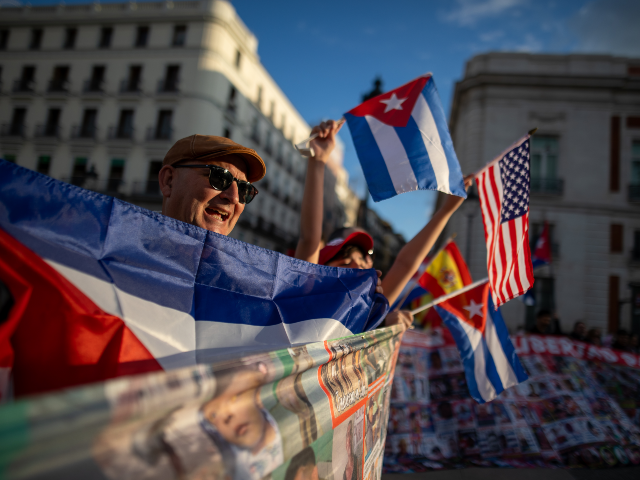

A coalition of anti-communist organizations in Cuba and the diaspora signed a document called the Agreement for the Liberation of Cuba on Monday, detailing the construction of a government to transition the island out of 67 years of repressive and impoverishing socialist rule.
Organized by the Assembly of the Cuban Resistance (ARC), a coalition that unites Cubans on and off the island, and Pasos de Cambio, a pro-democracy organization advocating for human rights, the event on Monday presented a specific blueprint for what should replace the Communist Party and the Castro dynasty that runs it.
The event follows a particularly turbulent time in Cuba after the arrest of deposed socialist dictator Nicolás Maduro in Venezuela, on whom the Castro regime relied significantly for access to oil and money to maintain the lavish lifestyles of the Castro family and its cronies. Maduro was arrested on January 3 and the United States, which executed the operation to extract him from Caracas, ended Venezuelan oil shipments to Cuba.
The lack of support from the Venezuelan socialists resulted in the Castro regime announcing it had run out of jet fuel, freezing its lucrative tourism industry. The end of Cuba’s parasitic relationship with Venezuela prompted the face of the Castro dictatorship, figurehead “president” Miguel Díaz-Canel, to call for “urgent transformations” this week in the nation’s economy to preserve the “revolution.”
“Today we know that the only exit from the crisis is an exit from the dictatorship,” Rosa María Payá, the head of Pasos de Cambio, said during the event debuting the Agreement for the Liberation of Cuba. “And it is urgent, because the human suffering of our families, the human suffering of our people on the island at the moment is brutal.”
The text of the Agreement, shared with Breitbart News, breaks the replacement of the Communist Party down into a three-part plan that addresses the humanitarian crisis caused by communism as soon as possible, then builds institutions to help make free and fair elections viable.
The first step, “Liberation,” requires the destruction of the Communist Party “and its mechanism of control,” in particular the repressive state security apparatus used to torture and imprison suspected and known dissidents.
The second step, “Stabilization,” requires an influx of humanitarian aid to free and heal the Cuban people suffering from critical shortages of basic needs and the lack of a functional healthcare system. This step also requires the “restoration of institutional order under civilian leadership” — the establishment of constitutional rules on how to proceed with the political future of the country.
The last step is “Democratization,” in which Cuba would hold free and fair elections.
To implement the plan, those involved propose the creation of a transitional government structure with “a limited mandate”: setting the stage for peace, the restoration of human rights, and legitimate elections. The transitional body would immediately free political prisoners and secure the safety of those seeking to express their political beliefs, faith, or assemble with whomever they please. The Agreement calls also for the implementation of smaller “working commissions” to execute on the plans for stabilization that the transitional government would detail. The document lists nine areas that require working commissions, including health, security, and “exile and reunification,” allowing the Cuban diaspora to participate in the reconstruction of the nation.
“The moment has come to end this crusade and for Cuba to be free again so that Cubans can decide their future,” Orlando Gutiérrez-Boronat, the secretary-general of the ARC, said at the signing event. “We make a call to work for the just and necessary rise of the people of Cuba against this disgraceful dictatorship. We make a call to the international diplomatic sector about this shameful regime.”
“We make a call to all of those, wherever they may be, who are Cuba and do not have blood on their hands, to take a step forward and support this people for them to be free,” he added.
The text of the Agreement signed notably begins with an appeal to God — notable given the atheist nature of the Marxist regime — and ends by declaring, “every Cuban, wherever they may be, is called to be a protagonist in their own liberation.”
In addition to the ARC and Pasos de Cambio, notable signatories include the Patriotic Union of Cuba (UNPACU), believed to be the largest dissident organization on the island, and the 2506 Brigade, the union of patriots that attempted to liberate the island in the April 1961 operation that then-President John F. Kennedy betrayed, allowing the communists to capture and massacre many of their comrades.
The tone in the White House today is far more favorable than it was towards the Cuban exile community than during the Kennedy rule. President Donald Trump, long an ally of the Cuban community in Florida in particular, told reporters last week that he was considering a “friendly takeover” of the island.
“The Cuban Government is talking with us. They’re in a big deal of trouble, as you know,” Trump said. “They have no money; they have no anything right now, but they’re talking with us, and maybe we’ll have a friendly takeover of Cuba.”
“We could very well end up having a friendly takeover of Cuba,” the president added. “We have people living here that want to go back to Cuba, and they’re very happy with what’s going on.”
Cuba experienced 1,185 protests in February, according to the Cuban Observatory of Conflicts (OCC), a watchdog organization that monitors dissident activity on the island. According to the independent outlet Cubanet, the number represents a record since the OCC began tallying the number of such incidents, and a 24 percent increase from January. The organization attributed the spike to “the Trump effect, the hope for freedom that the United States president and his secretary of state [Cuban-American Marco Rubio] have awakened among Cubans with their focus on the Cuba topic.”
COMMENTS
Please let us know if you're having issues with commenting.