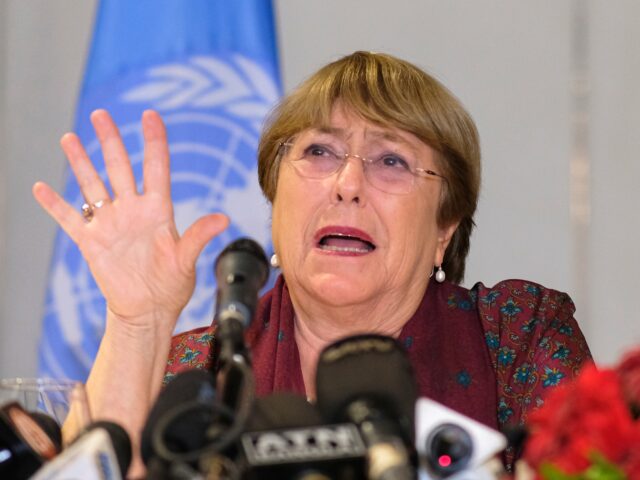

The administration of Chilean conservative President José Antonio Kast on Tuesday announced that Chile has withdrawn support for socialist former President Michelle Bachelet’s “unfeasible” bid to become the next U.N. Secretary-General.
The U.N. will elect a new secretary-general later this year to replace António Guterres, whose term will end at the end of 2026. Bachelet officially presented her bid to become the next U.N. chief in February alongside leftist former President Gabriel Boric, who left office on March 11. Her bid was launched with the joint endorsement of Boric alongside Brazil’s Luiz Inácio Lula da Silva and Mexico’s Claudia Sheinbaum.
On Tuesday, the Chilean Foreign Ministry released an official press statement informing that Chile is withdrawing from backing Bachelet’s joint U.N. bid. The decision, the Ministry detailed, comes after the government reached the conclusion that Bachelet’s bid an eventual success is “unfeasible” due to “the context of this election, the fragmentation of candidacies among Latin American countries, and differences with some of the key actors shaping this process.”
The Foreign Ministry also informed that in addition to withdrawing Chile’s endorsement, the ministry and all Chilean embassies will cease to participate in efforts to promote this candidacy — and pointed out that Chile will refrain from supporting any other candidate in this election process should Bachelet decide to continue with her candidacy, in light of her “track record.”
Bachelet served as president of Chile for two non-consecutive terms for 2006 to 2010 and from 2014 to 2018. After leaving office, she served as U.N. High Commissioner for Human Rights for a four year-term until 2022. Her tenure at the U.N. office was notably marked by her appeasement of China’s communist regime amid investigations over China’s genocide of Turkic peoples in occupied East Turkistan. Bachelet praised the Chinese regime for its “achievements” in human rights and for allegedly “dismantling” of concentration camps or Uyghurs and other Turkic people.
The former president was also criticized for holding “amiable” conversations with Venezuela’s deposed socialist dictator Nicolás Maduro at a time when her office widely condemned the Maduro regime’s human rights violations committed against Venezuelans.
Bachelet responded to the Chilean government’s decision through a public statement shared with local outlets announcing that she will continue with her candidacy without Chile, as she still has the support of Brazil and Mexico.
“My willingness to contribute to this challenge remains unchanged; therefore, I will continue to work closely with the governments of Brazil and Mexico, which have nominated me, thereby reaffirming the collaborative nature of this project,” the statement reportedly read in part.
“I understand that foreign policy positions may change with new administrations, and as a former head of state, I view this decision as part of the prerogatives of the current head of government, even though my vision for the country differs,” she continued.
At press time, the United Nations has formally received five different Secretary-General nominations, three of which originated from Latin American nations. Costa Rica presented the candidacy of Rebeca Grynspan Mayufis, who presently serves as head of the U.N. Conference on Trade and Development (UNCTAD), this month. In November 2025, Argentina presented the candidacy of Rafael Grossi, the current head of the International Atomic Energy Agency (IAEA).
Speaking to reporters on Tuesday during an official government public works inspection in the southern Chilean region of Los Lagos, President Kast revealed that he spoke with Bachelet on Friday and told her of the decision in advance.
“We were convinced that, given the fragmentation of candidacies from across the continent, it would be very difficult to secure enough votes for the president to be elected at the U.N. especially given the likelihood of a protracted campaign lasting months, which would come at a significant cost to our nation. I told her that we would not be supporting her candidacy,” Kast reportedly said.
The announcement comes after weeks of speculation on whether or not Kast, a hardline conservative, would maintain Chile’s support of the socialist former President’s U.N. candidacy. Kast, who won a landslide victory in December, met with Bachelet days after the election but explained to reporters at the time that he would not not comment on his stance over her candidacy until after he had taken office, as he deemed it appropriate to respect the outgoing Chilean government.
“The Foreign Minister, just as I have suggested, is anticipating something that was bound to happen: that the candidacy would not gain traction beyond the stated intention of President Lula and President Sheinbaum to support President Bachelet,” Kast said on Tuesday. “At some point, one has to make a decision; I had indicated that I would express my opinion after March 11.”
Kast said that if Bachelet were to withdraw her candidacy he would ask her for a new meeting and, based on that conversation, his government would explore the options moving forward. The Chilean president stressed that he would have “very much liked” if his predecessor, Gabriel Boric, had engaged with talks with the then-presidential candidates because “some of the candidates on the ballot would be responsible for steering the nation’s future.”
Christian K. Caruzo is a Venezuelan writer and documents life under socialism. You can follow him on Twitter here.
COMMENTS
Please let us know if you're having issues with commenting.