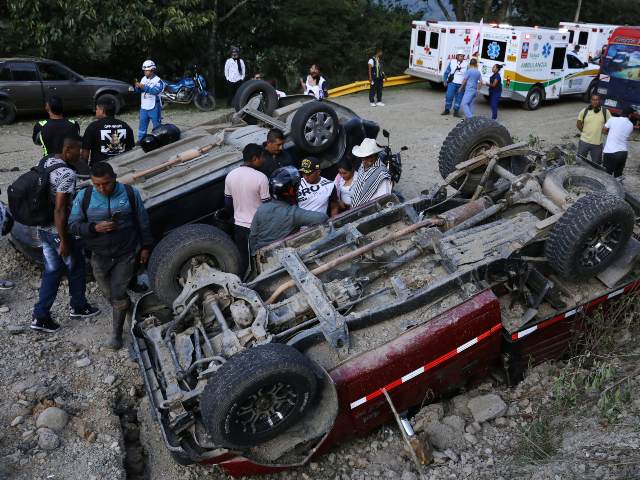

The Revolutionary Armed Forces of Colombia (FARC) Marxist terrorist group unleashed a deadly wave of 31 different terrorist attacks over the weekend — including a deadly highway bomb blast on Saturday that killed 21 civilians in what is now being described as the worst terrorist attack Colombia has suffered in decades.
FARC is a Marxist U.S.-designated Foreign Terrorist Organization (FTO) founded over 60 years ago that “dismantled” itself and “abandoned terrorism” in 2016 after its leadership signed a “peace deal” with the administration of former Colombian President Juan Manuel Santos, who was awarded with the Novel Peace Prize for his efforts.
For years, the Colombian government and mainstream media claimed that active FARC forces are a “dissident” faction known as the Central General Staff (EMC) and that the real leadership now resided in Bogotá. In reality, the Marxist group never stopped its drug trafficking and terrorist operations in Colombia. As part of the “peace deal,” FARC leaders were granted legal immunity and uncontested seats in the Colombian Congress. FARC’s party, Comunes, lost all five uncontested seats after it failed to obtain the minimum vote threshold stipulated by the deal during March’s legislative elections.
Over the past weekend, FARC’s EMC, under the orders of its leader Néstor Gregorio Vera Fernández, also known as “Iván Mordisco,” carried out 31 different terrorist attacks throughout the western and southwestern departments (states) of Cauca and Valle del Cauca, Hulia, and Nariño, leading to one of the most violent weekends in Colombia’s recent history. Colombian authorities reportedly thwarted five of the 31 FARC terrorist plots over the past hours.
Some of the attacks reportedly involved the use of explosive vehicles parked outside military facilities, using commercial-grade drones to drop grenades, acts of vandalism with pro-FARC messages, disruptions to traffic, road blockades, and one truck carrying live poultry being set on fire in the town of Jamundí.
Out of all 31 attacks, the deadliest — and the worst terrorist attack over the past two decades — occurred on Saturday on the Pan-American Highway near the municipality of Cajibío, Cauca, in which FARC terrorists threw explosive cylinders at a passenger bus, killing 21 civilians and leaving at least 56 injured. Colombian outlets noted that Saturday’s attack was the deadliest since the 2003 bombing of El Nogal social club in Bogotá, which killed 36 and left over 200 injured.
Vivian Tejada, a Colombian woman who lost three of her relatives during the terrorist attack, told NTN24 that her family was travelling on the bus on the way back after burying another relative who had recently passed away.
“It has hurt us deeply to lose four members of our family, friends, and acquaintances. It’s sad, it’s just so sad,” Luz Dani Valencia, who lost four family members by the deadly bomb attack, told NTN24.
Colombian far-left President Gustavo Petro claimed during a Monday broadcast that the wave of attacks could be aimed towards “sabotaging” the upcoming May 31 presidential elections. According to Petro, the attacks were not solely the work of FARC members, but instead allegedly were the actions of a broader network that he refers to as the “drug trafficking cartel,” a purported organization that the Colombian president claims is composed of international drug lords operating from Europe and the Middle East.
“It’s no surprise that groups in Cauca are trying to sabotage the elections — which is exactly what the drug trafficking cartel wants: for the far right to take power,” Petro reportedly claimed.
“The leader of the Cauca fronts isn’t Iván Mordisco, who is second in command; it’s the drug trafficking cartel,” he asserted.
The Colombian newspaper El Colombiano reported on Tuesday that Iván Mordisco unleashed the deadly wave of terrorist attacks across in retaliation over the recent death of his girlfriend, who went by the alias of “Lorena,” as well as the capture of four of his brothers throughout different military operations between August 2025 and March 2026.
El Colombiano detailed that “Lorena,” and five other FARC members, were killed on March 26 after the Colombian military launched a bomb attack near the rural town of Pacoa, Vaupés, followed by a raid by the Colombian Armed Forces’ Joint Special Operations Command. “Lorena” had been reportedly engaged in a romantic relationship with Iván Mordisco since 2021 and gave birth to a child of his in 2024.
“From that moment on, we were expecting a retaliation from ‘Mordisco’s’ group, but it wasn’t immediate. We understand that the man was wounded in that attack and had to step away from his unit to lie low while he recovered,” an unnamed Colombian miliary officer told El Colombiano. “It’s possible that he has now resumed command, and his way of announcing it is through this series of attacks.”
Hugo Alejandro López Barreto, the General Commander of the Colombian Military Forces, told reporters over the weekend that FARC’s recent wave of terrorist attacks is a response to the actions that the Colombian military has taken against the Marxist terror group over the past months and which have affected the group’s criminal structures.
On Monday, the U.S. embassy in Colombia issued a security alert urging American citizens to abstain from travelling to the Cauca and Valle del Cauca Departments, as the two regions are deemed unsafe for travelers outside of the cities of Popayan and Cali.
“Do not travel to these areas for any reason. Violent crime, like armed robbery and murder, is common in these locations. Terrorist groups are active in some of these areas. Due to the risks, some U.S. government employees working in Colombia are prohibited from traveling to these areas,” the security alert read in part.
Christian K. Caruzo is a Venezuelan writer and documents life under socialism. You can follow him on Twitter here.
COMMENTS
Please let us know if you're having issues with commenting.