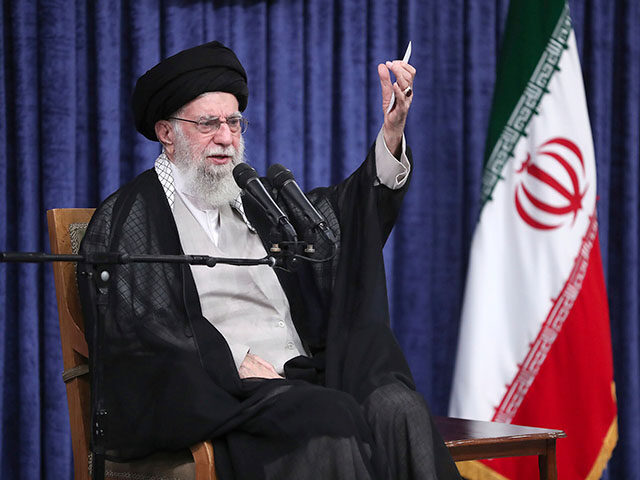

The “supreme leader” of Iran, Ayatollah Ali Khamenei, celebrated the violent 1979 seizure of the U.S. embassy in Tehran during an anniversary event on Monday, declaring that “intrinsic” differences between America and his regime made cooperation impossible.
Other wings of the Iranian Islamist apparatus, such as the terrorist Islamic Revolutionary Guard Corps (IRGC), also issued statements celebrating the hostage seizure as a victory for the “revolution” against a “den of espionage” (the embassy) and vowed to continue the legacy of the act. Iran celebrates the hostage crisis anniversary as a holiday known as the “Student Day and National Day of Fight Against Global Arrogance.”
“The conflict between the Islamic Republic and the United States is intrinsic, and a confrontation of interests between the two sides,” Khamenei told the students assembled for the event on Monday, according to the Iranian state propaganda outlet PressTV. “Only if the United States completely ends its support for the cursed Zionist regime [Israel], withdraws its military bases, and refrains from interference, could American requests for cooperation with Iran be considered—not in the near future, but later,” he said.
Despite his rhetoric, Khamenei has repeatedly approved rounds of negotiations with the United States, most recently early this year. Modern negotiations have largely focused on the United States attempting to convince Iran to abandon its illicit nuclear development program, which Iran denies is intended to build weapons. According to the International Atomic Energy Agency (IAEA), Iran is engaging in an unprecedented amount of enrichment uranium, generating amounts of fissile material that are far beyond what is necessary for civilian use.
The latest rounds of talks with the United States ended after the IAEA passed a resolution condemning Iran for its illicit nuclear activities; the administration of President Donald Trump approved the bombing of Iran’s largest nuclear facilities shortly thereafter, in June.
Elsewhere on Monday, Khamenei referred to the embassy seizure specifically as a “day of pride and victory” that “revealed the true identity of the United States government and the genuine nature of the Islamic Revolution.” He credited the violent mob of “students” attacking the embassy with revealing that Washington was involved in “conspiracy against the Revolution” via unspecified “documents” found there.
He reportedly followed up that statement by claiming that the Iranian regime’s frequent use of the slogan “Death to America” did not antagonize the United States.
“The issue America has with the Islamic Republic is intrinsic, a clash of interests, not slogans,” he reportedly claimed.
“The inherently arrogant nature of the US accepts nothing but submission,” Khamenei said in his remarks, according to a separate translation by the Iranian news agency Tasnim. “Every US president desired this, though some did not state it openly; the current president has expressed it explicitly, revealing the US’s true nature.”
Amid the chaos of the Islamist overthrow of the ruling Iranian monarchy in 1979, a group of violent fundamentalist supporters of Khamenei’s predecessor, Ayatollah Ruhollah Khomenei, stormed the American embassy in Tehran on November 4, 1979, taking 52 people hostage. The Iranian regime described the assailants to this day as “students” who spontaneously rose against the alleged oppression of America. The government of the United States until that time had been aligned with the Reza Pahlavi monarchy, but did not take any meaningful action to protect it from the jihadist uprising.
The “students” kept the 52 Americans and others hostage for 444 days, releasing them just hours after the inauguration of President Ronald Reagan in 1981.
While the hostages survived, the hostage crisis resulted in the death of eight American service members in a botched rescue operation greenlit by then-President Jimmy Carter.
The service members died as a result of a crash between two American aircraft; Islamist mobs paraded their bodies on television.
In 2016, decades after the affair that many attribute with Carter’s decisive presidential election loss in 1980, the BBC published an exposé claiming that Khomenei was in contact with Carter and attempting to convince him that the Islamist “revolution” would be friendly to America in the months before Carter’s administration chose to entirely abandon the legitimate government of Iran.
“You will see we are not in any particular animosity with the Americans, [and the new Islamic Republic will be] a humanitarian one that will benefit the cause of peace and tranquility for all mankind,” Khomenei reportedly told Carter.
The Iranian government denied and condemned the BBC report, calling it “propaganda.”
In addition to the appearance on Monday by Khamenei, Iran’s IRGC, a U.S.-designated terrorist organization and a formal wing of the Iranian armed forces, celebrated the anniversary of the hostage crisis.
“The takeover of the Den of Espionage [the U.S. embassy] embodies a strategic choice between the path of resistance, dignity, and independence versus that of compromise, submission, and surrender,” the IRGC statement read.
The IRGC invited Iranians to attend nationwide rallies against America on Tuesday, the official anniversary of the hostage crisis.
COMMENTS
Please let us know if you're having issues with commenting.