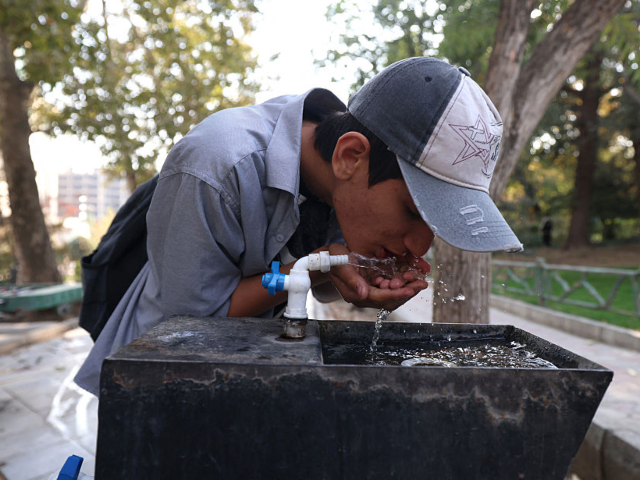

Officials in Iran have begun cutting the water pressure to homes in Tehran in response to an increasingly dire drought and water supply crisis, but refused this week to describe the “pressure cuts” as rationing even as it reduced Tehranis’ access to water.
The situation has become acute enough that the repressive Islamist regime in charge of Iran has allowed for open discussion of water rationing in state media and President Masoud Pezeshkian, who is subordinate to “supreme leader” Ayatollah Ali Khamenei, has proposed relocating Tehran to a more water-rich region.
The American outlet Radio Free Europe/Radio Liberty (RFE/RL) reported on Sunday that citizens in Tehran had begun documented cuts to their supply of drinking water and “experts” on state media were introducing the idea of water rations or even evacuating the capital if the dams that feed Iran’s plumbing systems do not replenish soon.
“Water rationing should have started much earlier,” RFE/RL quoted Iranian Water Industry Federation leader Reza Hajikarim stating on television. “Currently, 62 percent of Tehran’s water is supplied from underground sources, and the level of these aquifers has dropped.”
While “signals” from the government indicated impending water rationing, the independent outlet Iran International reported that local officials in Tehran emphasized the calls for water rationing and the lowering of water pressure in homes in the capital were not equivalent to an actual rationing policy.
“No water rationing — the scheduled and announced distribution and supply of water on a rotating basis — has so far been implemented in Tehran or any other city in the country,” the National Water and Wastewater Company insisted in remarks Iran International relayed that appeared in the state-linked Fars News Agency. Iranian officials conceded, however, that they had begun limiting the water pressure at nighttime, referring to the move as a “management tool” separate from rationing.
“We lower water pressure from midnight until around dawn to reduce urban leakage and allow reservoirs to refill,” an Iranian water industry spokesman said, according to Iran International.
The National Council of Resistance of Iran (NCRI), one of the largest Iranian anti-regime organizations in the country, described an “emergency” situation regarding the national water system, not just in Tehran, in an update citing sources on the ground on Monday.
“State reports say 19 dams are on the verge of complete depletion, while more than 20 dams are holding under five percent of their capacity,” the NCRI shared. “At the start of Aban (October 23 on Iranian calendar), only eight dams were in such critical condition; within less than two weeks, the number more than doubled, underscoring the rapid deterioration.”
While officials insist that the source of the problem is an unprecedentedly intense state of drought, the NCRI also attributed the water crisis to “years of mismanagement and inadequate investment in water ed, as population growth in major cities outpaced supply planning.”
“Despite repeated warnings from experts, authorities have relied on short-term measures such as pressure reduction and public appeals for conservation instead of structural reforms to modernize networks and control demand,” it added.
In Mashhad, Iran’s second-largest city, local officials conceded on Sunday that water reserves feeding the city from dams have dropped to three percent capacity, demanding better “consumption management.” Reporting on the situation in Mashhad, Iran International observed increased calls from the Islamist government for “moral discipline” on the part of regular Iranians, meaning more consistent efforts to use less water.
Yet Energy Minister Abbas Aliabadi conceded in remarks on Sunday that “Tehran’s water pipeline system is more than 100 years old and worn-out.” He blamed the water pressure reduction measures not only on the dilapidated state of the capital’s water system, but on the military attacks by Israel and the United States on the country in June in response to Iran bombing Israel repeatedly.
Iranian officials have not indicated that the situation is expected to improve in the near future, according to translations of state media broadcasts. On the contrary, Pezeshkian warned on November 6 that evacuating the capital will soon be necessary.
“If Tehran does not get rain by Azar [Iranian calendar month starting on 22 November], we will have to ration water. And if it still does not rain after that, we will have to evacuate the city,” the regional outlet Caspian News, citing the website Entekhab.ir, reported.
Pezeshkian has repeatedly made calls for building a new capital closer to the Persian Gulf, where the regime can more easily address water shortages. In October, Pezeshkian told local media that Iran does “not have an alternative anymore” from moving the government out of Tehran.
“Last year, rainfall was 140 millimeters, while the standard is 260 millimeters. That means rainfall has fallen by about 50 to 60 percent. This year, the situation is just as critical,” he noted at the time.
COMMENTS
Please let us know if you're having issues with commenting.