Iran’s state-run Tasnim News Agency claimed on Wednesday that the unmanned aerial vehicle (UAV) shot down by a fighter from the USS Abraham Lincoln was conducting a “routine and lawful mission over international waters.”
Tasnim cited Iranian military sources who claimed the drone was able to transmit reconnaissance data to its operators before it was destroyed.
U.S. Central Command (CENTCOM) said the Iranian drone “aggressively approached” the Lincoln battle group in the Arabian Sea on Tuesday with “unclear intent.”
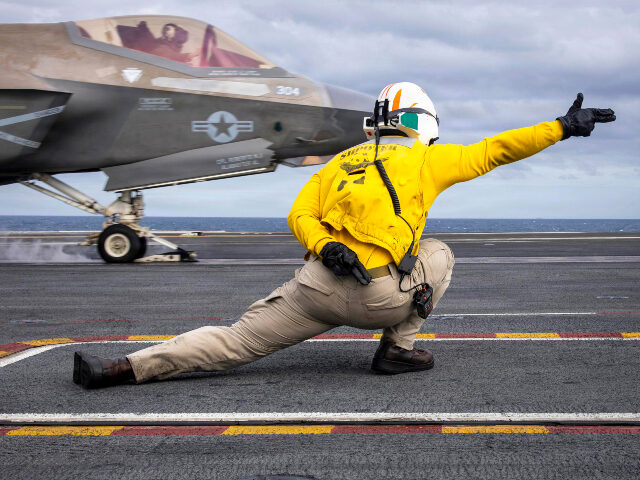
CENTCOM said the drone “continued to fly toward the ship despite de-escalatory measures taken by U.S. forces operating in international waters,” so an F-35C fighter was launched to shoot it down in self-defense.
According to CENTCOM, the incident was concluded without any damage to U.S. equipment or injury to American personnel.
The Iranian UAV was a Shahed-139, a long-range upgrade to the Shahed-129, a model that could carry missiles. Iran also produces a large volume of “kamikaze drones” that are basically remote-guided bombs, with Russia as an ardent customer.
Iran program director Behnam Ben Taleblu of the Foundation for Defense of Democracies (FDD) told the Jerusalem Post on Wednesday that Tehran was sending a message to President Donald Trump by dispatching a drone to menace the USS Abraham Lincoln.
Taleblu said Iran wanted to “make good on its threat that, if there is another war, it will be a region-wide war,” in which the Persian Gulf “stands to become a theater of conflict.” He added that Iran wants to evoke the memory of the Houthis attacking commercial shipping in the Red Sea during the Gaza War.
“Those asymmetric harassment tactics that the Houthis employed post-October 7 were actually created and perfected by the Islamic Republic for the Persian Gulf and Strait of Hormuz,” he said. “The regime used to often harass oil tankers and other vessels in the region with small boats, and then it shifted to doing so with drones.”
Taleblu thought Trump and the U.S. Navy handled Iran’s provocation perfectly, demonstrating a commitment to operational security with “pure military professionalism.”
“The USS Abraham Lincoln aircraft carrier and the F-35 jet that destroyed that drone passed their tests with flying colors,” he said.
As for the danger of Iran overwhelming the carrier group’s defenses with swarms of cheap drones, Taleblu noted that Iran does not have a huge inventory of UAVs like the Shahed-139 that have the range and altitude to reach the aircraft carrier. Iran tried using a “layered attack” of cruise missiles mixed with drones against Israel during the 12-Day War in June, and it was a failure, although there is always the possibility that Iran learned from its failure.
He cautioned:
While the Islamic Republic is weak, it is still lethal, and it is still in charge of a spectrum of unmanned aerial threats, which on the low end include mortars, then rockets, then drones, then cruise missiles and ballistic missiles, and together, the unmanned aerial threat spectrum becomes the regime’s biggest weapon of both punishment and deterrence.
Coincidentally, three Air Force pilots were awarded the Distinguished Flying Cross with a “C” device for combat this week, in recognition of their remarkable skill at shooting down Iranian drones while defending Israel in April 2024.
Maj. Benjamin “Boom” Saunders, Maj. Eric “Fume” Anderson, and Capt. Ryan “Hammer” Boodee, all with the District of Columbia Air National Guard’s 121st Fighter Squadron, received their awards in a ceremony at Joint Base Andrews in Maryland on Sunday.
The three American F-16 pilots encountered a swarm of over 100 Iranian drones heading for Israel as part of a combined drone swarm and missile attack. Saunders and Boodee shot down over 15 drones before Anderson and his wingman joined the battle. Saunders was able to take out at least one of the drones with his 20mm cannon, rather than using missiles.
The total number of Iranian drones destroyed by the three pilots was not disclosed to the public. They were also able to designate targets for other coalition forces during the engagement, which lasted for hours. U.S. forces in total were credited with shooting down over 80 Iranian drones on that night, plus at least six ballistic missiles.
COMMENTS
Please let us know if you're having issues with commenting.