
The Israel Defense Forces (IDF) ordered some 250,000 residents of southern Lebanon to evacuate on Wednesday ahead of major military action against the terrorists of Hezbollah.
The IDF published a map on Wednesday depicting the conflict zone as nearly everything south of the Litani River, an area that covers roughly eight percent of Lebanon’s territory. The IDF urged Lebanese civilians to relocate north of the river as the fighting with Hezbollah intensified, an order that impacts about five percent of the Lebanese population.
“Be aware that any movement south may endanger your life,” an IDF spokesman warned.
A senior Lebanese security official said that by Wednesday, Israeli forces had taken control of at least nine towns in southern Lebanon.
According to a report by The National, some Christian-majority towns in southern Lebanon have refused to obey the displacement order because they consider themselves neutral in the Hezbollah-Lebanon conflict.
Human Rights Watch (HRW) objected that the evacuation order was unlikely to be effective since some residents would be unable to leave due to health problems or general inability to make it north of the Litani River, so the IDF order could “improperly instill fear in the affected population.”
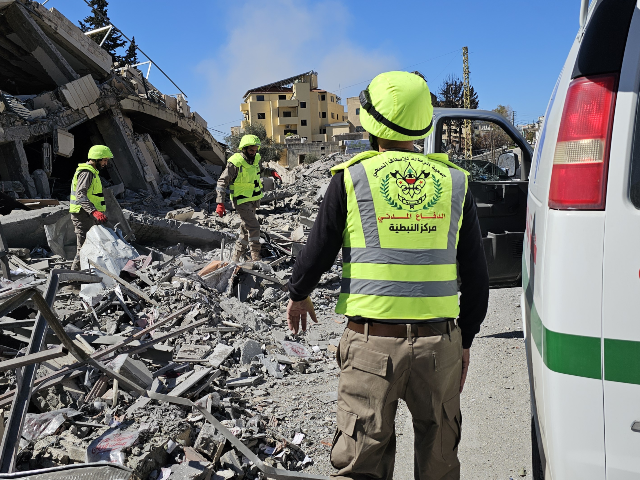
Israel launched a wave of airstrikes at Hezbollah positions across Lebanon on Wednesday, expanding its targeting portfolio to include locations beyond the Shiite-majority districts of Lebanon where the group usually operates. Lebanese officials claimed several of the airstrikes struck residential buildings and inflicted civilian casualties, but these claims have been difficult to confirm, especially since Hezbollah banned international media from entering southern Lebanon.
The Lebanese Health Ministry said on Thursday that at least 77 people have been killed, and over 500 wounded, across the country this week.
The IDF said it was “positioning troops a little farther” into Lebanon in order to “prevent any attacks against the northern communities” of Israel by Hezbollah. IDF officials said that Hezbollah is now launching dozens of rocket, missile, and drone attacks at Israeli targets every day.
The Israeli military issued another “urgent warning” on Thursday for the southern Beirut neighborhood of Dahiyeh, an area favored by Hezbollah officials. Residents were told to “save your lives and evacuate your residences immediately.” It was the first time Israel has called for a major evacuation so close to the capital of Lebanon.
The leftist New York Times (NYT) saw “preparations for a more significant incursion into Lebanon” on Thursday:
Soldiers set up checkpoints and turned aside some civilian traffic as flatbed trucks carrying armored vehicles — including tanks, armored personnel carriers, and mine-clearing and earth-moving equipment — clogged roads leading to the frontier.
Artillery fire could be heard occasionally on the Israeli side, followed seconds later by shell blasts in Lebanese territory.
The military also announced the call-up of its 146th Division, an armored unit of reservists that is part of Israel’s Northern Command.
Israelis living near the northern Lebanese border told AFP they were “tense” as IDF tanks and troops rolled through their towns, but they agreed that action was needed to end the threat of Hezbollah once and for all.
Lebanese sources told Reuters on Thursday that Hezbollah’s “elite fighters” from the Radwan Force were moving into the border region to meet the Israeli advance. Most of these fighters supposedly withdrew to north of the Litani River after the U.S.-brokered ceasefire with Israel in 2024, but were ordered to return after Hezbollah attacked Israel on Iran’s behalf on Monday.
Hezbollah Secretary-General Naim Qassem on Wednesday rejected criticism for attacking Israel and dragging Lebanon into the war with Iran.
“The displacement is intended to create a rift between Hezbollah and the people, but the people know it happened because of Israeli aggression,” he said.
“The displaced are our fathers, our sons, and our families — the families of the martyrs, the wounded and the prisoners. No one can create a rift between us. Hosting the displaced at this stage is a national responsibility that everyone must share,” he said — a choice of words likely to anger the Lebanese government, which has been complaining since Monday about Hezbollah hijacking Lebanon’s foreign policy.
Qassem gave a televised address on Wednesday in which he claimed Hezbollah’s attacks on Israel were a justified response to Israeli transgressions against the 2024 ceasefire, and for Israel killing Iran’s leader, Ayatollah Ali Khamenei.
Qassem rejected the Lebanese government’s complaints by sneering that Beirut should be falling into line behind Hezbollah to fight Israel.
“By God, how strange you are. What is your response to the wide-scale aggression?” he said, rejecting the Lebanese government’s demand that all Hezbollah weapons should be brought under its control.
“The topic of the resistance and the weapons of the resistance is not a subject of dispute for anyone or with anyone. It is a legitimate right. We are fighting in Lebanon in defense of our people, the future of our children and our country,” he said.
“Hezbollah and its Islamic resistance are responding to the Israeli-American aggression and this is a legitimate right,” he insisted. “For us, this is an existential defense.”
On Monday, Prime Minister Nawaf Salam declared all Hezbollah military activity “illegal and forbidden” and instructed Lebanon’s armed forces to arrest anyone who tries to attack Israel from Lebanese soil.
Salam also approved the “second phase” of the government’s plan to disarm Hezbollah in accordance with the 2024 ceasefire agreement, a plan Hezbollah will obviously resist while it is using those weapons to attack Israel. The Lebanese Army appears to be aware that it will need to work vigorously to pry Hezbollah’s rockets and missiles from its fingers.
Qatar-based Al Jazeera News suggested on Thursday that Hezbollah went all-in against Israel this week precisely because it knows its political support in Lebanon is fading, its patrons in Iran might no longer be able to supply it with money and weapons, and the rest of the Middle East has very little use for it. Even Hezbollah’s strongest political ally, Shiite Muslim parliamentary speaker Nabih Berri, appears to be souring on the group.
“If Hezbollah waited too long to resume resisting Israel militarily, it could find itself in a hole from which it could not emerge intact. This reality caused the party to renege on its promise to Berri months ago that it would not restart the war with Israel, which made Berri feel slighted, weakening their traditional alliance,” Al Jazeera said.
COMMENTS
Please let us know if you're having issues with commenting.