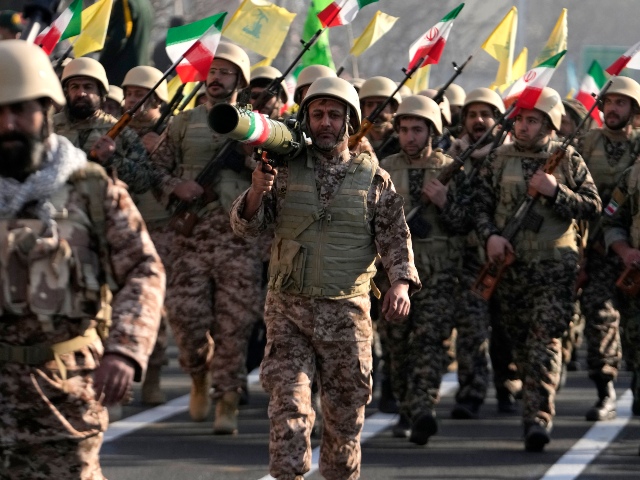

The Iranian terror state’s armed forces marked National Army Day on Friday by publishing a host of threats against the United States and Israel, asserting that their soldiers have a “finger on the trigger” to attack even as Iran appears to continue to adhere to a ceasefire set to expire on Tuesday.
President Donald Trump announced Operation Epic Fury on February 28 intending to degrade the Iranian government’s ability to threaten its neighbors, particularly Israel and America’s Gulf allies. The operation, alongside Israeli military action, has resulted in the elimination of dozens of senior Iranian officials, most prominently “supreme leader” Ali Khamenei. His successor, son Mojtaba Khamenei, has yet to be seen in public or on video since he was allegedly chosen to run the country.
Tehran and Washington reportedly agreed to a two-week ceasefire on April 8 meant to allow space for peace talks, and President Trump has claimed for weeks that the war was “close” to ending. The government of Pakistan mediated a round of talks last week between Iran and America intended to produce an agreement to prevent the resumption of hostilities on April 22. While no concrete deal surfaced between the parties after talks on Saturday, reports indicate that “indirect” talks have continued in pursuit of a deal.
President Trump himself told reporters on Thursday that a full agreement was “very close” to completion. One major obstacle to peace has been Iran’s threats preventing the flow of commercial traffic through the Strait of Hormuz, which the White House addressed by imposing a blockade on Iranian traffic in the strait. On Friday morning, Trump published a statement on his website, Truth Social, declaring that Iran had agreed to keep the Strait of Hormuz “fully open and ready for full passage.” Iranian Foreign Minister Abbas Araghchi appeared to confirm the announcement on Friday.
Prior to this announcement, Iranian President Masoud Pezeshkian — who was previously limited by Khamenei’s stranglehold on power, but has become more influential in the absence of Mojtaba Khamenei — affirmed that his government was “seeking lasting peace” for the Middle East and was committed to working towards it.
“Pezeshkian emphasized that since taking office, all efforts have been aimed at strengthening friendship and brotherhood both domestically and regionally, but hostile and provocative actions by the U.S. and the Israeli regime have been evident from the beginning,” Iranian state media reported. “He added that Iran is not seeking instability in the region; rather, it is focused on expanding friendly relations with neighboring and regional countries.”
Araghchi’s and Pezeshkian’s messages contrasted significantly in tone with the statements out of the Islamic Revolutionary Guard Corps (IRGC), a U.S.-designated terrorist organization, and the Iranian Army on Friday vowing to devastate the country’s enemies rather than work for peace. The Islamic Republic News Agency (IRNA), a regime outlet, shared both the Army and the IRGC declaring repeatedly that they were working in unison — hedging against rumors of division between the IRGC and other sectors of the Iranian Islamic regime — and prepared to kill.
“Referring to the honorable role of the Army in defending Iran’s independence and security, the IRGC stressed that the synergy and unity between the Army and other armed forces,” IRNA shared, “particularly the IRGC — as the ‘single hand and powerful arm of Iranians against enemies.'”
“The IRGC further described the strengthening of the Army’s air defense capabilities in intercepting and hunting down American and Israeli projectiles and fighter jets,” IRNA continued, “the execution of successful and destructive drone operations against enemy targets across the region, as well as the consolidation of an impenetrable border security belt.”
The IRGC reportedly emphasized that it had its figurative “finger on the trigger” and was ready “to deliver a powerful, destructive, and regret-inducing response to any aggressive or criminal action” by Washington and Jerusalem.
The Iranian army, represented by Major General Amir Hatami, similarly used the occasion of Army day to threaten the parties that the civilian wing of its government is reportedly negotiating in.
“While the Iranian diplomatic officials were engaged in negotiation, the Islamic Republic faced the enemy’s aggression,” Hatami declared on Thursday.
Iranian officials regularly use menacing and bombastic rhetoric against the West, particularly in messages intended for domestic audiences, as Tehran has faced regular waves of civil unrest and calls for freedom in the past decade. The Iranian regime has met these calls with slaughter, most recently killing thousands of peaceful protesters following an uprising in December. Iranian leaders occasionally pivot to threatening and demanding other countries in international venues. In a letter to United Nations leaders this month, for example, Iranian Representative to the U.N. Amir Saeid Iravani announced that Iran was seeking “compensation” from several Gulf states that it has targeted with airstrikes since the launch of Operation Epic Fury. Citing friendly relations with the United States, Iravani named Saudi Arabia, the United Arab Emirates (UAE), Bahrain, Qatar, and Jordan as countries Iran would like to give it money.
“By their internationally wrongful acts, they have breached their international obligations owed to the Islamic Republic of Iran under international law, thereby engaging their international responsibility,” he claimed, “and should make full reparation to the Islamic Republic of Iran, including compensation for all material and moral damage sustained as a result of their internationally wrongful acts.”
The Gulf states have not offered any indication that they are open to paying the country that has been bombing them for over a month any sort of “compensation.”
COMMENTS
Please let us know if you're having issues with commenting.