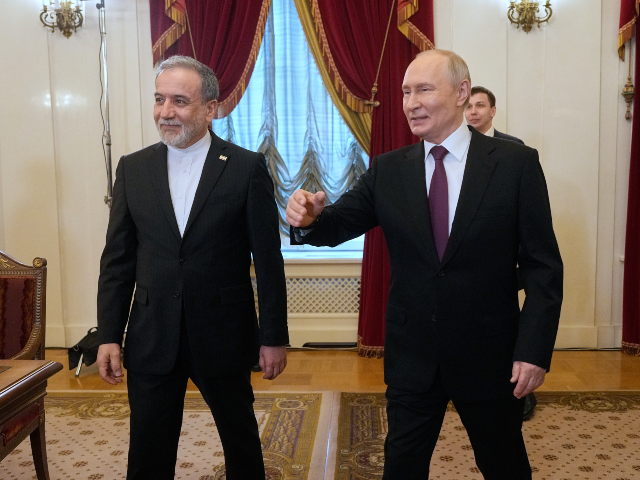

Iranian Foreign Minister Abbas Araghchi arrived in Moscow, Russia, on Monday and is expected to meet dictator Vladimir Putin for discussions on his country’s ongoing conflict with America.
Araghchi is concluding an extended travel itinerary that included stops in Pakistan — which has become a key negotiator between Tehran and Washington — and Oman, which previously served in a similar role. Russia has consistently been one of Iran’s closest allies, a leading member of the anti-American BRICS coalition that Iran belongs to, and a consistent antagonist to American interests at the United Nations Security Council. Russian officials this week repeated their demands that Iran be allowed to engage in illicit nuclear development or agree to a deal similar to the 2015 Joint Comprehensive Plan of Action (JCPOA), which Iran regularly violated. Iranian officials have consistently reached out to Russia following an increase in political and military pressure by America.
Iran and the United States have been attempting for weeks to negotiate an end to the conflict between them that began in February. The U.S. military has engaged in expansive airstrikes against Iranian targets, while Iran has retaliated by bombing over a dozen of its neighbors it believes to be friendly to America. Among the goals pursued by both sides is an agreement to end hostilities as well as to fully reopen transit in the Strait of Hormuz. The United States has blockaded Iranian ships in the strait, while Iran has vowed to prevent all transit by states hostile to it or friendly to Israel and America.
The foreign minister’s visit to Russia follows President Donald Trump announcing that he had canceled his negotiating team’s expected travel to Pakistan to meet with Iranian officials, dismissing it as a waste of time in part due to the lack of coherence within the structure of the Iranian government. As a result of Operation Epic Fury, a Pentagon project, and concurrent Israeli military operations in Iran, dozens of senior Iranian regime officials have been killed, including “supreme leader” Ayatollah Ali Khamenei. His successor, son Mojtaba Khamenei, has not been seen in public or issued any audio or video statements verifying his health status, leaving unclear exactly who is running the country. Araghchi and President Masoud Pezeshkian, who in theory should be subordinate to Mojtaba Khamenei, not only issue regular comments, but have appeared in public on the streets of Tehran, marking a stark contrast with the clerical wing of the regime.
Landing in Moscow, Araghchi celebrated his previous stops in Oman and Pakistan and expressed hope that engagements in Russia would help strengthen Iran’s diplomatic support during the current crisis.
“As you see, we have always held close consultations with Russia on a wide range of issues, particularly regional ones, and also held constant bilateral talks,” Araghchi said in a video posted on social media, according to the Russian news agency Tass.
“We held good consultations with our friends in Pakistan… The trip was successful. We assessed the outcome of our recent [meetings] and discussed in what direction and under what conditions talks can move on,” he added.
The Kremlin has confirmed that Araghchi will meet with Putin in St. Petersburg during his time in the country.
Iran’s ambassador to Moscow, Kazem Jalali, described the objective of Araghchi’s visit as coordination to ensure that Iran’s allies know what it hopes to achieve through ongoing negotiations to end the conflict.
“Coordinating interactions and advancing joint programs at the regional and international levels are the main objectives of this trip,” Jalali said in a social media post shared by the Iranian state-run Islamic Republic News Agency (IRNA). “Iran and Russia stand on the same front in the face of campaigns by hegemonic forces against independent and justice-seeking nations, as well as countries seeking a world free from unilateralism and Western dominance.”
IRNA added that Araghchi himself, before his scheduled visits in Moscow, described his tour so far as productive, without offering any details as to how.
“Developments have taken place in the negotiations,” it quoted Araghchi as saying. “Despite some progress in earlier rounds, the talks failed to reach their objectives due to the Americans’ approach, the excessive demands they made, and the wrong approaches they adopted.”
Multiple media outlets reported on Monday that Iran had organized a new proposal for negotiating with the United States to begin by first ending both sides’ restrictions in the Strait of Hormuz — but reportedly not discussing Iran’s illicit nuclear development at all. Trump has repeatedly stated that he would not accept any agreement that does not ensure that Iran can never obtain a nuclear weapon.
Tass, citing the pro-Iran outlet Al Mayadeen, reported on Monday that the new Iranian proposal contains three parts: a commitment not to resume bombings, followed by freeing up the Strait of Hormuz, and then, finally, discussions on Iran’s illegal nuclear program. According to Tass, the Iranian regime is insisting that “no other issues will be discussed” until both sides definitively agree to an end in hostilities.
It is unclear who in the Iranian leadership is responsible for this alleged plan. According to President Trump, and several global reports, Tehran has been fractured into two main factions, one led by Pezeshkian and one by the clerics surrounding Khamenei. This confusion led President Trump to declare this weekend that he would stop approving travel for his negotiators to meet Iranian leaders in person, as “nobody knows who is in charge.”
“I just cancelled the trip of my representatives going is Islamabad, Pakistan, to meet with the Iranians. Too much time wasted on traveling, too much work!” Trump said in a statement on his website, Truth Social, on Saturday. “Besides which, there is tremendous infighting and confusion within their ‘leadership’… If they want to talk, all they have to do is call!!!”
Trump later explained to a reporter, “I see no point of sending them on an 18 hour flight in the current situation [of the negotiations]. It’s too long. We can do it just as well by telephone. The Iranians can call us if they want. We are not gonna travel just to sit there.” He added, however, that he was not planning to end the currently indefinite ceasefire in the near future.
Trump initially announced a ceasefire, concluding on April 21, to allow space for negotiations to address America’s concerns with Iran’s rogue behavior. Trump then extended the ceasefire indefinitely before the April 21 deadline, citing the lack of coherence within the Iranian government.
“Iran is having a very hard time figuring out who their leader is! They just don’t know!” Trump wrote in a statement last week. “The infighting is between the ‘Hardliners,’ who have been losing BADLY on the battlefield, and the ‘Moderates,’ who are not very moderate at all (but gaining respect!), is CRAZY!”
Pezeshkian, Araghchi, and several other Iranian leaders responded to Trump’s observations by publishing nearly identical statements claiming unity. Mojtaba Khamenei issued a written statement claiming that the true fragmentation was in the Trump administration, offering no evidence for this claim.
COMMENTS
Please let us know if you're having issues with commenting.