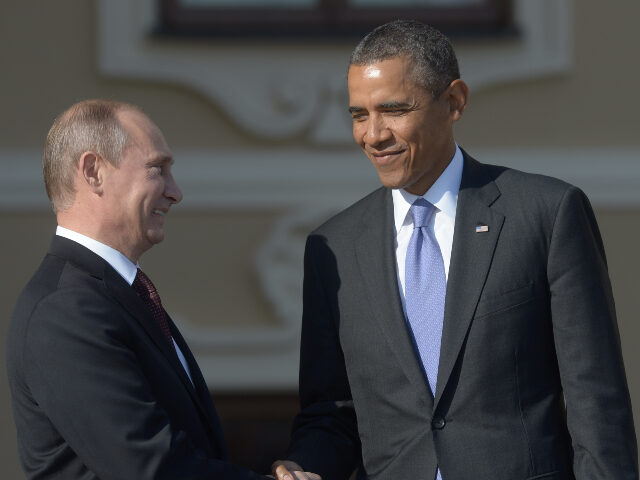

Russian Foreign Minister Sergey Lavrov said on Tuesday that Iran and the United States should reach an agreement similar to former President Barack Obama’s 2015 nuclear deal in order to make peace.
“If the current efforts of the Iranian and American negotiators, which we support, result in something like the 2015 agreement, I think it would be a great success,” Lavrov said at a press conference after meeting with Taher al-Baour, the acting foreign minister of one of Libya’s two governments. Libya was torn in half and became infested with terrorists and warlords after Obama attacked the country in 2011 to change its regime.
Returning to Obama’s other notable foreign policy accomplishment, Lavrov said Russia supports Iran’s belief that “it has already been a victim of false promises, including the Joint Comprehensive Plan of Action approved by the U.N. Security Council in 2015.”
“It contained all the answers to the questions that the U.S. now poses, and the U.S. itself withdrew from it,” Lavrov complained.
The Russian foreign minister claimed the 2015 nuclear deal, formally known as the Joint Comprehensive Plan of Action (JCPOA), would have satisfied President Donald Trump’s demand that Iran must never develop nuclear weapons.
Lavrov further claimed:
Among other things, it noted Iran’s absence of military groundwork in the nuclear sphere and imposed the strictest control over the nuclear program in the world, which was harsher than the IAEA measures adopted for countries that have signed the agency’s guarantees protocol.
“History should serve as a lesson, which is why success now would mean returning to the previous agreements,” he concluded.
In reality, the JCPOA by no means prevented Iran from developing nuclear weapons – it merely delayed the process by a nominal ten years, and the Iranians cheated on even that restriction, as witness the huge stockpile of near-weapons-grade uranium they are currently attempting to hide from international weapons inspectors and the United States military.
President Trump withdrew from the JCPOA in May 2018, denouncing it as a “horrible one-sided deal that should never, ever have been made.”
“At the heart of the Iran deal was a giant fiction: That a murderous regime desired only a peaceful nuclear energy program. Today, we have definitive proof that this Iranian promise was a lie,” he said when announcing his decision to withdraw.
The JCPOA supposedly remained in effect with its other signatories in Europe, but Iranian violations became more obvious, including the use of prohibited uranium centrifuges, uranium enrichment at prohibited facilities, refusal to fully comply with International Atomic Energy Agency (IAEA) inspectors, and most obviously Iran’s insistence on creating a massive stockpile of uranium enriched far beyond any conceivable civilian purpose.
In June 2025, after years of tolerating Iran’s cheating to keep the remains of the JCPOA alive, the IAEA finally issued a formal declaration that Iran was in breach of its nuclear non-proliferation obligations.
The IAEA cited Iran’s “many failures to uphold its obligations since 2019 to provide the agency with full and timely cooperation regarding undeclared nuclear material and activities at multiple undeclared locations.”
Iran arrogantly dismissed the censure as “completely political and biased,” and defiantly announced that it would open yet another uranium enrichment facility.
Israel and the United States launched airstrikes against Iran’s illicit nuclear program shortly after the IAEA censure, culminating in the massive U.S. strikes that destroyed Iran’s three main uranium enrichment facilities on June 22, 2025.
The day after the U.S. strikes Ali Larijani, top adviser to Iranian Supreme Leader Ayatollah Ali Khamenei, made a thuggish threat to “settle accounts” with IAEA Director-General Rafael Grossi for the non-compliance declaration, even though Grossi did not approve of the strikes against Iran. Neither Khamenei nor Larijani lived to make good on that threat, as both were eliminated during Operation Epic Fury.
COMMENTS
Please let us know if you're having issues with commenting.