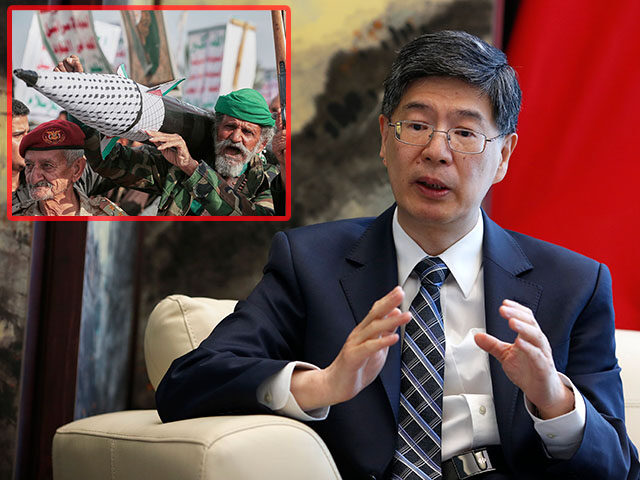

The Chinese Foreign Ministry pronounced Beijing “deeply concerned” on Thursday over the ongoing war between Iran and its proxies and the United States in the Middle East, demanding all parties “remain calm.”
The Foreign Ministry’s declaration follows the return of the Yemeni Houthi terrorist organization to the fray, announcing that they would begin attacking ships attempting to navigate around the Bab el-Mandeb Strait to disrupt global commerce on Tehran’s behalf, particularly targeting Saudi-linked vessels. While the Houthis maintain superficially friendly relations with China and have previously claimed they would not damage Chinese-linked ships, the terrorist notably did attack ships owned or otherwise associated with China during their previous attempt to disrupt commercial traffic near the Red Sea following the genocidal Hamas attack on Israel on October 7, 2023.
The Chinese Communist Party has historically supported Iranian interests in the Middle East and Iranian terrorist proxies such as Hamas. Communist leaders, including genocidal dictator Xi Jinping, have maintained a marked distance from Iran during the current conflict with the United States, however, repeatedly demanding that all sides of the war respect freedom of navigation in and around the Strait of Hormuz, which Iran’s terrorist Islamic Revolutionary Guard Corps (IRGC) have blockaded on and off since March. China is heavily dependent on the Middle East for its oil and other fossil fuel supplies, placing it in an especially vulnerable position despite not being an active combatant in the conflict.
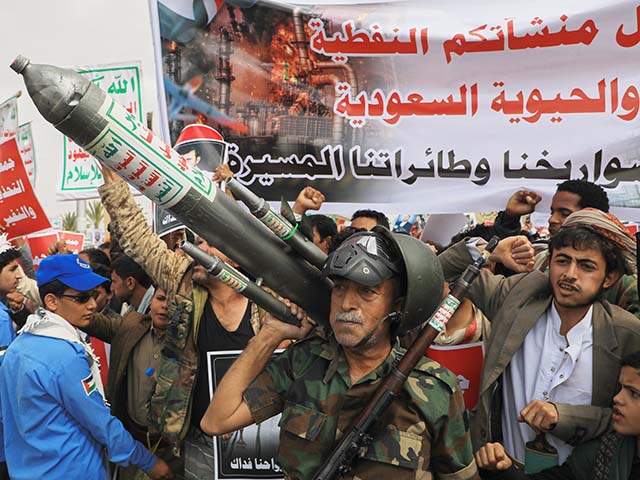
Houthi supporters hold a rally in Sanaa, Yemen, Friday, July 17, 2026, against the Saudi-led coalition. Banner in Arabic reads, “All Saudi oil facilities are targets to our missiles and drones.” (AP Photo/Osamah Abdulrahman)
Asked about the current situation in the region, in which the Houthis have resumed attacking random commercial vessels, Chinese Foreign Ministry spokesman Lin Jian insisted that all belligerents stop the conflict, failing to distinguish traditional ally Iran from the United States.
“China is deeply concerned over the latest round of escalation in the Middle East and Gulf region,” Lin told reporters. “The negotiation outcomes did not come easy, more fighting serves no one’s interests, and the sovereignty, security and territorial integrity of regional countries should be respected and upheld.”
“Parties concerned need to remain calm, exercise restraint, stop hostilities, resume contact and dialogue, resolve disputes through political and diplomatic means, and strive for a full and lasting ceasefire at an early date,” he commanded, adding that China “stands ready to … make further efforts to facilitate the end of fighting. In reality, China has played no known material role in the conflict or its attempted resolution.
While broadcasting through the world via its Foreign Ministry that China was not exonerating the Iranian terror state of its role in the conflict, China’s ambassador to Tehran, Cong Peiwu, did offer words to the state-run Islamic Republic News Agency (IRNA) in support of the country on Wednesday. Declaring the Chinese Communist Party “on the right side of history,” Cong issued a statement to IRNA declaring that Beijing “has always supported Iran’s efforts to defend its sovereignty and national interests.”
“Stating that the region must move beyond the shadow of war and towards lasting peace,” IRNA shared, “the Chinese ambassador once again referred to four major initiatives put forward by President Xi in April this year, emphasizing adherence to the principles of peaceful coexistence, respect for national sovereignty, international law, and coordination between development and security.”
The state outlet added that Cong defended China’s stance during the conflict with America, in which it has taken no affirmative actions to benefit Iran, as a “fair and responsible stance, resolutely opposing hegemonic aggression.”
The various diplomatic statements from China follow the return of the Houthis to the fore of economic disruptions in the Middle East. This time, rather than targeting America and Israel directly, the Houthis announced this week that they would impose a “maritime ban” on Saudi ships attempting to navigate through the Red Sea. Yemen’s geographic position offers the Houthis a significant advantage in its ambitions to control Red Sea traffic, as the country lies on the southern shores of the sea.
The Houthis are a Shiite jihadist terrorist organization backed by Iran that has attempted to usurp the power of the legitimate government of Yemen since 2014, when the launched a civil war and took over the nation’s capital, Sana’a. Their slogan is “Allahu akbar, Death to America, Death to Israel, a Curse upon the Jews, Victory to Islam.”
“The Yemeni armed forces affirm their complete readiness for all options, and any foolish act committed by the reckless Saudi enemy through all escalation will be met with a comprehensive and decisive escalation, by Allah’s will and power,” jihadist Houthi spokesman Yahya Saree declared on Monday.
The Houthis claimed to attack two Saudi tankers, the Encelia and the Layla, in the Red Sea overnight on Wednesday into Thursday. The attacks have raised concern regarding the Chinese economy as the Communist Party relies in large part on Saudi oil to fulfill its domestic demand. Bloomberg News reported on Thursday, however, that at least one Chinese-owned tanker leading Saudi Arabia full of oil, the Xin Long Yang, successfully passed around the Bab el-Mandeb strait out of the Red Sea that day and another tanker, the Cosnew Lake, was en route to complete the transit as of Thursday morning. The ships, operated by China’s Cosco Shipping, both reportedly signaled to those nearby that it was carrying Chinese cargo and crew.
While these particular Chinese-linked ships appear to have successfully avoided the Houthi attacks, there is no guarantee for any future vessels trying to navigate in the region. Following the Houthi announcement of a naval blockade in 2023, the group went out of its way to verbally exempt Russia, China, and Iran from their terrorist activities. But by March 2024, a Chinese ship, the Huang Pu, was bombed while trying to sail near Yemen. It was only temporarily set on fire and survived the attack, but the strike established a precedent that Beijing could not trust the Houthis to protect their maritime assets.
COMMENTS
Please let us know if you're having issues with commenting.