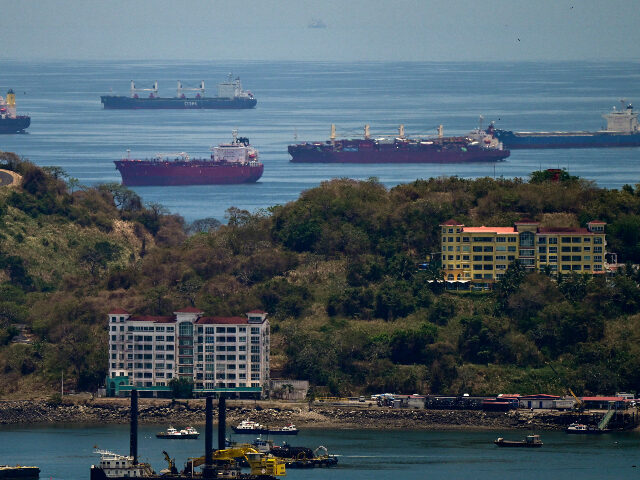

Ricaurte Vásquez, the Administrator of the Panama Canal Authority (ACP), said Thursday that the ongoing conflict in the Middle East has led to a surge in traffic through the Panama Canal.
The Panamanian newspaper La Prensa reported that traffic through the Panama Canal has increased over the past weeks to the point that on some days it has reached its maximum operational number of crossings allowed of 40 vessels per day.
La Prensa noted that global supply chains of fuels such as petroleum, liquefied natural gas (LNG), and liquefied petroleum gas (LPG) that were normally sent from the Persian Gulf to markets in Europe and Asia have been disrupted by the ongoing conflict in the Middle East — forcing those markets to seek new supply routes and alternatives, primarily from the United States, with the Gulf of America emerging as a key hub for energy shipments.
In that context, La Prensa wrote, the Panama Canal has taken on greater importance, becoming a key route for ensuring the timely delivery of energy products to strategic destinations, in addition to container, bulk, and other cargo. The newspaper made particular mention of the tanker Gas Virgo, a Singapore-flagged ship carrying LPG originally bound for Europe that changed its route to China and whose shipping company paid up to $4 million for a spot to pass through the Panama Canal due to its urgency and to avoid shipping penalties.
Vásquez spoke to reporters on Thursday on the sidelines of a local event. He confirmed the surge in transit through the Panama Canal and provided more details on the situation at the trade route. Vásquez reportedly explained that traffic volume has indeed “significantly” increased in recent weeks, primarily due to LNG tankers — going from approximately four per month in January to fifteen in March. According to La Prensa and other Panamanian outlets, the increase in traffic is directly linked to disruptions to Qatar’s LNG production after Iran’s attack in early March.
The official pointed out that although there is a higher transit volume through the Panama Canal, the route is not currently experiencing “congestion.”
“Gentlemen, there is higher volume, yes, there is higher volume. Is there congestion? No. It’s one thing for there to be more cars on the highway during Carnival and for traffic to flow so smoothly that there are no traffic jams. It’s another thing entirely if there was an accident and a traffic jam resulted,” Vásquez told reporters.
“We don’t have congestion caused by a traffic jam. We have ships waiting. Some arrive early, others arrive on time, and we serve them all,” he continued.
Referring to the situation surrounding the Gas Virgo and the $4 million payment it issued to secure an urgent transit spot through the Panama Canal, Vásquez said that the vessel urgently paid such a high amount because it would have faced penalties of between 10-15 times higher had it not arrived to its destination in time. He noted that the incident is “an extreme case that the world wants to portray as the norm” and such high prices as “constant,” explaining that no extraordinary increase in revenue is expected for that reason, but the “budget target will be met.”
“We do not believe that the situation in the Middle East is conducive to increasing the Canal’s revenue. Let’s be clear about what we do, the reliability of demand for the service is critical. When this route ceases to be reliable — as has happened with other canals — people take precautions and always look for alternatives,” Vásquez said.
Vásquez further argued that the fact that a ship pays millions of dollars for a slot to transit the Panama Canal represents “less than 5 percent” of those that sought to transit, and explained that under normal conditions the price for a transit slot is between $250,000 and $300,000 — whereas it is currently $400,000 to $425,000.
“The priority remains ensuring reliable service for our customers, regardless of the rates,” he stressed.
COMMENTS
Please let us know if you're having issues with commenting.