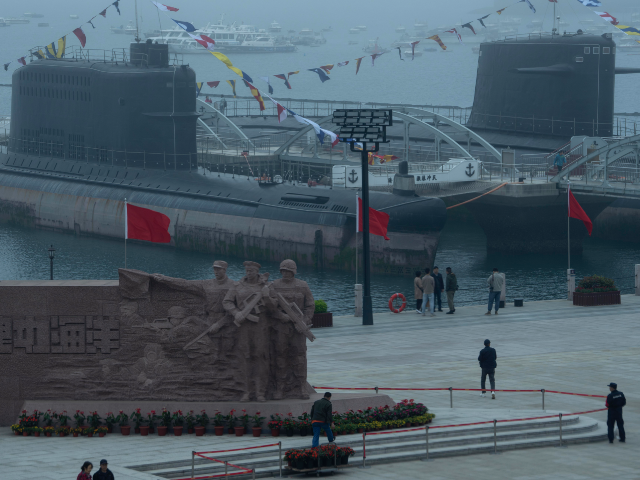

Pakistan on Thursday sent representatives to the Chinese port city of Sanya for a ceremony to commission the first of eight Hangor-class attack submarines Islamabad plans to purchase from Beijing.
Pakistani President Asif Ali Zardari and naval chief Adm. Naveed Ashraf attended the ceremony in Sanya, along with senior naval officials from both countries. Zardari praised the acquisition of the Hangor-class sub as a “historic milestone” for modernizing Pakistan’s navy and maintaining a “robust, balanced, and credible defense posture.”
“The advanced submarine strengthens Pakistan’s maritime defense, protects economic lifelines, and reflects strategic partnership with China,” said a statement from Zardari’s office on Thursday.
Adm. Ashraf alluded to the crisis in the Strait of Hormuz by saying it was important to upgrade Pakistan’s navy during a time of “disruptions at critical maritime choke points.”
“A stable, rule-based maritime order demands technologically advanced naval forces,” he said. “These submarines will play a pivotal role in deterring aggression and ensuring the security of vital Sea Lines of Communication (SLOCs) across the Arabian Sea and the wider Indian Ocean region.”
The Pakistani Navy celebrated the commissioning of the new sub as “another chapter in the time-tested and enriching friendship between Pakistan and China.”
The designation Hangor is a Bengali name, meaning “shark,” chosen to honor an aging French-built submarine that survived the destruction of most of Pakistan’s surface navy in the 1971 Indo-Pakistan War, and went on to sink an Indian frigate named INS Khurkri.
This gave the original Hangor the distinction of being the first submarine since World War II to sink an enemy warship, and it subsequently eluded a massive sub hunt by the Indian Navy to return safely to port in Karachi, further enhancing the psychological and cultural impact of its wartime achievement.
The date of PNS Hangor’s fabled engagement, December 9, became a holiday called Hangor Day in Pakistan. The original Hangor remained in service until 2006, when it was decommissioned and put on display in the Pakistan Maritime Museum.
The new Hangor-class submarine is reportedly based on China’s Type 039A Yuan-class submarine, which was designed to lurk underwater for extended periods of time and then surface to harass enemy forces with torpedoes and anti-ship cruise missiles.
The Yuan-class is relatively small by modern submarine standards, the better to operate in shallow coastal waters. It boasts an air-independent propulsion (AIP) system, which gives it longer range underwater and a stealthier profile than earlier diesel-electric designs.
According to Adm. Ashraf, the subs China is building for Pakistan will have advanced weapons and sensors to go along with the new AIP technology.
Pakistani officials said the new submarine fleet will ultimately consist of eight boats, four built in China and four made in Pakistan under a technology transfer agreement. The decision to purchase advanced subs from China was made after Pakistan successfully used Chinese J-10C fighter jets against India when the two nations came to the brink of war last summer. The Pakistani and Indian governments strenuously disagree about which side came out on top during the brief conflict.
Pakistan has nuclear weapons, but defense analysts believe their warhead technology cannot be miniaturized enough to make the small Hangor subs into nuclear launch platforms.
India will probably retain the edge in naval strength since it has two aircraft carriers and three nuclear-powered ballistic missile submarines (SSBNs.) The Indian military never misses an opportunity to remind Pakistan and China that it has achieved the “nuclear triad,” meaning it has the capability to launch nuclear missiles from land, air, and sea.
COMMENTS
Please let us know if you're having issues with commenting.