Oct. 15 (UPI) — The Trump administration has vowed to open up public land to usher in an age of American energy dominance but in the Western United States there is little frontier left.
More than 81% of public lands administered by the Bureau of Land Management in the Western United States are already open for oil and gas production leasing, according to a report by The Wilderness Society, a nonprofit organization focused on conservation.
The U.S. Geological Survey estimates that there is much more oil and gas that can be extracted from federally managed public lands, according to a report published in June. It estimates there are 29.4 billion barrels of oil and 391.6 trillion cubic feet of gas that are technically recoverable, meaning they can be produced using currently available technology and industry practices.
“This is an acceleration and amplification of what we saw in the energy dominance agenda under the first Trump administration,” Ben Tettlebaum, director and senior staff attorney for the Wilderness Society, told UPI. “What is distinct right now is its claim for wanting so-called energy dominance, particularly leveraging our shared public lands for that use. It seems it’s trying to leverage that use above all others.”
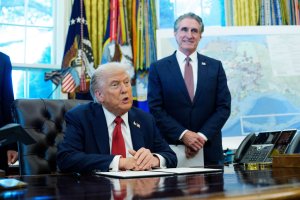
The focus of President Donald Trump is not on the lower 48 states alone. Last week, Trump approved the Ambler Road project, a 211-mile industrial road that will cross the Gates of the Arctic National Park and Preserve.
The road will be used to enable trucks and equipment to access the Ambler Mining District, a region in Northwestern Alaska with copper, zinc, gold, lead and silver deposits.
The U.S. government has reached an agreement with Trilogy Metals, a mineral mining company based in Vancouver that operates in the Ambler Mining District. According to the White House and Trilogy Metals, the U.S. Department of War will invest $35.6 million in the company, making it a 10% shareholder as part of the agreement. It will also have the future option to purchase
Trilogy Metals is partnered with Ambler Metals in a joint agreement to mine in the Ambler district.
Last year, the Biden administration blocked the Ambler Road project. President Joe Biden said the project was blocked to protect 28 million acres of land and Native communities in Alaska.
The move by the Trump administration reverses course on Biden-era efforts to maintain public lands. It also marks the second high-profile instance of the U.S. government buying a stake in a private company under the Trump administration.
In August, the Trump administration purchased a 10% stake in chip manufacturer Intel.
The U.S. government has invested in private companies on rare occasions though the circumstances in this instance are unique. Notably those were domestic companies, unlike Trilogy Metals.
The government invests in American companies when there is a risk of those companies collapsing, such as banks and vehicle manufacturers during the Great Recession. Those investments were tied to a government interest: avoiding further economic hardship. They were also temporary investments with recipients of government assistance required to pay the government back.
In the case of the Ambler Road project, the White House cited a public interest in accessing critical minerals domestically.
“[American Petroleum Institute] continues to welcome the administration’s efforts to restore a pro-development approach to land use and leverage our nation’s vast resources,” Tim Charters, director of upstream policy for the American Petroleum Institute, told UPI. “Responsible energy development on public lands strengthens America’s energy security, powers our economy and supports state and local conservation efforts.”
The Permian Basin in Southeast New Mexico and West Texas is a hotspot for oil drilling and industry experts told UPI it will see increased attention as the Trump administration invites more energy production.
Eli Hilbert, organizing director at Texas Permian Future Generations, told UPI residents of the basin are deeply tied to the oil industry. Most of them are supportive of the president’s desire to increase production. Yet volatility in the industry ushered in by Trump’s tariff and international policies is dragging down oil prices and causing layoffs.
“Oil was staying pretty steady at $70 to $72 a barrel until Trump announced tariffs,” Hilbert said. “Ever since it’s been up and down between $70 and $55. They still support Donald Trump, who is leading energy in the direction of more layoffs and less drilling.”
ConocoPhillips announced last month that it will lay off about 25% of its workforce by the end of the year.
Earlier this year, Chevron announced it would lay off 15 to 20% of its workforce.
While jobs come and go as the oil market fluctuates, the effects of drilling are long lasting. If and when drilling ends at a site, maintenance of the drill site must continue indefinitely.
“We will need to maintain these oil wells forever,” Hilbert said. “There are tens of thousands in West Texas we’re going to have to plug and check for millenia. We could employ every single person working in oil doing that for the next 100 years. The problem is there’s no money in that.”
Hilbert adds that many who work in the oil business are not concerned with the environmental or health effects associated with drilling.
“The problem is people don’t really live in Midland and Odessa [Texas] for long periods of time,” Hilbert. “It’s a place you come, make your money and leave.”
Texans have seen what happens when abandoned oil wells are not plugged and maintained. The artificial lake, covering 60 acres of land, is filled with toxic water due to a leaking oil well. It spews hundreds of gallons of toxic wastewater per minute and has been doing so for more than 20 years.
“It smells terrible. It has dangerous levels of hydrogen sulfide,” Hilbert said. “Because nobody took care of it 20 years ago, it’s ballooned into a huge problem.”
A struggle has persisted over the years to determine who is responsible for the cleanup. The Railroad Commission, the state agency responsible for regulating the oil and gas industry, and the county water district are in a dispute over which body is responsible for plugging the well.
COMMENTS
Please let us know if you're having issues with commenting.