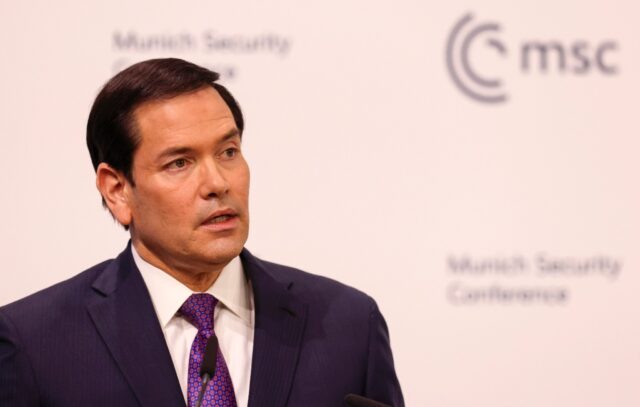
European countries gave a cautious welcome Saturday to US Secretary of State Marco Rubio’s more conciliatory tone at the Munich Security Conference but stressed that major differences remained with their traditional ally.
In a keynote address to dozens of world leaders, foreign ministers and defence chiefs, Rubio declared that Europe and the United States “belong” together and focused heavily on shared history and heritage.
“The fate of Europe will never be irrelevant to our own,” he said in an address greeted by repeated rounds of applause, adding that “ultimately our destiny is, and will always be, intertwined with yours”.
All eyes had been on Rubio’s speech, a year after US Vice President JD Vance used the same stage to deliver a withering attack on Europe’s immigration policies and accused the continent’s governments of curbing free speech.
It also came after tensions soared recently over US President Donald Trump’s ambitions to seize Greenland, an autonomous territory of EU and NATO member Denmark.
German Foreign Minister Johann Wadephul praised the fact the top US diplomat had focused on what Europe and America had achieved together in the past and could do in future.
“So he was looking forward — this is good,” Wadephul said, adding that it signalled the relationship could again be a “success story”.
But Wadephul also emphasised that many “uncertainties” remained.
Rubio in his speech did not shy away from more controversial topics, criticising mass migration to the West and what he labelled its de-industrialisation, and attacking the United Nations for failing to resolve conflicts.
He urged Europe to join Trump’s drive for global “renewal”, saying that acting together “will restore to us a clear sense of ourselves”.
“It will restore a place in the world, and in so doing, it will rebuke and deter the forces of civilisational erasure that today menace both America and Europe alike.”
‘Bumpy days’
French Foreign Minister Jean-Noel Barrot said Rubio’s speech had received a generally positive response as he had referred to the “common history” shared by the US and Europe, particularly when it came to democracy.
But Barrot stressed his focus remained on forging “a strong and independent Europe… irrespective of the speeches that we hear at the Munich Security Conference”.
For Estonia’s Defence Minister Hanno Pevkur, overall the address was a relief as it showed the US and Europe “are still allies and partners”.
“As it is in every marriage, you have some bumpy days and you have some bumpy roads, but you can always… smooth the road,” he told AFP.
Wadephul meanwhile also said that “for Germany and for Europe, it’s absolutely clear we need new global partners”.
He was speaking on a panel alongside the foreign minister of India, with which the EU signed a mammoth trade deal last month.
And he took a dig at Rubio’s attack on the United Nations, saying that the world has to “stick to our international rules-based order”.
He called the United Nations “our Board of Peace,” referring to Trump’s recently established conflict resolution organisation that some view as a bid to rival the UN.
Some were more openly critical of Rubio.
Gabrielius Landsbergis, Lithuania’s former foreign minister, said the US politician had brought a “lot of white paint to Munich to cover the cracks caused by the great rupture.”
“This was not a departure from the general position of the US administration,” he posted on X. “It was simply delivered in more polite terms. I am not sure the white paint will hold.”
COMMENTS
Please let us know if you're having issues with commenting.