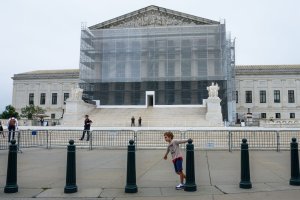
Sept. 4 (UPI) — President Trump launched a bid in the Supreme Court to overturn the U.S. Court of Appeals ruling that most of his tariffs were unlawful.
Officials filed a petition late Wednesday, asking justices for an expedited ruling that the president does have the power to tax imports from the United States’ trading partners after the lower court found he had exceeded his authority and that duties and taxes were a power reserved to Congress under the Constitution.
The administration requested the Supreme Court hear his appeal in early November and make a final judgment as soon as possible, instead of the nine months such decisions usually take.
Solicitor General John Sauer’s petition argued that the “erroneous decision has disrupted highly impactful, sensitive, ongoing diplomatic trade negotiations, and cast a pall of legal uncertainty over the president’s efforts to protect our country by preventing an unprecedented economic and foreign policy crisis.”
With the legal challenge from small U.S. importers and some states against Trump’s tariffs threatening to rip the heart out of his economic and foreign policy and compel the repayment of tariffs collected so far, Sauer said the “stakes could not be higher.”
In an attached codicil, Treasury Secretary Scott Bessent said Friday’s ruling by the U.S. Court of Appeals for the Federal Circuit “gravely undermines the president’s ability to conduct real-world diplomacy and his ability to protect the national security and economy of the United States.”
Counsel for the defendants said they believed they would win the case.
“These unlawful tariffs are inflicting serious harm on small businesses and jeopardizing their survival. We hope for a prompt resolution of this case for our clients,” said Jeffrey Schwab of Liberty Justice Center.
Trump announced plans in April to impose 10% tariffs on virtually every country in the world, plus “reciprocal” tariffs where the United States ran a trade deficit, claiming he was acting to redress fundamentally unfair arrangements that had decimated domestic industries and undermined national security.
He cited the International Emergency Economic Powers Act, which grants the executive powers to counter “unusual and extraordinary” hazards.
The U.S. Court of International Trade in New York first ruled the tariffs were illegal in May, that the IEEPA did not extend to import taxes and that Congress’ exclusive power to regulate international commerce took precedence over the president’s duty to protect the economy.
The CIT also struck down separate tariffs imposed on China, Mexico and Canada in an effort to force those countries to act to stem what Trump claimed were intolerable volumes of drugs and illegal immigrants entering the United States.
The administration then took the case to the appeals court in August, which, despite being split, upheld the ruling of the CIT, blocked the tariffs completely and ordered the court to consider whether universal relief was necessary.
However, it opted to stay its decision through Oct. 14 to allow for an appeal to a higher court.
Trump’s petition on Wednesday warned that the Supreme Court putting off ruling through June could result in significant disruption from trying to restore the $750 billion to $1 trillion in tariffs that would have been collected by then.
COMMENTS
Please let us know if you're having issues with commenting.