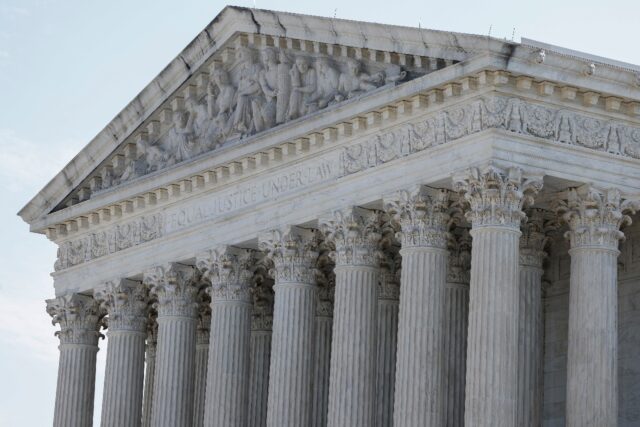

A divided US Supreme Court on Wednesday weighed the Trump administration’s move to strip deportation protections from hundreds of thousands of Haitians and Syrians living in the United States.
Solicitor General John Sauer told the court the Department of Homeland Security’s decision to end Temporary Protected Status (TPS) for 350,000 Haitians and 6,000 Syrians was not subject to judicial review.
Lawyers for Haitian and Syrian TPS holders countered that conditions in their home countries remained unsafe and the administration’s move was motivated at least in part by racial animus.
A majority of the six conservative justices on the top court appeared to favor the government’s arguments while the three liberal justices were seemingly opposed.
TPS protects its holders from deportation and is granted to people deemed to be in danger if they return home because of war, natural disaster or other extraordinary circumstances.
President Donald Trump campaigned for the White House on a pledge to expel millions of migrants and has pushed to dismantle the TPS program as part of his broader immigration crackdown.
A ruling in the case could have implications for more than one million beneficiaries of TPS status from more than a dozen countries.
“We’re talking about the power to mass expel people who have done nothing wrong to countries that remain unsafe,” said Ahilan Arulanantham, a lawyer representing the Syrian TPS holders in the case.
TPS status has been revoked for nationals of Afghanistan, Cameroon, Ethiopia, Honduras, Myanmar, Nepal, Nicaragua, Somalia, South Sudan, Venezuela, Yemen, and others in addition to Haitians and Syrians since Trump took office.
‘Discriminatory’
Haitians became eligible for TPS in 2010 following a devastating earthquake, and the country continues to suffer from severe poverty, rampant violence from heavily armed gangs and chronic political instability.
The State Department advises Americans not to travel to the Caribbean nation “due to kidnapping, crime, civil unrest and limited health care.”
TPS was extended to war-torn Syria in 2012.
Justice Sonia Sotomayor, a liberal, asked Sauer whether a “discriminatory purpose may have played a part” in the decision to strip TPS status from Haitians and referred to statements by Trump.
“We have a president saying at one point that Haiti is a quote filthy, dirty and disgusting s-hole country — I’m quoting him — and where he complained that the United States takes people from such countries instead of people from Norway, Sweden or Denmark,” Sotomayor said.
Sauer replied that the president’s comments were being taken out of context and he was referring to “problems of crime, poverty and welfare dependency.”
He said court review of TPS decisions was barred to prevent “judicial micromanagement” of foreign policy determinations.
DNA sample and a will
Justice Ketanji Brown Jackson, another liberal, asked to what extent country conditions are taken into account in deciding to remove TPS status.
Safety is considered, Sauer said, but so is “whether allowing the aliens to stay here would be contrary to the United States national interest.”
Justice Brett Kavanaugh, a conservative, noted that TPS was granted to Syrians during the era of the “brutal” Assad regime and it has since been deposed.
Arulanantham, the lawyer for the Syrians, said the State Department’s website says armed conflict in Syria “remains active.”
“Their own website is saying, ‘If you go to Syria, leave a DNA sample, execute a will before you go,'” Arulanantham said.
Geoffrey Pipoly, representing Haitian TPS holders, said the “true reason” for terminating their TPS status is the “president’s racial animus towards non-white immigrants.”
“The president has disparaged Haitian TPS holders specifically as undesirables from a quote, shithole country, and — days after falsely accusing them of, quote, eating the dogs and eating the cats of Americans — he vowed that he would terminate Haiti’s TPS,” Pipoly said.
“And that is exactly what happened,” he added.
The Supreme Court is expected to issue a ruling in the case by the end of June or early July.
COMMENTS
Please let us know if you're having issues with commenting.