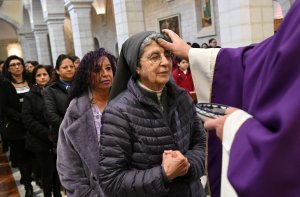
Dec. 4 (UPI) — A commission chosen by the late Pope Francis to study the possibility of women becoming deacons in the Catholic Church has voted against it.
Francis established the “Study Commission on the Female Diaconate” in 2020 to follow up on a previous group that studied the history of women deacons in the New Testament and early Christian communities.
Though the group said women could not be deacons, it expressed hope that access to other ministries could expand for women.
The group consisted of a president, Cardinal Guiseppe Petrocchi of Aquila, Italy; secretary the Rev. Denis Dupont-Fauville; and 10 others. The others included five women and five men, which included two permanent deacons from the United States and three priests.
The report was published Thursday and addressed to Pope Leo XIV. The Vatican News said Leo requested the report, dated Sept. 18, be made public.
One reason listed for the denial was that not enough people spoke up on the matter.
“At the last working session (February 2025), after the Synod [of Bishops] had allowed anyone who wished to submit contributions, the Commission examined all the material received. Although many interventions were submitted, the persons or groups who sent their writings numbered only 22 and represented few countries. Consequently, although the material is abundant and in some cases skillfully argued, it cannot be considered the voice of the Synod, much less of the People of God as a whole.”
The report listed eight statements or theses that the group voted on, and it revealed the number of votes, though not how each member voted.
One of the theses that showed a vote split down the middle was about masculinity: “The masculinity of Christ, and therefore the masculinity of those who receive holy orders, is not accidental but is an integral part of sacramental identity, preserving the divine order of salvation in Christ. To alter this reality would not be a simple adjustment of ministry but a rupture of the nuptial meaning of salvation.”
The thesis got a vote of 5-5.
The group also voted on a preamble that shows the most hope for women in service of the church, with a vote of 9-1 in favor, was: “It is now up to the discernment of pastors to evaluate what further ministries can be introduced for the concrete needs of the church of our time, thus ensuring adequate ecclesial recognition of the diakonia (service) of the baptized, particularly of women. Such recognition will be a prophetic sign, especially where women still suffer situations of gender discrimination.”
In his conclusion, Petrocchi said there is “an intense dialectic” between two theological orientations. The first maintains that the ordination of a deacon is for ministry and not for priesthood: “This factor would open the way toward the ordination of women deacons.” This refers to the permanent deacon, one who isn’t trying to become a priest.
The second theology insists “on the unity of the sacrament of Holy Orders, together with the nuptial meaning of the three degrees that constitute it, and rejects the hypothesis of a female diaconate; it also notes that if the admission of women to the first degree of Holy Orders were approved, exclusion from the others would become inexplicable.”
Petrocchi doesn’t address the fact that permanent deacons in the Catholic Church are allowed to be married, whereas those vying for the priesthood are not.
In 2019, a group of cardinals from the Amazon basin area considered the possibility of women deacons and married priests as a way to combat a shortage of priests in the area. They presented their concerns to Francis, who then said he would assemble a commission to study both options.
“I am going to take up the challenge that … you have put forward, that women be heard,” Francis said.
The report did not name the commission members, but The Catholic Standard said Francis had named the following: U.S. Deacon Dominic Cerrato, director of deacon formation for the Diocese of Joliet, Ill.; U.S. Deacon James Keating, a former director of theological formation at the Institute for Priestly Formation at Creighton University in Omaha, Neb.; The Rev. Santiago del Cura Elena, a priest of the Archdiocese of Burgos, Spain; the Rev. Manfred Hauke, a German-born professor at the Theological Faculty of Lugano, Switzerland; and the Rev. Angelo Lameri, a professor of liturgy and the sacraments at Rome’s Pontifical Lateran University.
The five women chosen were: Catherine Brown Tkacz, a U.S.-born professor at the Ukrainian Catholic University in Lviv; Caroline Farey, a theologian and catechist educator who serves as Diocesan Mission Catechist for the Diocese of Shrewsbury, England; Barbara Hallensleben, professor of theology at the University of Fribourg, Switzerland, and former member of the International Theological Commission; Rosalba Manes, a consecrated virgin and biblical scholar who teaches at Rome’s Pontifical Gregorian University; and Anne-Marie Pelletier, a French biblical scholar.
COMMENTS
Please let us know if you're having issues with commenting.