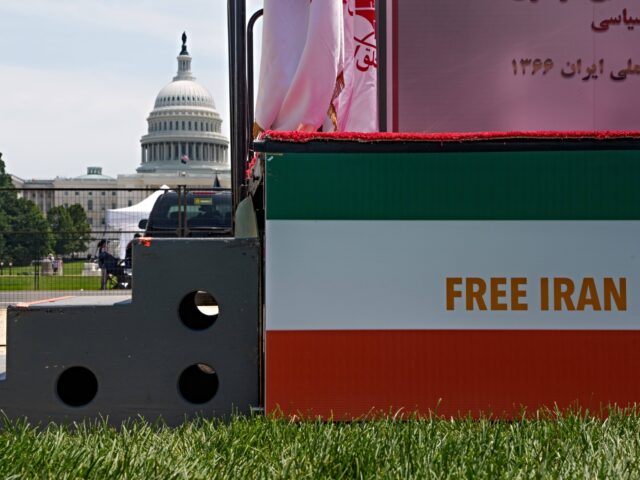

Hundreds of Iranian-American scholars, professionals, human rights advocates, youth, and community leaders from across the United States joined prominent former U.S. and European officials in Washington to map what organizers called a concrete roadmap for democratic transition in Iran. The gathering warned the clerical regime has entered its “final phase” and insisted “a democratic alternative capable of replacing it” already exists in the National Council of Resistance of Iran (NCRI).
The Free Iran Convention 2025, held last Saturday at the Hyatt Regency in Washington, D.C., under the theme “The Path to a Democratic, Prosperous Republic in Iran,” convened under the auspices of the NCRI’s U.S. Representative Office and drew more than 1,000 attendees for an all-day program of panels and speeches. The gathering culminated in keynote addresses by former Secretary of State Mike Pompeo, former U.K. House of Commons Speaker John Bercow, former U.S. Ambassador Carla Sands, and former Congressman Patrick Kennedy.
In an exclusive statement to Breitbart News, Bercow said he had “never attended a convention which had such a current of electricity, energy, and enthusiasm” in more than four decades in politics, hailing the Free Iran Convention 2025 as “an organizational triumph” for the NCRI and “a tribute to the participants.”
Organizers said the central message that emerged was stark: Iran’s crisis has become irreversible under clerical rule, structural conditions for regime change now exist, and the NCRI—anchored in President-elect Maryam Rajavi’s Ten-Point Plan for a free, secular, non-nuclear republic—has positioned itself as the organized alternative.
Rajavi: ‘The Regime Has Reached Its Final Phase’
Addressing the convention online from France, NCRI President-elect Maryam Rajavi declared that the regime has reached “the final phase of its winter,” incapable of reform and trapped in repression, plunder, warmongering, and nuclear brinkmanship, and she reiterated her longstanding “Third Option”—neither appeasement nor foreign war, but the overthrow of the Velayat-e Faqih system of absolute clerical rule by the Iranian people and their organized Resistance.
“The central question facing the Iranian people and the international community is how meaningful and lasting change can be achieved in Iran,” Rajavi said, arguing that the overthrow of the Velayat-e Faqih regime is both necessary and urgent and warning that decades of Western appeasement have “paved the way for the expansion of fundamentalism” while blocking democratic change, even as Iranian society has become a “powder keg” with workers, teachers, retirees, shantytown residents, and MEK-affiliated Resistance Units confronting the Revolutionary Guards across all 31 provinces.
Outlining her program, Rajavi reaffirmed the NCRI’s commitments to a democratic republic based on universal suffrage, free elections, separation of religion and state, gender equality, abolition of the death penalty, and autonomy for Iran’s nationalities, stressing, “We are not fighting to seize power. Our goal is to return sovereignty to the people of Iran,” and vowing that a provisional government would organize elections for a Constituent Assembly within six months of the regime’s fall.
Society Ripe for Change
In the opening session, “Society Ripe for Change,” scholars argued Iran’s crisis has become irreversible under clerical rule.
Former University of Connecticut engineering dean Dr. Kazem Kazerounian described a structurally “collapsed” economy turned into a tool of repression and plunder, with roughly 80 percent of Iranians living below the poverty line and the Islamic Revolutionary Guard Corps controlling much of the economy.
University of Kansas computer scientist Dr. Hossein Saiedian tied those failures to the regime’s “core foundational problem: its illegitimacy,” arguing the clerical leadership “stole the revolution” in 1979 and crediting the NCRI’s exposure of the Natanz nuclear site in 2002 as a “courageous act of patriotic intelligence” that triggered sanctions and isolation.
California physician Dr. Ashraf Zadshir traced how isolated protests evolved into nationwide uprisings in 2017, 2019, and 2022 across all 31 provinces, noting chants rejecting both “reformists” and “hardliners” and concluding that Iran has entered a “permanent state of defiance.”
Women: From Targets to Leaders
A second session, “Iranian Women and the Legacy of Resistance,” examined how women have moved from primary targets of repression to the decisive force shaping Iran’s democratic movement.
Pediatrician Dr. Azadeh Sami argued that systemic misogyny under both the Shah and the current theocracy pushed women into the organized resistance—especially the MEK—where they rose into strategic and operational leadership, creating “the longest-running women-led movement in the region.”
Family-law attorney Hannane Amanpour described gender inequality as “completely by design,” rooted in a constitution that denies women equal rights in both private and public life, but pointed to the MEK’s internal model—culminating in Rajavi’s selection as NCRI President-elect in 1993—as proof that “No to compulsory hijab, no to compulsory religion, no to compulsory government” can be a governing principle, not just a slogan.
Mapping the Transition
A third session, “Transition Strategy: Mapping Iran’s Path from Dictatorship to Democracy,” focused on how regime change can be achieved and managed.
Software engineer Farideh Sedighi argued that regime change is “not only possible but increasingly inevitable,” pointing to converging pressures from a collapsing economy, deepening popular unrest, and rapidly expanding Resistance Units that carried out thousands of operations and symbolic acts across more than 100 cities in the past year.
NASA scientist Dr. Behzad Raofi said engineers are trained to break complex systems into components and concluded “the only realistic strategy to bring this regime down is to fight it and overthrow it,” given the clerical establishment foreclosed peaceful change from the outset and responded to peaceful demonstrations with bullets and gallows.
Executive surgeon-scientist Dr. Firouz Daneshgari answered skeptics by pointing to the Resistance’s record—from mobilizing hundreds of thousands of supporters with only a few hundred surviving MEK members after the Shah’s prisons in the late 1970s to exposing Tehran’s clandestine nuclear program beginning in 2002 and building resilient Resistance Units that regenerate despite arrests and executions—arguing that “history, capability, and evidence all point to one truth: the Resistance is not only ready, it is already leading the path to freedom.”
Youth Refuse to Accept Dictatorship as Iran’s Destiny
The fourth session, “Youth as the Driving Force of Iran’s Democratic Future,” spotlighted a generation that refuses, in the words of one speaker, to “accept dictatorship as Iran’s destiny.”
Senior medical dosimetrist Mohammadreza Hesami, who spent his adolescence in Iran, described growing up under a system more interested in policing how young people dress and think than in nurturing their talents, arguing the regime’s harsh treatment of student activists and young MEK supporters reflects “a generation that no longer believes in them.”
Computer science student Ryan Nasir portrayed MEK-affiliated Resistance Units—nurses, students, workers, and professionals across all 31 provinces—as “the tip of the spear,” whose slogans and operations prove “the regime is not ten feet tall,” and said their open messages of support for the MEK and NCRI, sometimes filmed in broad daylight in Tehran, show a dictatorship losing its grip.
University of Virginia law student Seena Saiedian explained why youth now overwhelmingly demand regime change, not reform, saying decades of failed “moderate” presidencies have convinced them no meaningful progress is possible within the system and their courage rests on knowing “a viable alternative exists” in the NCRI and the MEK, with democratic principles and institutional guardrails for free elections.
A special “Voices from Iran” segment brought the struggle directly into the hall through recorded messages from political prisoners on death row and Resistance Units vowing to continue their activities, drawing attention to 17 dissidents sentenced to death for cooperating with the MEK.
After the panels, a series of keynote speeches from Western dignitaries reinforced the same themes of regime collapse, internal resistance, and the NCRI’s claim to be a ready alternative.
Pompeo: ‘These Rotten Regimes Fail’
Former Secretary of State Mike Pompeo praised Rajavi’s leadership and described the opportunity for change as “real” thanks to “the bravery of Iran’s organized political opposition,” painting a picture of a weakened regime that is “more internationally isolated than ever,” has “zero popular legitimacy,” and now relies almost exclusively on fear.
He said Tehran’s regional influence is collapsing—with Hezbollah “reduced to impotence, a shadow of what it once was,” Bashar al-Assad’s grip in Syria badly eroded, and Iran’s nuclear capabilities “massively diminished”—and compared today’s moment to patrolling the East German border as a young Army officer when few believed the Soviet bloc would ever fall.
“These rotten regimes fail,” Pompeo told the audience. “We only know that the requirement is internal resistance to force that moment to come more readily and sooner.”
Pompeo urged the United States and Europe to enforce snapback sanctions and “starve the regime” of money, warning that “if you appease tyrants, they will grow in power and stature,” and stressing that the NCRI has never asked for American boots on the ground—only political support and pressure so that “a thriving, democratic, popular government in Iran, not a theocracy, not a monarchy,” can emerge.
Bercow: ‘They Cannot Be Improved. They Have to Be Removed.’
Former U.K. House of Commons Speaker John Bercow denounced Iran’s clerical rule as a “four-and-a-half-decade-long essay in barbarity” and a “failed state,” arguing the mullahs fundamentally misunderstand government’s purpose, which is “to serve, to facilitate, and to empower the people,” and instead use power “to repress, to dominate, to terrorize.”
“That’s why they can’t be improved,” he declared. “They have to be removed.”
Bercow reserved some of his sharpest language for those promoting a return to monarchy, insisting “the alternative is not, is not, is not Son of Shah—no way,” and mocking Reza Pahlavi’s blueprint as recreating autocratic control.
He argued legitimacy instead belongs to those who stayed on the ground, organized resistance, and paid the price—the MEK and NCRI, whose tens of thousands of martyrs and ongoing Resistance Unit activities he cited as proof.
“The reason why the regime is doomed to fail,” he said, “is that in the end, you cannot extinguish the flame of freedom… love trumps hate. Hope trumps fear.”
‘No Turban, No Crown’
Former U.S. Ambassador to Denmark Carla Sands said the regime’s escalating brutality is driven “not by confidence but by fear,” noting that the restoration of U.N. snapback sanctions has further cornered Tehran, but arguing the regime “does not fear exiled monarchs or lobbyists,” it fears “the MEK,” because it is organized with leadership, structure, and Resistance Units preparing for a transition of power.
Rejecting any return to dictatorship, she declared Iranians “will not trade a turban for a crown,” saying legitimacy belongs to those who “paid the price in prisons and in the streets,” not those who inherited titles.
She highlighted the NCRI’s women-led culture as “the only revolution in the Middle East led by women,” adding, “When Iran rises, it will rise under the leadership of its daughters,” and urged democratic governments to recognize Iranians’ right to overthrow the regime and acknowledge the NCRI as their legitimate representative.
Kennedy: ‘A Universal Fight for Freedom’
Former Congressman Patrick Kennedy cast Iran’s struggle as part of a “universal fight” for human dignity, drawing on his family’s civil-rights legacy and recalling visits to Ashraf-3 in Albania, which he called “a model of what Iran can look like” where, despite bombings and siege, residents “still played their music, recited poetry, and celebrated one another.”
He embraced Rajavi’s Ten-Point Plan as the democratic alternative and dismissed monarchist revivals as “a comedy,” arguing the real future lies in a pluralistic republic.
Quoting his uncle Robert F. Kennedy, he told the crowd that each act of resistance sends “a tiny ripple of hope” which, joined together, “can knock down the mightiest walls of oppression,” and said he looks forward to taking his children one day “to a free Iran” to see the country rebuilt by its own people.
Benson: ‘The Regime Is a Paper Tiger’
Conservative commentator Guy Benson closed the convention by declaring his commitment to “a free, secular, democratic, non-nuclear Iran, as determined and secured by and for the people of Iran and no one else,” saying that especially since October 7 the world has recognized “the head of the snake of terrorism lies in Iran” and that the regime has been exposed as a “paper tiger” whose proxies and nuclear program have suffered “massive” setbacks.
Noting bipartisan House backing for a resolution endorsing Iranians’ desire for a democratic republic, he praised the opposition for never acquiescing to despair and urged the audience to imagine a future convention “not in Washington, New York, Paris, or Brussels—but in a free, thriving Tehran,” where Iranians and allies would gather “not to discuss what might be, but what has been achieved.”
By the convention’s close, organizers said a single theme had crystallized: change in Iran is both inevitable and urgent, driven by a society in permanent revolt, a regime weaker than at any point in its history, and an organized alternative in the NCRI anchored in Rajavi’s Ten-Point Plan.
That blueprint calls for universal suffrage, free elections, separation of religion and state, gender and ethnic equality, abolition of the death penalty, autonomy for Iran’s nationalities, and a non-nuclear, peaceful foreign policy—principles that NCRI officials say have drawn support from more than 4,000 lawmakers worldwide, 130 former world leaders, and 80 Nobel laureates, as well as a bipartisan majority in the U.S. House of Representatives.
Joshua Klein is a reporter for Breitbart News. Email him at jklein@breitbart.com. Follow him on Twitter @JoshuaKlein.
COMMENTS
Please let us know if you're having issues with commenting.