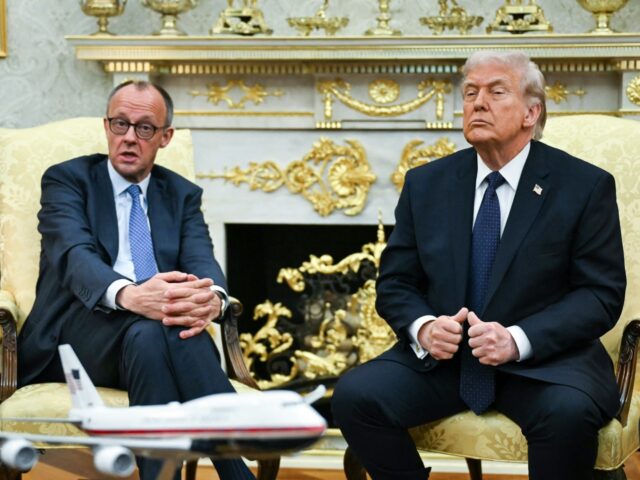

The United States has announced that it intends to withdraw thousands of troops from bases in Germany over the next year as the Trump administration looks to reshape its forward deployment posture following the conflict in Iran.
In what may serve as the first domino to fall in the Trump administration’s response to public disloyalty from NATO allies in Europe, the Pentagon said on Friday that U.S. Secretary of War Pete Hegseth has ordered 5,000 soldiers to be removed from Germany.
In a statement provided to the AFP on Friday evening, Pentagon spokesman Sean Parnell said: “We expect the withdrawal to be completed over the next six to twelve months.”
“This decision follows a thorough review of the Department’s force posture in Europe and is in recognition of theater requirements and conditions on the ground.”
It came after President Trump said earlier this week that his government was “studying and reviewing the possible reduction of Troops in Germany.”
The U.S. leader has also signalled potential troop reductions elsewhere in Europe, including in Spain and Italy, both of which to varying degrees openly opposed the war in Iran, with Spain refusing access to its military bases and airspace and Italy reportedly restricting its airspace for strikes on Iran.
When pressed earlier this week as to whether he planned on cutting troop numbers in Italy and Spain, Mr Trump said bluntly: “Yeah, probably, I probably will. Why shouldn’t I?”
As of the end of the year, there were 3,814 active-duty American troops residing in Spain, 12,662 in Italy, and 36,436 in Germany.
While Berlin did not baulk at the U.S. using its bases during the Iran conflict like Madrid, German Chancellor Friedrich Merz has drawn the ire of President Trump for publicly criticising the war, claiming that there was no strategy behind it.
Firing back earlier this week, President Trump said that the “Chancellor of Germany should spend more time on ending the war with Russia/Ukraine (Where he has been totally ineffective!), and fixing his broken Country, especially Immigration and Energy, and less time on interfering with those that are getting rid of the Iran Nuclear threat, thereby making the World, including Germany, a safer place!”
Meanwhile, President Trump has also taken aim at Germany on trade, announcing on Friday that the U.S. would be imposing a 25 per cent increase on car and truck tariffs from the European Union, a move that will likely hit the major car-producing sector in Germany particularly hard. Trump said tthat it was a result of the EU failing to fully comply with the historic trade deal negotiated by the Trump White House last year.
“It is fully understood and agreed that, if they produce Cars and Trucks in U.S.A. Plants, there will be NO TARIFF. Many Automobile and Truck Plants are currently under construction, with over 100 Billion Dollars being invested, A RECORD in the History of Car and Truck Manufacturing. These Plants, staffed with American Workers, will be opening soon — There has never been anything like what is happening in America today!” he wrote on Truth Social.
The troop reduction in Germany also comes after a decade of criticism from Mr Trump, who had previously lambasted Berlin for having become reliant on Russian energy while at the same time relying on the United States to provide for its defence against Moscow.
While President Trump has successfully pressured NATO allies, including Germany, to finally increase their defence spending, the lack of support during the Iran war has led him to renew his critiques, noting that the alliance was not there for America when it called for support.
Responding to the announced move, a spokesman for NATO said on Saturday morning: “We are working with the U.S. to understand the details of their decision on force posture in Germany.
“This adjustment underscores the need for Europe to continue to invest more in defence and take on a greater share of the responsibility for our shared security – where we’re already seeing progress since Allies agreed to invest 5 per cent of GDP at the NATO Summit in The Hague last year. We remain confident in our ability to provide for our deterrence and defence as this shift towards a stronger Europe in a stronger NATO continue.”
COMMENTS
Please let us know if you're having issues with commenting.