
President Donald Trump has said that far more troop reductions are in the offing after the Pentagon announced on Friday that some 5,000 U.S. soldiers would be withdrawn from bases in Germany over the coming year.
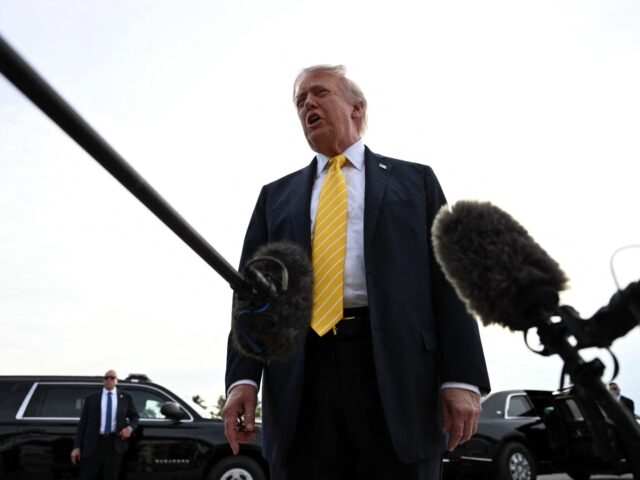
In a press gaggle on the tarmac of the Palm Beach airport on Saturday evening, President Trump said of his planned troop reductions in Germany: “We’re going to cut way down. And we’re cutting a lot further than 5,000.”
The U.S. leader had previously planned to bring back around 9,500 soldiers from Germany during his first term in office; however, his successor, Joe Biden, reversed the decision before it could be enacted. At present, approximately 36,000 troops are stationed in Germany and around 80,000 across Europe.
The announced move comes amid a broader shift in U.S. military policy towards NATO and Europe in light of the response to the Iran conflict. Although Berlin did not go as far as Madrid in blocking base access for American forces, German Chancellor Friedrich Merz has been vocally critical of the White House’s strategy in the conflict, claiming that Iran had “humiliated” the United States.
President Trump has long been critical of the military arrangement with Germany, in which America essentially underwrites the nation’s defence, despite Germany having partnered economically with adversarial nations like Russia and communist China.
German Defence Minister Boris Pistorius said that the presence of American troops is in the interest of both countries, noting: “We work closely with the Americans, in Ramstein, in Grafenwöhr, in Frankfurt and elsewhere, for peace and security in Europe, for Ukraine and for common deterrence.
“The USA also bundles other military functions here, for example, for its security policy interests in Africa and the Middle East,” he added.
Regardless, the Defence chief said that Europe must “take more responsibility for our security,” saying that “for all future tasks, we coordinate closely with our allies, for example, within the framework of the Group of Five, that is, with Great Britain, France, Poland, and Italy.”
Meanwhile, Germany also looks set to come under increased economic pressure from the United States, with President Trump announcing this week plans to increase tariffs on cars and trucks by 25 per cent — including Germany’s already struggling automotive sector — over what he claimed were violations of the trade deal by the EU.
The announcements will likely spell more domestic headaches for Chancellor Merz, whose government has become increasingly unpopular as questions have begun to swirl in Berlin about the possibility of an early election.
Currently, Merz’s Christian Democratic Union (CDU) and its sister party, the Christian Social Union in Bavaria (CSU), trail the upstart populist Alternative for Germany (AfD) by a record 5 points in the polls amid growing dissatisfaction with the economy and continued struggles with mass migration.
COMMENTS
Please let us know if you're having issues with commenting.