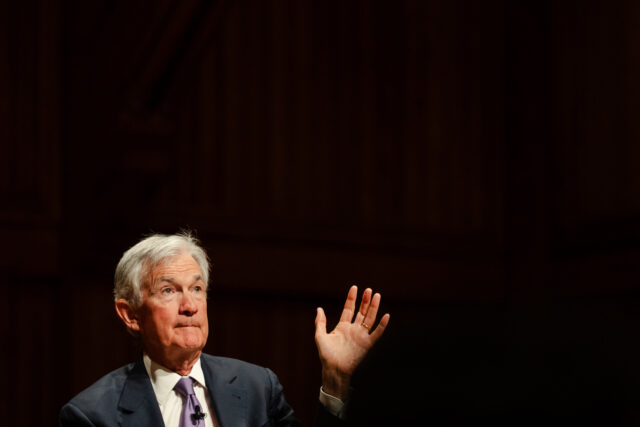

Jerome Powell is not quite done running the Federal Reserve yet.
The Federal Reserve Board voted on Friday to designate Jerome Powell as chair pro tempore until Kevin Warsh is sworn in as the new chair. The move was announced in a terse press release: “This temporary action to name the incumbent as chair pro tempore is consistent with past practice during similar transitions between chairs.”
The press release did not explain what statutory authority the Board was relying on. Nor did it address the fact that the claim of consistency with precedent is, in critical respects, unsupported by the historical record.
The Federal Reserve Act does not provide an express mechanism for filling a chair vacancy. Instead, it provides that if the chair is “absent,” the vice chair may preside over Board meetings. If both the chair and vice chair are absent, “the Board may elect one of its members to serve as chair pro tempore.”
The Board’s Friday action does not fit this language. Vice Chair Philip Jefferson is not absent. He voted for the appointment. The statute contemplates temporary absence from a meeting, not a vacancy in the chair position itself caused by the expiration of a term.
The Board has not publicly explained what statutory authority it was relying on. No statement from the Federal Reserve’s general counsel or from Board leadership has articulated a legal basis for the action. Over the past few months, Powell has frequently claimed, without evidence, that he would remain chairman even after his term expired if a successor was not confirmed.
The Fed stated that this action is “consistent with past practice during similar transitions between chairs.” The historical record is more complicated than the Fed’s statement suggests.
The Board has appointed chairs pro tempore in the past. In 1996, Alan Greenspan served as chair pro tempore between his two confirmed terms. Jerome Powell did the same in 2022. Before that, Marriner Eccles served in this capacity in 1948, and Arthur Burns did so in 1978.
But in each of these cases, there was explicit or implicit presidential involvement. When Greenspan held over in 1996, his re-nomination was pending and he was expected to be reconfirmed. When Powell held over in 2022, the same was true. In neither case was the Board asserting an independent power to choose its own head against presidential will.
The Burns case in 1978 is more instructive. The Board did appoint Burns as chair pro tempore during a vacancy—but only after President Carter expressly designated Burns as acting chairman. Carter explicitly invoked his authority as President to make the appointment, understanding it as his prerogative.
A less clear historical precedent involves Paul Volcker in 1987. Volcker’s term as chair expired on August 6. Alan Greenspan had been nominated by President Reagan and confirmed by the Senate on August 3. Greenspan took the oath on August 11. During that gap, Volcker served as chair pro tempore.
But this precedent does not support the Board’s independent action. Reagan appeared publicly with Volcker and Greenspan to explain the transition. The President accepted Volcker’s stepping down “with great reluctance and regret” and expressed confidence in Greenspan. The arrangement bore the President’s public stamp of approval. It was Reagan’s succession plan, not an assertion of Board autonomy.
In none of these past instances did the Board unilaterally appoint a pro tempore chair in the face of a presidential succession in which the president’s nominee had already been confirmed and swearing-in was imminent. In 1987, the President had publicly blessed the arrangement. In 1978, the President made the appointment himself. In the Greenspan and Powell re-confirmations, the President had re-nominated them and they were expected to be reconfirmed.
Two of seven governors—Steven Miran and Michelle Bowman—objected to the unlimited designation. They stated that the arrangement “should be subject to renewal by another vote of the Board or potential presidential action,” suggesting they understood presidential authority as the ultimate backstop.
Miran voted against the action. Bowman abstained.
The practical stakes are real. Earlier this year, a dispute between the Justice Department and Senate Republicans over an investigation into the Fed created the possibility that Powell’s term could have expired before his successor was confirmed. If the Board can unilaterally appoint a pro tempore chair without presidential involvement, a Senate faction aligned with an outgoing chair could theoretically extend that chair’s de facto authority even if the President had successfully nominated a replacement.
The move could establish a precedent for the Board to designate its own temporary leader during future gaps between the expiration of a chair’s term and the swearing-in of a successor.
The Trump administration did not respond to a request for comment on the Fed’s move.
COMMENTS
Please let us know if you're having issues with commenting.