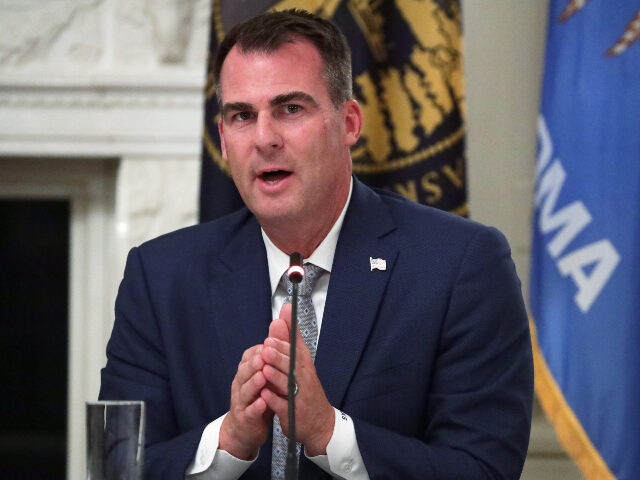

Oklahoma Gov. Kevin Stitt (R) signed a bill into law on Tuesday that criminalizes the distribution of abortion drugs.
House Bill 1168 makes providing abortion drugs to pregnant women who are seeking abortions a felony. A violation of the law carries a fine not exceeding $100,000 and ten years in prison, or both, the Journal Record reported. The law does not apply to drugs used to treat miscarriages and ectopic pregnancies.
The measure is expected to take effect on August 12. Oklahoma also already has a law restricting abortions except to save the life of the mother.
The bill’s sponsors include state Rep. Denise Crosswhite Hader, and state Sen. David Bullard, both Republicans.
“This bill is about protecting women from the horrible side effects of these pills,” Crosswhite Hader said in a press release. “It’s also to protect women from being taken advantage of by someone looking to personally profit from the distribution of these pills.”
Senate Minority Leader Julia Kirt (D) claimed the bill is largely political and will be used by Republicans on the campaign trail, Oklahoma Voice reported.
“We had a lot of speeches that were campaign prep speeches,” she said of the debate on the bill.
The new law comes as Louisiana battles the U.S. Food and Drug Administration in court over a Biden-era policy allowing abortion pills to be sent via mail in the wake of the Supreme Court’s Dobbs decision.
The pro-abortion Biden administration temporarily suspended the in-person requirement, which mandated a woman visit a healthcare provider to obtain the pills, in 2021 and made the change permanent in 2023 as an act of defiance after the Supreme Court overturned Roe v. Wade. The FDA’s mail-order scheme has enabled abortionists in blue states to mail abortion drugs into states with pro-life laws, and blue states have passed “shield laws” protecting abortionists from adverse legal action in red states.
The State of Louisiana, along with Rosalie Markezich — a woman who alleges her boyfriend was able to order abortion drugs online from California and coerce her into taking the pills — filed a lawsuit against the FDA in October 2025. The lawsuit argues that the FDA acted unlawfully by loosening safeguards around mifepristone and allowing it to be sent via mail, including violating the Administrative Procedure Act (APA).
Earlier this month, a three-judge panel of the U.S. Court of Appeals for the Fifth Circuit blocked the policy and issued a scathing rebuke of the FDA’s 2023 REMS action permanently removing the in-person requirement. The panel wrote that the Biden administration’s removal of the in-person requirement was an explicit attempt to undermine pro-life state laws in the wake of the Supreme Court’s Dobbs decision and pointed out that the FDA itself has now admitted the move is not backed by rigorous science.
The circuit court also found that Louisiana has standing to sue, is facing irreparable harm both legally and financially, and will likely succeed in its challenge on the merits.
The drug companies, Danco Laboratories and GenBioPro, appealed to the Supreme Court alleging imminent financial harm, and the High Court ultimately decided last week to allow the mail-order abortion policy to continue during litigation. Conservative Justices Samuel Alito and Clarence Thomas dissented.
The lawsuit will continue to play out in lower courts and may appear before the High Court again for further review.
In 2023, the Guttmacher Institute estimated that medication abortions accounted for 63 percent of all abortions within the formal U.S. healthcare system. That percentage was up from an estimated 53 percent in 2020 and 39 percent in 2017. The report did not account for abortion pills obtained through underground national and international networks, including those that send pills to women in states with abortion restrictions.
The pro-abortion organization estimated that 91,000 telehealth abortions were provided in 2025 under blue state shield laws to people in states with abortion restrictions.
In a medication abortion, mifepristone blocks the action of progesterone, which the mother’s body produces to nourish the pregnancy. When progesterone is blocked, the lining of the mother’s uterus deteriorates, and blood and nourishment are cut off to the developing baby, who then dies inside the mother’s womb. The drug misoprostol (also called Cytotec) then causes contractions and bleeding to expel the baby from the mother’s uterus.
Katherine Hamilton is a political reporter for Breitbart News. You can follow her on X @thekat_hamilton.
COMMENTS
Please let us know if you're having issues with commenting.