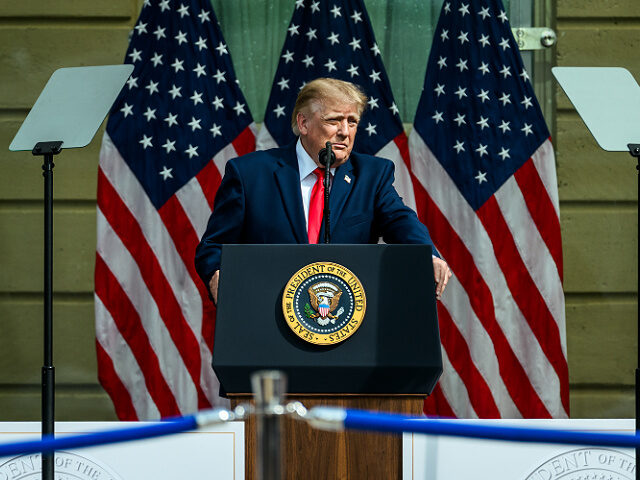

President Donald Trump said Wednesday that Iran has contacted the United States “directly” and “very much” wants a deal, expressing hope that the nearly seven-month conflict is approaching its end after predicting last week that the fighting would conclude following November’s midterm elections.
“Hopefully we’re toward the end of the war,” Trump told reporters after arriving in North Carolina, responding to a question about what phase the conflict had reached.
Trump then turned to the prospect of an agreement with Tehran.
“Iran is very much wanting to make a deal,” he said. “We’ll see how that works out.”
Asked moments later whether he had recently heard from Iran directly or through intermediaries, Trump replied: “Directly.”
The disclosure follows a series of increasingly explicit statements from Trump that the conflict could be approaching its end. Last week, he predicted the fighting would conclude following the November midterm elections, arguing that Tehran could no longer sustain the pressure.
“I think the war will end immediately after the election because they can’t hold out any longer,” Trump said.
By Monday, Trump was publicly describing Tehran as actively seeking an agreement while leaving the decision over renewed engagement to Washington.
“The failing Nation of Iran wants to make a deal, quickly and badly,” Trump wrote on Truth Social. “I will determine whether or not the U.S.A. will choose to engage — the concept of which we are open to.”
Vice President JD Vance reinforced that emerging end-state Tuesday, declaring the “first phase” of the U.S. campaign complete and saying the conflict would enter a “much different phase” within months as Washington shifts toward preventing Tehran from rebuilding the capabilities destroyed since fighting began Feb. 28.
“There are really two phases to this thing, and the first phase is done,” Vance said.
Vance described the opening phase as the destruction of Iran’s nuclear program and the severe degradation of its conventional military and ability to project power.
The next task, he explained, is to “ensure that they’re not able to rebuild and try to maintain as much global stability in the wake of that.”
Vance also backed Trump’s assessment that the conflict could change substantially following the midterms, while emphasizing that the president will ultimately determine when the campaign ends.
“We can’t predict the future, but I think the president is right to say that this thing will enter a much different phase in a couple of months,” Vance said. Trump, he added, “is the person who determines … when conflicts start and when they stop.”
The administration is already preparing for what could follow the current phase of the conflict. Trump is expected to meet with Gulf leaders on the sidelines of the United Nations General Assembly in New York next Tuesday to discuss the next steps in the war, Axios reported Wednesday, citing three sources with direct knowledge.
The meeting is expected to include discussions of U.S. ideas for a postwar strategy as Trump and his senior team develop a “day-after” plan expected to be finalized following the midterm elections, according to the outlet. The State Department sent initial invitations Wednesday to leaders or foreign ministers from Saudi Arabia, the United Arab Emirates, Qatar, Bahrain, Kuwait and Oman, with the gathering potentially expanding to other Arab and Muslim countries.
The diplomatic signals come as Washington continues applying military and economic pressure aimed both at preventing Tehran from rebuilding its military capabilities and further isolating the regime from the global economy.
CENTCOM spokesman Capt. Tim Hawkins said Wednesday that internationally recognized shipping lanes through the Strait of Hormuz remain free of mines, with U.S. forces staying “present and watchful” to keep them clear.
“The strait is open, those lanes are open, and that is why commercial vessels continue to flow through them,” Hawkins said, describing the U.S. blockade against Iran as “ironclad.”
CENTCOM said Tuesday that U.S. forces had redirected 103 commercial vessels under the blockade, while Hawkins said Wednesday that the military has helped facilitate commercial traffic carrying more than 900 million barrels of crude through Hormuz since early May.
Washington is simultaneously tightening its effort to cut Tehran off financially. Treasury on Wednesday convened global financial institutions under Operation Economic Outcast, providing them information aimed at shutting down revenue streams and procurement networks tied to the Iranian regime.
“Treasury continues to sever every economic lifeline Tehran has left,” Treasury Secretary Scott Bessent said, adding that financial institutions were working “in lockstep with the U.S. government” to support the campaign.
Treasury said its collaboration with the private sector is intended to ensure there is “no space for the Iranian regime to rebuild its capacity” to threaten the United States and the wider world.
Even as Trump increasingly points toward an end to the fighting, he has made clear that any agreement with Tehran would extend well beyond the nuclear restrictions Washington sought before the conflict.
“I’m doing much more than a nuclear deal,” Trump said last week. “There’s a lot more than nuclear.”
Trump said additional demands would now be on the table, which Washington had not been pursuing three months earlier, underscoring how dramatically the terms of any renewed diplomacy have shifted after nearly seven months of U.S. military and economic pressure.
Joshua Klein is a reporter for Breitbart News. Email him at jklein@breitbart.com. Follow him on Twitter @JoshuaKlein.
COMMENTS
Please let us know if you're having issues with commenting.