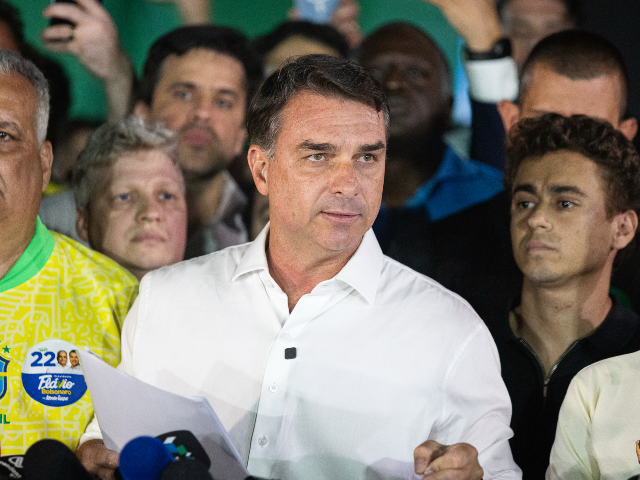

Sen. Flávio Bolsonaro published a letter on Wednesday night, deleted and edited twice thereafter, in which he addressed his departure from Brazil after losing Sunday’s presidential election, declaring himself the victim of a “witch hunt” and insisting he had not abandoned his country.
Sen. Bolsonaro won the first round of the presidential election this year against incumbent socialist President Luiz Inácio Lula da Silva, a surprise relative to polling expectations, in early October, but Lula was declared the victor on Sunday by a wide margin. Bolsonaro and his conservative camp have denounced irregularities in the race, in particular condemning the unprecedented and unconstitutional decision by a justice on the Supreme Federal Tribunal (STF), the nation’s top court, to extend voting by two hours.
Polling stations should have closed by 5 p.m. local time, and most did, but a few minutes after 5, Justice Cristiano Zanin ordered stations to remain open through 7 p.m.. Only polling stations that had disobeyed the established procedures were able to remain open, as the technology used in the elections does not allow closed polling stations to reopen.
The order was given in response to complaints in the nation’s northeast, Lula’s traditional stronghold, of transportation issues for voters. Cristiano Zanin had served as Lula’s personal defense lawyer before he was appointed to the STF.
Just hours after Sen. Bolsonaro refused to concede the election, citing the irregular STF situation, another STF justice, the notorious Alexandre de Moraes, issued an order demanding Bolsonaro hand over his passport, citing an alleged financial investigation into the senator. Sen. Bolsonaro then disappeared, issuing two videos on social media but not appearing in public, before reports confirmed that he had refused to hand over his passports and had escaped, first to Argentina, then Ecuador, and ultimately to Miami, Florida.
From Florida, the senator published a letter on his social media accounts explaining his position: he rejects the results of the election, refers to himself as the “leader” of Brazil, and compares himself to legendary historical figures such as France’s Charles de Gaulle, Cuban founding father José Martí, and Venezuelan Nobel Peace Prize winner María Corina Machado, who notably returned to Venezuela this weekend after struggling to come home for months.
In the first iteration of the letter, Sen. Bolsonaro referred to himself as “president-elect” of Brazil, a phrase he deleted from subsequent copies of the letter. The Bolsonaro camp has not explained the reason for this change at press time.
“I address the Brazilian people and international community as the leader of Brazil,” the final form of the letter began.
The letter begins with a statement of gratitude for President Javier Milei of Argentina, who reportedly offered the senator personal support to escape Brazil, and for President Donald Trump, who has reportedly offered Sen. Bolsonaro and his family political asylum.
“President Trump is a great defender of the freedom of expression,” Sen. Bolsonaro declared.
Regarding the election, Bolsonaro denounced “repugnant electoral fraud” and addressed the situation with the extending of vote times by Justice Zanin, describing it as a grave legal violation “that justifies the nullifying of the Lula-Alckmin ticket” (Gerald Alckmin is Lula’s vice presidential running mate). This claim reiterated Sen. Bolsonaro’s statement prior to his departure that he would seek to organize an effort to find Lula unfit to hold the presidency as a result of the Supreme Court situation and other irregularities, such as the alleged use of government funds for his campaign.
He also observed that the STF began demanding his passports to prevent him from leaving the country seven minutes after the election results were confirmed, explaining that this persecution necessitated his exit from the country. Sen. Bolsonaro compared his situation to that of other opposition leaders and political figures throughout history:
Rui Barbosa went into exile for confronting Floriano Peixoto and from there continued to defend the rule of law and liberty. Charles de Gaulle led a free France via London, condemned to death by the Vichy regime, and returned to free his country. José Martí organized the struggle for the independence of Cuba from New York. In Venezuela, Juan Guaidó and Edmundo González had to leave their country for facing the chavista dictatorship, and María Corina Machado, persecuted in the same way, refused to legitimize fraud and became a global symbol of democratic resistance. They were all treated as criminals by the regimes they confronted. History called them something else.
Sen. Bolsonaro also repeatedly insisted he had not fled the country, nor that he was withdrawing from Brazilian politics.
“I want to leave clear: I did not flee Brazil, I left Brazil,” he asserted. “I left an exceptional [irregular] regime to be able to be the leader my people deserve, as silenced, imprisoned, and censored, as my father is, I would not be able to offer that leadership and we would be subject to the institutional theater of a castrated opposition controlled by a Supreme Court full of regime servants.”
“It was not my intention to leave my country, but I know exactly where this is going,” the letter explained. “This is the classic manual for any coup d’etat.”
“The political persecution that began with my father, ex-president Jair Bolsonaro, and was expanded to thousands of other patriotic everyday Brazilians and even American citizens, has only one objective: to silence any person who does not agree with the exceptional regime installed in Brazil through a Supreme Court backed by the criminal Workers’ Party organization,” he continued.
Sen. Bolsonaro concluded with a request to the international community: “don’t normalize what is happening in Brazil. What is going on today in my country is not normal and cannot be treated as normal.”
He also asserted to conservatives in Brazil that he remained the leader of the Brazilian opposition, an apparent attempt to ensure that other popular conservatives in the country do not attempt the fill the void that he leaves in the country.
“I will lead the opposition from here. I will say what you, over there, cannot say, and will assume the risks that you cannot,” Sen. Bolsonaro promised.
In the United States, Sen. Bolsonaro joins his brother, former Chamber of Deputies lawmaker Eduardo Bolsonaro, who has been exiled in America since March 2025 after the Lula government threatened criminal action against him for the vague charge of “crimes against sovereignty.”
COMMENTS
Please let us know if you're having issues with commenting.