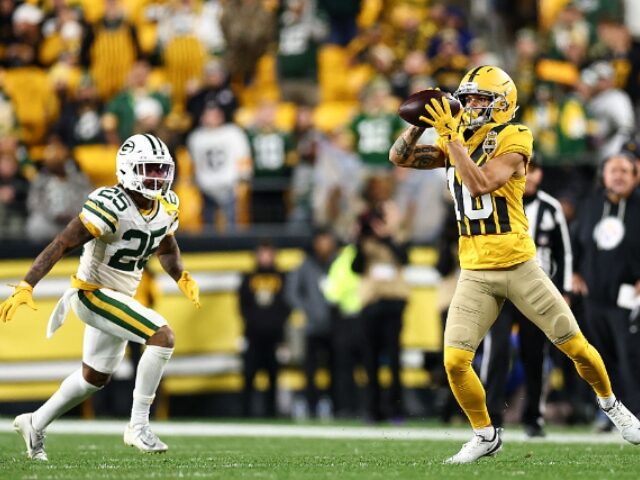

The Packers-Steelers game seemed all but settled in the final moments of the fourth quarter Sunday night, with the only notable remaining photo-op being the exchange of handshakes after Green Bay thoroughly humbled their former signal-caller, Aaron Rodgers.
But it turns out something quite significant was yet to come.
With the Packers ahead 35-19 and the Steelers driving in a last-ditch attempt to tie the score, Rodgers connected with second-year wide receiver Roman Wilson on what appeared to be a touchdown catch. However, the pass was ruled incomplete after Packers corner Carrington Valentine managed to knock the ball loose.
This surprised some, since Wilson had control of the ball with two feet down and took an additional step. Still, it was a bang-bang play, and the refs ruled it incomplete.
But that call would not stand.
NFL replay assist came in almost immediately after the ruling of incomplete and reversed the call, making it a catch and a touchdown for the Steelers.
After the play, NBC color commentator Cris Collinsworth had the question most of us had: What are the rules for using replay assist versus a team having to challenge a play on the field?
NBC rules analyst and former referee Terry McAulay attempted to explain.
“So on that play it was objectively clear and obvious without any further analysis that it was a touchdown because he got the control, two feet down, took an additional step,” McAulay said.. “On the line feed, we can see it was a touchdown. So, replay assist, that’s when they can come in and review it immediately and fix it.”
Speaking again on behalf of bewildered fans everywhere, Collinsworth pressed McAulay on the confusion among fans and the media about how the NFL is using replay assist.
“Terry, would you grant me it’s hard to understand what the difference is, and the blurring of the line sometimes comes down to plays,” Collinsworth continued. “Is this an evolving art or do we actually have hard and fast rules here?”
McAulay answered, “It’s evolving and they’ve gotten better with it, being more consistent with it. One of the key things I said was ‘without further analysis.’ If they’ve got to go on and look at several different angles … they’re not going to assist. Plays like this that can be done really very quickly with just minimal analysis, that’s where they’re going to go and replay assist, and it needs to be objective.”
On the face of it, this seems like a satisfying answer until you realize that it’s absolutely not true.
If the league is only to intervene in plays that don’t require “further analysis,” then where was the league earlier in the day when the referees in the Giants-Eagles game made an egregious and obvious mistake in ruling Eagles quarterback Jalen Hurts’ forward progress stopped, and negating a clear fumble?
Jalen Hurts was clearly fighting for extra yards, and his forward progress was not stopped. That play required no further review and was immediately obvious to anyone who has been watching football for more than eight minutes.
Yet, where was the league? Why didn’t they intervene?
McAulay says the league needs to be “objective” in the application of replay assist. Yet, the two most prominent examples of replay assist impacting games this year have come on Sunday Night Football. Last night’s touchdown to Roman Wilson and Jared Goff’s negated touchdown against the Chiefs a few weeks ago. Unless the Sunday night shift at the NFL replay office has itchy trigger fingers, it sure seems like the league is using replay assist pretty aggressively during primetime games, which is not objective.
Not to mention, the touchdown to Wilson came before the two-minute warning, meaning it fell outside the time period where all scoring and change-of-possession plays fall under automatic review. The Steelers had no timeouts and no challenges remaining.
So, the league basically jumped in and did the Steelers a massive solid.
Cynics would say the league didn’t want to lose viewers in the final minutes of the game and intervened to give the Steelers a chance with two minutes left. I don’t know if I track with that all the way, but there is something very, very fishy about it, and questions need to be asked about whether replay assist should be applied before the two-minute warning when the team in question has no timeouts and no challenges.
Collisnworth asked whether there are hard-and-fast rules regarding replay assist. McAulay essentially said no. We need some hard-and-fast rules.
COMMENTS
Please let us know if you're having issues with commenting.