
A growing number of organizations around the world are working to establish a widely recognized certification system for products and services created without artificial intelligence, as concerns mount over AI’s impact on creative industries and employment.
BBC News reports that at least eight different initiatives are currently developing labels to identify human-made content, according to a count by BBC News. These declarations, which include phrases such as “Proudly Human,” “Human-made,” “No AI,” and “AI-free,” are increasingly appearing on films, marketing materials, books, and websites as part of a broader response to concerns about job displacement through AI-powered automation.
The proliferation of competing certification systems has raised concerns among experts about potential consumer confusion. Dr Amna Khan, a consumer expert from Manchester Metropolitan University, emphasized the need for standardization. “AI is creating significant disruption and competing definitions of what is ‘human made’ are confusing consumers,” Khan told BBC News. “A universal definition is essential to build trust, clarification and confidence.”
The movement toward AI-free certification has emerged as generative AI tools have begun replacing human work across multiple industries, including fashion, advertising, publishing, customer service, and music. Organizations developing these labels include both commercial companies and non-profit entities based in the United Kingdom, Australia, and the United States. One way the designation could serve consumers is to avoid “AI Slop,” the poorly done AI content flooding platforms like YouTube.
Current certification systems vary significantly in their implementation and rigor. Some platforms, such as no-ai-icon.com, ai-free.io, and notbyai.fyi, allow users to download labels either free of charge or for a fee with minimal or no verification process. Other systems, like aifreecert, require payment and employ strict vetting procedures that use professional analysts and AI-detection software to verify whether products have incorporated AI technology.
However, establishing clear standards for what qualifies as “human made” presents significant technical challenges. AI Research Scientist Sasha Luccioni explained the complexity of the issue. “AI is now so ubiquitous and so integrated into different platforms and services, that it’s truly complicated to establish what ‘AI free’ means,” Luccioni said. “From a technical perspective, it’s hard to implement. I think that AI is a spectrum, and we need more comprehensive certification systems, rather than a binary with AI/AI-free approach.”
Some advocates propose focusing certification specifically on generative AI technologies—systems that create text, code, music, or video based on human prompts. The 2024 thriller Heretic, starring Hugh Grant, included a disclaimer in its closing credits stating that no generative AI was used in the film’s production.
Building on this approach, film distributor The Mise en scène Company recently added a “No AI was used” stamp to promotional materials for its latest release, which was written, directed, and edited primarily by a single individual. The distributor has also published its own classification system online, hoping to establish an industry standard. CEO Paul Yates explained the company’s position: “We support the AI industry and we think its an exciting time but we think that as a result of AI content there is an economic premium put on human-made content and we want to lean into that.”
The creative industries have become a particular focal point for AI-related concerns, as entire books and films can now be produced using AI technology far more quickly and cheaply than traditional methods. Some companies, like Bollywood film studio Intelliflicks, openly specialize in creating AI-generated films. However, other AI-generated content does not always disclose its origins to consumers, as demonstrated by last year’s case of the viral band Velvet Sundown, which was later revealed to be entirely AI-created.
In the publishing sector, major publisher Faber and Faber has begun placing a “Human Written” stamp on select titles. Author Sarah Hall requested this designation for her novel Helm, describing the use of books to train AI models as “creative larceny at scale.” However, Faber has not publicly disclosed its criteria for classifying books as “Human Written” or detailed its auditing procedures.
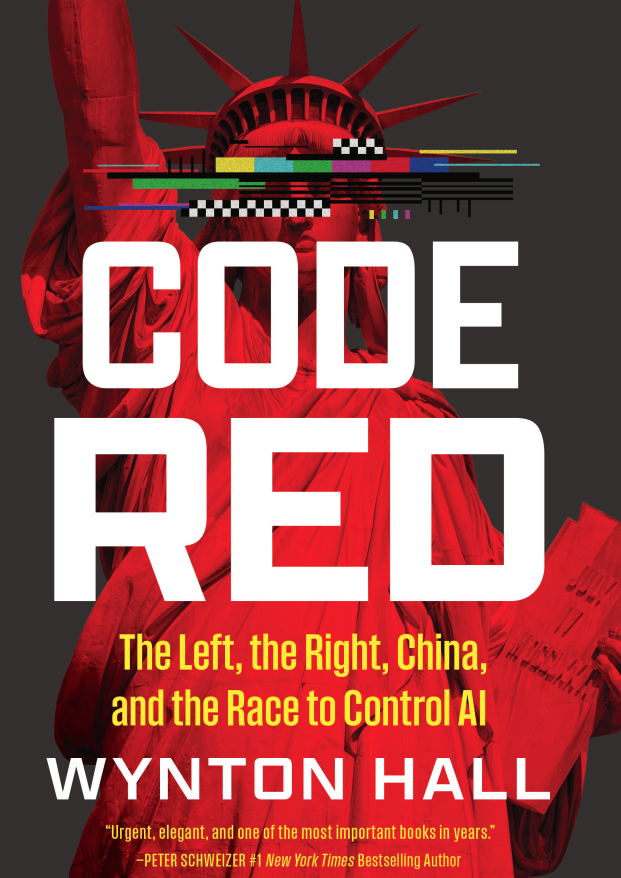
Breitbart News social media director Wynton Hall has written his forthcoming book, book Code Red: The Left, the Right, China, and the Race to Control AI, to serve as the definitive guide on how the MAGA movement can create positions on AI that benefit humanity without handing control of our nation to the leftists of Silicon Valley or allowing the Chinese to take over the world. One crucial component of the book is how AI will impact work for everything from accountants to movie stars
Senator Marsha Blackburn (R-TN), who was named one of TIME’s 100 Most Influential People in AI, praised Code Red as a “must-read.” She added: “Few understand our conservative fight against Big Tech as Hall does,” making him “uniquely qualified to examine how we can best utilize AI’s enormous potential, while ensuring it does not exploit kids, creators, and conservatives.” Award-winning investigative journalist and Public founder Michael Shellenberger calls Code Red “illuminating,” ”alarming,” and describes the book as “an essential conversation-starter for those hoping to subvert Big Tech’s autocratic plans before it’s too late.”
Read more at BBC News here.
Lucas Nolan is a reporter for Breitbart News covering issues of free speech and online censorship.
COMMENTS
Please let us know if you're having issues with commenting.