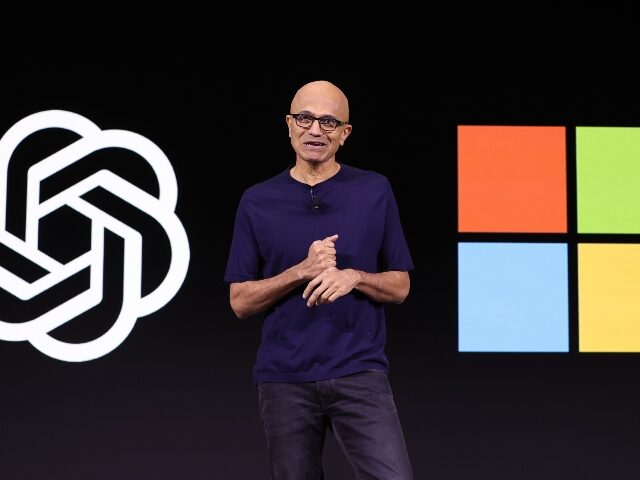

Microsoft spent years telling regulators it was just an investor in OpenAI, but a federal judge has now cleared the way for a jury to decide whether the company was secretly running the show — and whether its own executives knew the arrangement was unlawful before the first dollar ever moved.
When Satya Nadella was interviewed by Kara Swisher in November 2023, just after OpenAI’s board had fired and rehired Sam Altman over a single weekend, the Microsoft CEO was in a boastful mood. Asked about his company’s relationship with the world’s most valuable AI startup, he offered a quip that has haunted his lawyers ever since: “We are in there. We are below them, above them, around them.”
Thanks to a federal judge’s ruling in the blockbuster Musk v. Altman trial, a jury is going to weigh whether Nadella’s remarks were just swagger, or if he actually meant what he said.
For years, Microsoft has stated publicly to regulators and Congress that it is merely an investor and commercial “partner” of OpenAI, not an owner. The unsealed record in Elon Musk’s lawsuit, which proceeded to trial last week, tells a sharply different story, one that gets to the heart of Musk’s allegation that OpenAI violated the integrity of nonprofit laws.
In March 2018, Altman approached Microsoft about converting OpenAI from a nonprofit into a for-profit venture. That same day, Microsoft Chief Technology Officer Kevin Scott emailed Nadella with a candid warning: “I wonder if the big OpenAI donors are aware of these plans? Ideologically, I can’t imagine that they funded an open effort to concentrate ML [machine learning] talent so that they could then go build a closed, for-profit thing on its back.”
Scott essentially told Nadella in writing that the planned agreement would violate the trust of those who contributed millions to OpenAI based on the belief that their contributions would benefit humanity, not Microsoft. Sixteen months later, Microsoft invested $1 billion anyway. Musk’s attorneys placed the Scott email at the top of their summary judgment brief, the position lawyers reserve for their most damaging exhibit.
Things gets worse for Microsoft. Days before the first investment closed, CFO Amy Hood emailed Nadella regarding OpenAI’s much-hyped “capped profit” structure: it was “not terribly constraining nor terribly altruistic if made transparent,” she wrote.
The company then insisted the actual numbers be kept out of any public announcement. By October 2020, Nadella was holding internal meetings about whether Microsoft was “effectively owning” a charity. Executives asked themselves whether it was lawful. They proceeded anyway.
The contractual terms speak for themselves. According to a footnote in a January court filing, the 2019 deal gave Microsoft the right to terminate the entire arrangement if OpenAI replaced its CEO, a financial weapon pointed at the board if it ever tried to fire Altman. The 2021 amendment added a veto over open-sourcing and embedded Microsoft personnel inside the company. The 2023 deal handed Microsoft rights to virtually all of OpenAI’s intellectual property and approval over major structural decisions. This is not the behavior of typical passive investors.
Then came the November 2023 board crisis, the clearest evidence of Microsoft’s real intentions. When OpenAI’s directors fired Altman on a Friday, Microsoft built a $25 billion subsidiary in a single business day, ready to absorb Altman, his co-founder, and the entire OpenAI workforce. Nadella personally compiled lists of replacement directors. Within 96 hours, the board reversed itself. The two safety-minded directors who had tried to enforce the charity’s mission, Helen Toner and Tasha McCauley, were forced out. Both later testified under oath that Microsoft’s commercial pressure was a factor in the firing. That’s commonly referred to as a hostile takeover. But unlike typical hostile takeovers, this one happened without the pesky inconvenience of a tender offer.
Then, there’s leftist billionaire Reid Hoffman, who sat on both Microsoft’s and OpenAI’s boards from 2019 to 2023, voting on Microsoft-OpenAI agreements from his OpenAI seat. Hoffman initially submitted a sworn declaration claiming he had abstained. He later filed a corrected declaration admitting that he hadn’t. The billionaire who devotes his time and fortune to extreme leftist causes has not faced a perjury accusation as of this writing.
The FTC, under Republican Chairman Andrew Ferguson, has escalated its own Microsoft probe, issuing civil investigative demands to Microsoft’s competitors as recently as February. The Justice Department, the European Commission, and Britain’s Competition and Markets Authority have parallel inquiries. All have access to the same unsealed discovery.
Microsoft’s defense is that it was a passive investor that knew nothing about any breach of duty. The record contains an email from its own CTO to its own CEO flagging that breach in writing before the first dollar moved, internal notes asking whether the arrangement was lawful, contracts handing Microsoft control over CEO succession, sworn testimony from former directors, and a 96-hour campaign that reversed a board decision and replaced its safety hawks with friendlier faces.
A jury will have to be persuaded that Microsoft did not know what its own executives put in writing they knew, one of many facets of the fight over the future of AI playing out in court this month.
Lucas Nolan is a reporter for Breitbart News covering issues of AI, free speech, and online censorship.
COMMENTS
Please let us know if you're having issues with commenting.