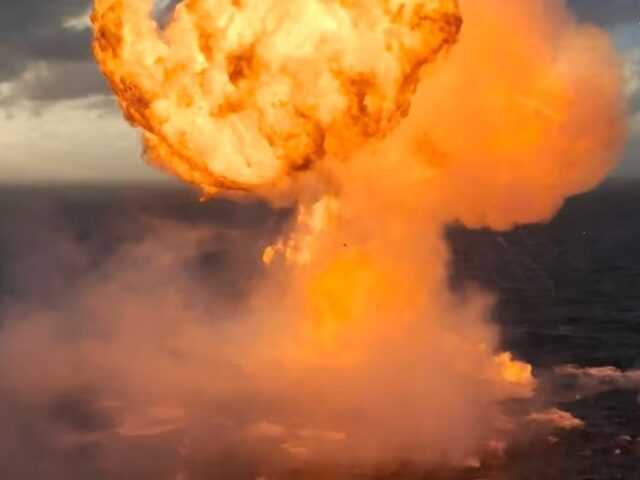

Elon Musk’s SpaceX claimed a successful launch of its newest Starship variant on Friday evening, overcoming significant engine malfunctions to achieve its intended landing destination in the Indian Ocean. The test flight ended with a massive fireball as the spacecraft tipped into the water off Australia’s western coast, an explosive finale the company said was expected to occur.
The Orlando Sentinel reports that the debut flight of SpaceX’s Version 3 Starship lifted off just after 6:30 p.m. from the company’s Starbase facility in Texas on Friday. The mission experienced complications shortly after liftoff when the upper stage, designated Ship 39, separated from its Super Heavy booster with one engine failing to activate. The booster itself encountered more severe problems, with all 33 of its Raptor engines shutting down prematurely after separation. This forced an unplanned high-speed crash into the Gulf of Mexico rather than the intended controlled landing.
“We’ve definitely got a ship in space right now,” said SpaceX commentator Dan Huot. “I wouldn’t call it a nominal orbital insertion … but we’re on a trajectory that we had analyzed, and it’s within bounds.” Despite the engine issues, Ship 39 continued its journey through space using its remaining five engines, which burned slightly longer than originally planned to compensate. The spacecraft coasted for over an hour before reaching the Indian Ocean landing site, where it successfully hovered above the water for several seconds before tipping over and exploding as expected.
“That ball of fire was exactly what we wanted to see for the ship today as weird as it may sound,” said SpaceX commentator Kate Tice. The explosive conclusion, similar to previous test flights, generated enthusiastic cheers from SpaceX employees watching from Texas. The unexpected engine failure meant Ship 39 retained more propellant than anticipated during landing, contributing to a more spectacular explosion. SpaceX founder Elon Musk congratulated the launch teams on social media platform X, calling it “an epic first Starship V3 launch & landing! You scored a goal for humanity.”
This test flight represented the first launch attempt for Version 3 of the Starship system and marked the twelfth suborbital test flight overall. The launch had been delayed one day from its original Thursday schedule due to a hydraulic pin malfunction that prevented a launch tower arm from retracting. Technical teams successfully resolved the issue overnight.
During the flight, the upper stage successfully deployed 20 Starlink satellite simulators and two specialized satellites designed to capture video scans of the heat shield. The deployment generated applause from gathered SpaceX employees. “Pew, pew. Two down, 20 to go,” Huot said as the satellites were released.
SpaceX conducted several experimental tests during the mission, including deliberately removing a single heat tile to measure stress on adjacent tiles during flight. The company also tested grid fin and flap maneuvers to stress the vehicle during reentry. “We want to test out these maneuvers, these principles prior to actually bringing the hardware back to the pad,” Tice said. “This is the same reason why we were intentionally not trying to bring the booster back to the pad, so we’re trying all these things out in this developmental phase of the vehicle, and really proving what a test flight is.”
Read more at the Orlando Sentinel here.
COMMENTS
Please let us know if you're having issues with commenting.