

This morning’s key headlines from GenerationalDynamics.com:
- Greece asks for ‘Air to Breathe’ in austerity requirements
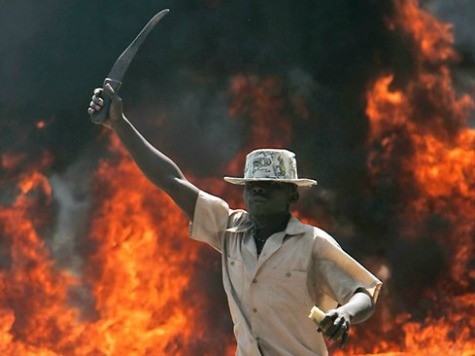
- Ethnic Bloodbath in Kenya kills 62 people, mostly women and children
- France’s Hollande breaks campaign promise, ejects Roma Gypsies
Greece asks for ‘Air to Breathe’ in austerity requirements
Greece’s Prime Minister Antonis Samaras said in an interview onWednesday that Greece didn’t want any money but just wanted a littlemore time to meet its commitments:
Let me be very clear: we are not asking for extramoney. We stand by our commitments and the implementation of allrequirements. But we must encourage growth, because that reducesthe financing gaps.
All we want is a little ‘air to breathe’ to get the economy goingand increase state income. More time does not automatically meanmore money.
Greece plans to ask for a two-year extension on meeting itsausterity commitments, and the problem for him is that this WILLmean more money — an extra 20 billion euros because Greece won’tbe reducing its debt fast enough.
Eurogroup finance chairman Jean-Claude Juncker met with Samarasin Athens on Wednesday, and said that it was the speculators’ fault,not Greece’s fault, that Greece was in trouble:
I am coming to Greece as a friend…The truth is Greece is suffering from a credibility crisis. Thefirst step should be to show Greece is taking fiscal consolidationseriously.
As far as the immediate future is concerned, the ball is in theGreek court. In fact this is the last chance and Greeks have toknow this.
The Juncker statement was very cordial, but it more or lesscontradicted Samaras’ statement. “Air to breathe” would mean atwo-year delay in meeting its commitments, and that request would betaken by the Germans as meaning that Greece is not “taking fiscalconsolidation seriously.” Samaras will be visiting Paris on Fridayand Berlin on Saturday to beg. AP and Kathimerini
Ethnic Bloodbath in Kenya kills 62 people, mostly women and children
At least 62 people, including 11 children and women, were massacredTuesday night in an ethnic bloodbath in southeastern Kenya. Visitorsdescribed scenes as similar to mass murders of the Great Lakes region,with mutilated bodies of children and women, old and young, strewnacross homesteads, their blood caked on the ground, and flies flyingall over. Nominally, this was a conflict of a type that occurs in allcountries, between farmers who plant crops and fence off their landand pastoralists (cattle herders) who want their cattle to grazefreely. In the 1800s, this was a battle in the United States, asdepicted in the 1941 Rodgers and Hammerstein Broadway musical,should be friends!”
But in Kenya, the conflict has taken on a much deadlier dimension.The ethnic Pokomo tribe of farmers attacked the pastoralist Ormas,burning down entire villages, killing people at random, as well as thecattle. This was a revenge attack for a small attack ten days ago,when the Orma herdsmen attacked Pokomo villagers. This has revivedfears of an all-out tribal war in Kenya, the same fears that arosein December 2007, when widespread ethnic violence broke out acrossthe country, following an election.
From the point of view of Generational Dynamics, Kenya’s lastgenerational crisis war was the Mau-Mau Rebellion that climaxed in1956. When the 2007 uprising occurred, I wrote that only 51 years had passed, so a new crisiswar at that time was possible but very unlikely. As each year goesby, and there are fewer and fewer people left from the generationsthat survived the previous crisis war, a new crisis war becomes morelikely. Today we’re at the 55-year point, so a new crisis war is morepossible today than in 2008. An analysis of hundreds of previouscrisis wars in history reveals that a plurality of them occur at the58 year point. Standard Media (Kenya)
France’s Hollande breaks campaign promise, ejects Roma Gypsies
France’s Socialist president François Hollande promised, during theelection campaign, to stop the policy of ejecting Roma Gypsies fromillegal, squalid camps in France that former president Nicolas Sarkozyhad followed. Sarkozy came under severe criticism across Europe forthe harsh policy, which put Roma Gypsies out on the street with noplace to live. Hollande promised that the Roma would not be ejectedunless an alternative place to live were provided, but he is breakingthat promise and human rights groups are expressing outrage. AFP
Permanent web link to this article
Receive daily World View columns by e-mail
COMMENTS
Please let us know if you're having issues with commenting.