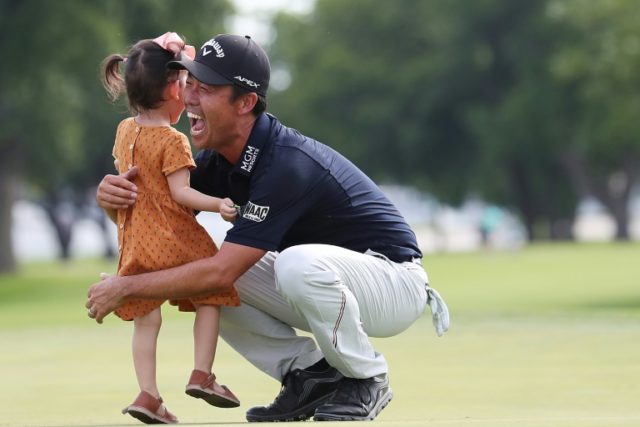

Los Angeles (AFP) – Kevin Na fired a final-round 66 at Colonial Country Club on Sunday to win the US PGA Tour’s Charles Schwab Challenge by four strokes over fellow American Tony Finau.
Na continued his mastery of the classic course in Fort Worth Texas, starting the day with a two-shot advantage that was never really challenged.
Na’s six birdies included a 33-footer at the fourth and a 20-footer at the eighth.
He rolled in a 12-footer at the 72nd hole to cap his four-under par round with a birdie for a 13-under total of 267.
“It feels great,” said Na, who celebrated with his toddler daughter, Sophia, in his arms.
Na, 35, boasts an impressive record at Colonial, where he thrust himself into contention with a second-round 62. That was his third score of 62 or better on the course, where he matched the record of 61 on the way to a fourth-place finish last year.
He said he eyed the club’s “wall of champions” on the first tee Sunday, “and in my head I engraved my name on it.
“Every year I come here I know I had a chance to win and I knew before my career was over I was going to definitely win here,” added the South Korean-born American, who believes the compact course is one of “seven or eight” that offer him a chance to win on the US tour without a big-hitting game.
Finau, who was among a group of five players to start the round two shots behind Na, moved within one shot of the leader with his birdie at the second.
He was two adrift on the back nine but the gap widened when Na birdied 14 and Finau bogeyed 16.
Finau finished with four birdies and two-bogeys in a two-under 68 for 271.
It was a further stroke back to American Andrew Putnam (66) and Taiwan’s Pan Cheng-tsung (69).
Local favorite Jordan Spieth, who also started the day two off the lead, couldn’t maintain his hot streak on the greens.
He closed with a two-over par 72 that left him eight back and still in search of his first victory since he captured his third major championship at the British Open in 2017.
COMMENTS
Please let us know if you're having issues with commenting.