
Unknown gunmen opened fire “indiscriminately” in a residential area of Jos, Plateau State, Nigeria on Sunday night, killing an estimated 30 people during a time in which jihadists in the country tend to orchestrate massacres against Christians.
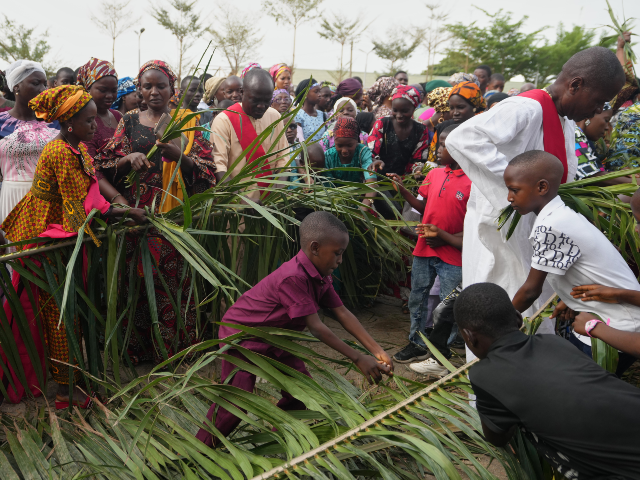
Christians around the world marked Palm Sunday this week, the first day of Holy Week and a holiday that observes the arrival of Jesus to Jerusalem shortly before his crucifixion. Religious freedom advocates, witnesses to jihadist violence, and researchers have compiled years of evidence indicating that groups such as Boko Haram, the Islamic State, and the Fulani jihadists more common in the Middle Belt of Nigeria tend to stage massacres during or near the holiest Christian holidays.
Reports at press time on the number of people killed by this latest attack are mixed. Nigerian newspapers, often hesitant to identify Islamist terrorists as the attackers in these cases, referred only to “gunmen” on motorcycles as the suspects. Eyewitnesses reportedly differed on whether they believed the killers to belong to Boko Haram, a Sunni jihadist terror organization most active in the nation’s northeast, or the Fulani terrorists. Plateau state is in Nigeria’s Middle Belt, where the majority-Muslim north of the country meets the majority-Christian south, and the site of decades of jihadist atrocities against indigenous Christians in the area.
The incident took place in the Agwan Rukuba community of Jos.
“Eyewitnesses told our correspondent that the attackers, who rode on motorcycles, invaded the community around 7:30 pm, while people were going about their normal businesses, firing bullets indiscriminately and causing panic among residents,” the Nigerian newspaper Daily Trust reported.
Police officials reportedly documented 14 deaths in the attack, according to the Nigerian newspaper Vanguard. Local leaders told the newspaper, however, that the death toll was likely much higher. As of Monday morning local time, Vanguard reported that Barr Dalyop Solomon Mwantiri, President of the Berom Youth Moulders Association (BYM), estimated at least 27 deaths.
International Christian Concern (ICC), a global humanitarian aid group, reported that the attack killed at least 30 people, according to its sources on the ground.
“The incident occurred during the evening, when armed men reportedly entered the community and opened fire on residents. Eyewitnesses described the attack as coordinated, with multiple casualties recorded and several homes affected,” ICC noted.
The humanitarian group noted that, while local media only reported the presence of “gunmen” and identified neither the attackers nor the victims or potential reasons for the attack, a humanitarian worker on the group published a video on the social media site Facebook explicitly describing the attack as an Islamist attack on Palm Sunday targeting Christian.
The worker, Alex Barbir, appears in the video before a fire at nighttime, accusing President Bola Tinubu, who has denied the existence of any discrimination in the country, of ignoring the genocidal targeting of Christians by Islamist groups. He referred to the victims as “innocent Christians.”
“Tinubu where are you as your people are slaughtered in the night… you allow your people to be killed again and again and again and again,” he asserts.
Other outlets also published videos of the chaos at night as the gunmen opened fire, apparently shooting at anyone they could target. As the massacre occurred at night, the footage is difficult to follow.
The governor of Plateau state, Caleb Mutfwang, visited Angwan Rukuba on Monday, entering the area in an armored tank. His government imposed a 48-hour curfew and announced that it would pay the medical bills for all those injured.
“I assure you that those responsible for this evil act will not go unpunished. My administration will pursue justice relentlessly until the perpetrators are brought to book,” he declared.
“I call on all citizens, our traditional rulers, religious leaders, and community stakeholders to work with us,” Mutfwang stated in a message on social media that did not mention religious identity. “Security is a shared responsibility, and together, we must rise above division and confront this challenge with unity and resolve.”
While he did call the attacks “barbaric,” Mutfwang’s condemnation was more muted than last year, when jihadists killed over 60 Christians as Holy Week began. At the time, Mutfwang referred to the violence as a “genocide;” locals identified the attackers as Fulani jihadists.
Christian persecution experts and human rights activists have for years identified Nigeria as the deadliest place in the world to practice the faith.
“Across Nigeria in recent years, on average there have been 8 violent attacks per day. The Middle Belt, particularly Benue and Plateau state, continues to experience frequent deadly attacks,” Ryan Brown, the CEO of the Christian aid organization Open Doors, told Breitbart News in November.
“From April 2023 to January 2024, there were 98 attacks on Christian villages in Mangu LGA Plateau state alone, causing significant loss of life and property,” he explained at the time. “This past Easter, at least 43 people were killed in Bassa LGA. In June 2025, Christian communities in Guma LGA in Benue state are reported to have faced at least six attacks between 8 and 14 June, which left more than 218 dead and thousands displaced.”
President Donald Trump placed Nigeria on the State Department’s list of Countries of Particular Concern (CPC) for religious freedom on October 31, citing the ongoing massacres of Christians by jihadist terrorists.
“Christianity is facing an existential threat in Nigeria. Thousands of Christians are being killed. Radical Islamists are responsible for this mass slaughter,” he said in his announcement of the CPC designation. “The United States cannot stand by while such atrocities are happening in Nigeria, and numerous other Countries. We stand ready, willing, and able to save our Great Christian population around the World!”
Trump approved airstrikes on jihadist groups in the country on Christmas Day 2025, in conjunction with the government of President Bola Tinubu.
COMMENTS
Please let us know if you're having issues with commenting.