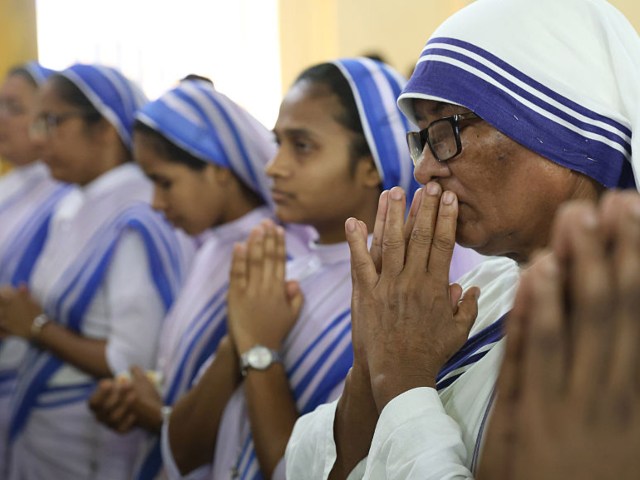

Protests continued this week throughout India in response to the prosecution of two Catholic nuns and a third Christian on charges of “conversion” and “human trafficking” for helping accompany a young Christian woman to a job opportunity.
The nuns, Sisters Preeti Mary and Vandana Francis, were released on bail this weekend following ten days behind bars as the local law enforcement authorities in Chhattisgarh delayed their criminal process for unspecified reasons. The women — along with a third identified as Sukaman Mandavi — are still facing the criminal charges after a radical Hindu nationalist organization apprehended and assaulted them for helping a local travel.
The triggering incident occurred on July 25. The three accused were reportedly accompanying a group of unnamed local tribal girls to Chhattisgarh’s Durg Railway Station. Despite local media regularly referring to them as “girls,” the three have been identified as adults between the ages of 19 and 22. According to one of the girls, who spoke to India’s NDTV, she was seeking to travel to Agra for a job opportunity as a cook. The young woman insisted that she had converted to Christianity years prior to the incident, denying the claim that the nuns were somehow illicitly converting the group.
“We three (girls) were travelling together. Sukhman bhaiya was dropping us to Durg because we didn’t know the way,” the unnamed young woman told NDTV. “The ticket collector fined us for not booking tickets. As we were leaving, Bajrang Dal members came and starting claiming that were were being taken forcibly.”
Bajrang Dal is a violent Hindu nationalist organization that regularly assaults and persecutes non-Hindus, particularly Christians. Hindu nationalists believe that all Indians must worship as Hindus and consider Christianity a foreign invasive religion to be eradicated.
The mob of Bajrang Dal supporters reportedly beat the nuns and the girls, then threatened the girls to testify before law enforcement that they had been trafficked and forcibly converted. The one young woman speaking to NDTV identified the main person threatening the girls as Jyoti Sharma, “a woman associated with a Hindutva outfit,” who allegedly warned “she must say she was being taken against her will, or else her brother would be beaten.”
Sharma insisted to reporters that she had a recording of the girls in question condemning the nuns for trafficking. Bajrang Dal complained that “the issue of religious conversion” had worsened recently and the ruling Hindu nationalist Bharatiya Janata Party (BJP) had not done enough to persecute Christians.
Following the arrests, protests erupted throughout India demanding freedom for the nuns. The latest occurred in Chicalim, Goa, a region with a relatively high Christian population, on Tuesday. Christians in the area organized a silent procession to pray for the nuns and the young women involved.
“We may be silent, but our God fights for us,” Father Bolmax Pereira, one of the organizers of the march, stated, according to local outlet The Goan.
The main opposition political party in India, the Indian National Congress (typically referred to as just Congress), joined Christians in protesting for the rights of the nuns.
The Catholic Bishops’ Conference of India (CBCI) issued a statement this weekend expressing gratitude for the freedom temporarily granted to the nuns under bail, gently urging the BJP to act to contain the threat created by its Hindu nationalist supporters.
“We are grateful to the Government for the support shown in this case. We hope this marks the beginning of renewed efforts to protect the rights and dignity of all religious minorities in our secular democracy,” Archbishop Andrews Thazhath, president of the CBCI, said in the statement.
“While appreciating the government’s responsiveness, the CBCI also called for a stronger commitment to upholding the constitutional rights of all minorities, especially the right to freedom of religion as enshrined in the Indian Constitution,” the statement continued.
The CBCI again affirmed that “the girls involved are already Christians and legally adults, and therefore, demanded the immediate quashing of the case.”
The bishops had previously confirmed the violent and unlawful nature of the arrests, detailing, “They were physically assaulted and the arrest took place despite written consent letters issued by the parents of each woman above 18 years of age.”
The local BJP has largely abstained from commenting on the matter. In Kerala, home to the largest population of Christians in the country, the local BJP president condemned the arrests, but regional leaders outside of Chhattisgarh have no power to act and the region is notorious as one of the most repressive against its native Christian population in the country.
According to a study published by the Religious Liberty Commission of the Evangelical Fellowship of India (EFIRLC) on Tuesday, Chhattisgarh is the second most dangerous region of India for Christians, after Uttar Pradesh. The group documented 86 incidents of persecution there between January and July 2025, compared to 95 in Uttar Pradesh and 334 incidents throughout all of India.
“According to EFIRLC’s findings, threats and harassment comprised 107 incidents, while false accusations and arrests accounted for 116 cases,” Christianity Today reported. “The documentation also recorded 42 instances of physical violence and 29 cases where worship services were disrupted, often during Sunday gatherings.”
Speaking to Breitbart News, an expert on Christian persecution in India who asked not to be named due to the dangerous situation in the country detailed regular abuses of the legal system against Christians mirroring the plight of the Chhattisgarh nuns.
“Christian persecution in India extends far beyond headline violence through systematic social boycotts, economic exclusion, and legal harassment,” the expert explained. “Converts from Hinduism face the harshest treatment, experiencing family rejection, loss of employment, denial of government benefits, and exclusion from village resources like wells and markets.”
The expert noted Christians often face “targeting during religious festivals, destruction of crosses and churches, forced participation in Hindu rituals, and organized campaigns like Ghar Wapsi (reconversion ceremonies).”
“Local authorities, particularly in BJP-controlled states, frequently delay investigations into anti-Christian violence,” the expert noted, “register cases under lesser charges, or fail to arrest perpetrators.”
“The disconnect between national rhetoric and local implementation creates an environment where religious minorities face increasing vulnerability despite official proclamations of tolerance,” the expert concluded.
COMMENTS
Please let us know if you're having issues with commenting.