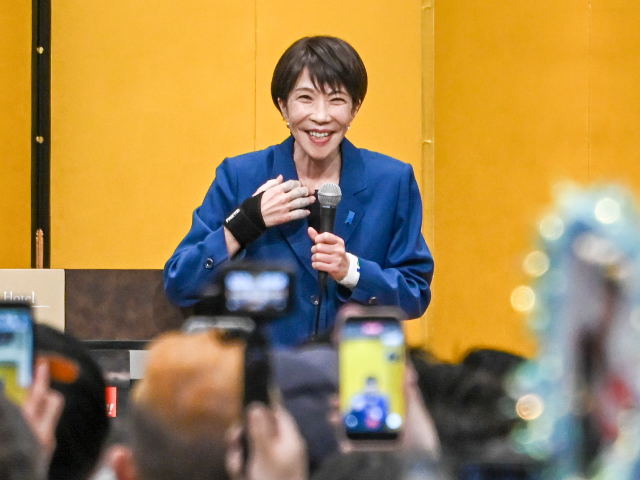
Japanese Prime Minister Takaichi Sanae took a gamble by holding early parliamentary elections as a referendum on her agenda, but the gamble looks like it will pay off as her enormous personal popularity is set to sweep more members of her governing coalition into the Diet.
Takaichi is especially popular with young voters who have been rushing to stores to buy her favorite foods, accessories, and even her signature pink pen.
Reuters on Wednesday cited polls that show Takaichi set to capture up to 300 of the 465 seats in Japan’s lower house due to “Sanamania.” Sanakatsu in Japanese, a term playfully adapted from oshikatsu, the Japanese term for obsessive pop-culture fandom runs wild across the nation. She has a 60 percent approval rating overall, but it soars to an amazing 90 percent among voters under 30.
The company that makes Takaichi’s favorite black leather bag, the “Grace Delight Tote,” is struggling to keep them in stock due to heavy demand from young customers, even though the bag costs $900 and is usually preferred by older customers. The waiting list for buying one of the bags is now nine months long.
Young people are also scrambling to buy copies of the pink pen Takaichi uses to take notes, and even bags of the shrimp rice crackers she was only briefly seen holding while on a train. She has 2.6 million followers on social media platform X versus about 64,000 for opposition leader Noda Yoshihiko. When she gave visiting South Korean President Lee Jae-myung a drum lesson last month by playing a tune from “K-Pop Demon Hunters,” the Japanese Internet melted down.
Bemused observers credit Takaichi’s meteoric popularity to her quirky background — she built her mad drum skills by playing in a heavy-metal band when she was in college — and a strong conservative shift among Japanese youth. She also seems to have won new fans by the very act of calling snap elections and forthrightly positioning them as a referendum on her agenda.
“I believe that the only option is for the people, as sovereign citizens, to decide whether or not Sanae Takaichi should be prime minister,” she said when announcing her decision to dissolve the lower house of parliament on January 19.
“Can you entrust the management of the nation to Sanae Takaichi? I ask the people directly to judge,” she said, effectively giving the public a second chance to vote for, or against, her.
Takaichi’s confidence and sincerity in calling the snap election impressed some voters who were on the fence about Japan’s first female prime minister. Her optimism has been a refreshing contrast to the dour leadership of her Liberal Democratic Party (LDP), which lost its leadership in both houses of parliament over the past few elections, and seemed on the verge of losing its perch as Japan’s dominant postwar party before Takaichi came along.
“She has a clear, decisive way of speaking. She communicates in a bright, positive way and I think that energy resonates with young people,” a young fan of Takaichi told Reuters.
The prime minister also endeared herself to Japanese voters with her ironclad work ethic and her touching devotion to her husband, LDP politician Yamamoto Taku, who is ten years her senior and wheelchair-bound after a recent stroke.
The Economist sounded a note of caution last week, pointing out that LDP has the same dismal approval ratings it did last October when it got thumped in lower-house elections. Even the most stratospheric levels of popularity for an individual leader can be difficult to translate to an entire political party.
Furthermore, while younger voters bubble with admiration for Takaichi’s honesty and courage, the wider public seemed slightly nonplussed by her call for snap elections, viewing it as an old-school political maneuver that was unbecoming of the exciting new type of leader Takaichi wants to be. Her personal approval rating is soaring, but approval for her administration is actually down about 16 percent since she took office, according to Nikkei Asia.
Nikkei Asia noted on Wednesday that young voters do not always show up on Election Day, in Japan as elsewhere, but associate professor Fujita Yuiko of the University of Tokyo pointed out that Takaichi’s appeal transcends shallow pop-star fandom, and her supporters are genuinely enthusiastic about the change she represents.
“Until now, politics has been dominated by senior male figures. The fact that the prime minister is now a woman, someone with a different background from what people are accustomed to, creates a feeling that something is shifting,” Fujita said.
“Young people pay the closest attention to economic policy, and her emphasis on the economy has further strengthened the perception that change may be on the horizon,” she said.
Fujita added that younger Japanese people are enthusiastic for Korean pop culture and wish to build better relations with South Korea free of the resentments related to World War II that linger among older people in both countries. Takaichi talks constantly of her love for all things Korean, and if she didn’t already have that vote tucked securely in her Grace Delight Tote, inviting the South Korean leader to play a tune from “K-Pop Demon Hunters” would have done it.
On the other hand, Fujita joined many other analysts in predicting that Takaichi’s personal popularity might not translate to the landslide vote she wants in the snap election.
“Many young people hold strong negative feelings toward politics dominated by senior men. Even if they support Takaichi, it is unlikely they would automatically vote for such LDP candidates if they were to run in their local districts,” she said.
Another observer, associate professor Tanihara Tsukasa of Ritsumeikan University, noted that aside from a few wacky music videos, Takaichi doesn’t really do anything differently with her social media presence than other Japanese politicians. She has millions of followers on X because “her presence in the real world is strong,” and her popularity is “effectively carried over into the online space.”
Takaichi’s surprisingly close friendship with U.S. President Donald Trump could be a wild card as well. The two leaders have gushed with praise for each other, even as Trump made some fairly steep demands of Japan on trade and defense. Takaichi treated her first meeting with Trump as though she had gotten a backstage pass at a rock concert.
The Trump factor in elections can be like shooting craps with three extra dice. Older Japanese voters have fond memories of Trump’s close personal friendship with the late prime minister Abe Shinzo, who Takaichi counts as a mentor. Takaichi is planning a trip to the United States in late March, and the Trump administration is planning to give her the red carpet treatment, including the relatively uncommon honor of treating her as a state guest — but Takaichi might have to delay or cancel her trip if the snap election goes badly.
The future of Takaichi Sanae’s administration will be revealed soon, as Japan is scheduled to hold its snap parliamentary election this Sunday, February 8.
COMMENTS
Please let us know if you're having issues with commenting.