
What if we held a recession and no one lost their job?
The Department of Labor on Friday will deliver its report on its two monthly surveys meant to capture the health of the nation’s labor market. The first is known as the household survey and is derived from a survey of around 60,000 households conducted by the Census Bureau. Its main product is the unemployment rate as well as the various breakdowns along demographic lines and reasons for unemployment.
The other is the establishment survey of businesses and government agencies from which we get data on the size of nonfarm payrolls, hourly and weekly earnings, the labor force participation rate, and average hours worked. It is based on the payroll period that included the twelfth of each month, which means it does not necessarily reflect any late-breaking changes in the economy. The data gets seasonally adjusted and adjusted for the Bureau of Labor Statistics’ estimates of payroll changes caused by the closings and openings of businesses during the month.
One way to think about what a soft-landing would look like is that the establishment survey would show the net number of people added to payrolls falling while the household survey would not record a big jump in unemployment. Back when he was thinking a soft-landing was realistically achievable, Federal Reserve Chairman Jerome Powell also talked about bringing down the number of job openings without reducing actual employment by much. A month ago or so, Powell seemed to assume that reducing these measures of demand for workers would bring down inflation—although that is very much an unproven assumption.

Federal Reserve Chairman Jerome Powell testifies before the House Financial Services Committee on June 23, 2022, in Washington. (AP Photo/Kevin Wolf)
The recent Fed minutes seemed to abandon the soft-landing hypothesis. The Fed now appears to understand that it will likely not only have to slow job openings or even hires, but also actually reduce employment. Even that, however, is unlikely to reduce inflation very quickly. As a result, it will likely take several months of worsening jobs numbers and rising unemployment to noticeably bring inflation back toward the Fed’s two percent target. The idea that we’ll get anywhere near the target in less than a few years—absent a very deep recession—looks increasingly implausible.
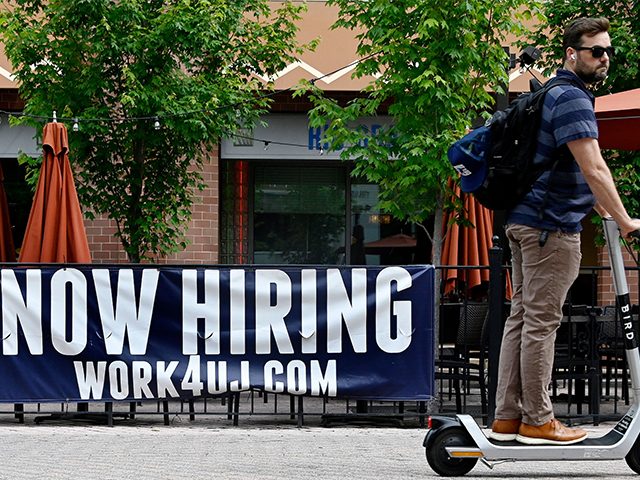
One reason for that is the new stickiness of job growth. Jobs grew rapidly in the first quarter of this year even though the economy was technically contracting. Now the economy appears to be contracting again—and not just for technical reasons related to the trade deficit and inventories. Manufacturing is in contraction in much of the country, if the regional Fed reports are to be believed. New business is drying up for both services and manufacturing. Construction seems to have rolled-over as mortgage rates hit home affordability. Yet the economy added millions of jobs in the first five months of the year, and unemployment is near historic lows. Jobless claims have ticked up a bit—but nowhere near anything that would normally look like a recession.
This situation could resolve itself in a way that would make the Fed’s inflation fight easier. The softness on the demand side for goods and services could prompt businesses to downsize payrolls. That would bring wage growth down and, eventually, tame inflation. That word eventually is covering a lot of ground. There may be a protracted period of stagflation—low growth and high inflation—under this scenario.
This is not the only possible outcome. We could instead see high employment and rising wages revive demand for goods and services, adding to growth and inflation. Under that scenario, the Fed would have to raise interest rates even further and most likely induce a severe recession to bring the wage-price spiral to an end.
Tomorrow’s report on the employment situation may begin to give us an indication of where we’re headed. Nonfarm payrolls are expected to grow by 270,000, a big slowdown from the 390,000 added in May. The unemployment rate, however, is expected to hold steady at 3.6 percent. In other words, economists are forecasting that in June something like the soft-landing scenario played out—although few now think it can stay that soft. A bigger slowdown in hiring or a large increase in unemployment seems unlikely given that the Job Opening and Labor Turnover Survey released Wednesday showed 11.3 million jobs at the end of May. But the economy appeared to undergo a marked downward shift in June, so the possibility cannot be ruled out.
COMMENTS
Please let us know if you're having issues with commenting.