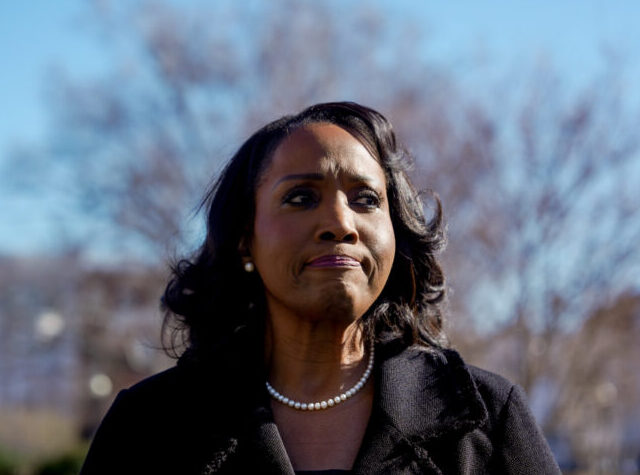

The Supreme Court appeared to cast a skeptical eye on the Trump administration’s claim that it had the authority to dismiss Federal Reserve Governor Lisa Cook based on mortgage fraud allegations without giving her a formal hearing.
But they also expressed doubt that the law afforded Fed officials as much protection as Cook’s lawyers claimed.
Much of the nearly two hours of oral arguments on Wednesday focused on the unusual emergency nature of the case and its rush from the Oval Office to the Supreme Court, with stops in between at a district court in Washington, D.C. that granted an preliminary injunction keeping Cook in place and a divided appeals court that upheld the injuction. Justice Samuel Alito asked why the case had to be handled in a “hurried manner” by the courts.
After a housing finance official in the Trump administration last year accused Cook of falsely claiming two properties as her primary residence in order to gain favorable mortgage terms, President Trump told the Fed governor she should resign and later said he was removing her from office. Cook sued in federal court to keep her job and a district judge ruled that Cook’s removal was improper because the allegations involved conduct prior to her role at the Fed and did not afford her appropriate notice and process to contest the charges.
At the start of oral arguments, Chief Justice John Roberts noted that there remained disputed factual matters as to the motivations for Cook’s alleged misstatements to lenders, hinting that the case may have reached the court prematurely.
At the heart of the case is the scope of presidential authority to remove Fed governors. By statute, governors serve 14 year terms unless earlier removed by the president “for cause.” Both sides in the Cook case agree that this bars a president from removing a Fed governor for a dispute over monetary policy.
Sauer argued to the court that the law did not require the president to give Cook a hearing and that the courts should largely defer to the president about what constitutes legal “cause” for removal. He said that while there is some room for judicial review, an allegation of gross negligence in respect to mortgages qualified as cause for removal.
Paul Clement, the lawyer representing Cook, argued that the “for cause” provision should be read to be identical to removal provisions that specify officials can only be removed for “inefficiency, neglect of duty, or malfeasance.” These so-called INM provisions have also been read by courts to require a hearing and to apply only to in-office conduct.
Both positions provoked sharp questions from the Court. Justice Brett Kavanaugh worried that the administration’s reading of the law lead to “at-will” removal of Fed officials, undermining the independence of the central bank. He raised the prospect of a future Democrat president removing all Republican appointees on pretextual grounds. Too deferential a reading of the “for cause” provision would incentivize the president to engage in “search and destroy” hunts for flimsy causes to remove officials.
Justice Amy Coney Barrett noted that Clement’s position that “for cause” should be read as incorporating the INM requirements was not backed up by the text of the Federal Reserve Act. Both Barrett and Alito asked Clement about hypotheticals in which a Fed official engaged in deplorable conduct—such as domestic abuse or expressing admiration for Hitler—either prior to taking office or unrelated to the office, forcing Clement to admit that his position would mean they would not be removable by the president.
Alito also challenged the idea that the law required a hearing for Cook, noting that the outcome of the hearing would still be up to the president. Clement argued that even if the president would determine the result, Cook was still entitled to be able to argue her case. Roberts also appeared to be skeptical of the idea that a hearing would accomplish much.
Although much of the public discussion has turned on arguments about how markets and the economy might react, very little time was spent on the question during oral arguments. Sauer dismissed as “prediction of doom” the arguments several economists had made on Cook’s behalf that giving the president too much sway over the Fed would tank financial markets or push the economy into a recession. He pointed out that the stock market rose in the days after Trump announced Cook’s removal.
The recent accusations by Fed chairman Jerome Powell that the Trump administration was using an investigation into cost overruns in a Fed building renovation project as a pretext to seize control of monetary policy were not mentioned during the hearing. Powell attended the hearing, apparently in a show of support for Cook.
The justices could send the case back to the lower court without any opinion at all, allowing the case to make its way through the judicial system. It was unclear during oral arguments whether they would leave standing the order keeping Cook in office, although several justices appeared to be leaning in that direction. Barrett noted that since the president did not control the Fed, keeping her in office while the case is litigated would be unlikely to inflict “irreparable harm” on the executive branch.
COMMENTS
Please let us know if you're having issues with commenting.