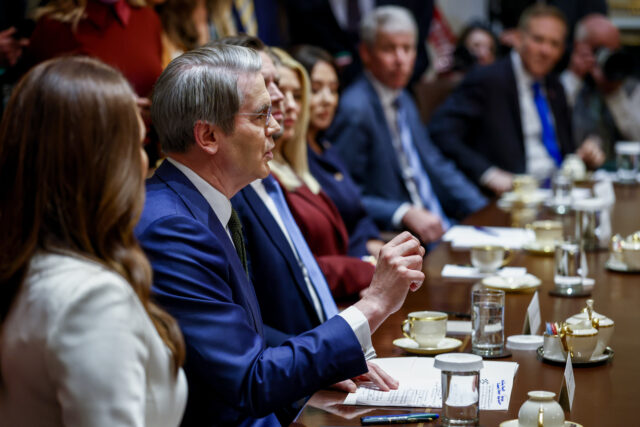

Treasury Secretary Scott Bessent cast the confrontation with Iran as a two-front war on Thursday, telling President Trump that American economic strength has been as critical to the campaign as the military operation unfolding across the Persian Gulf.
“The Iranians believe they are fighting a two-front war,” Bessent said at a cabinet meeting at the White House. “It is a military war that our great warriors are prosecuting, but on the other side they are trying to take control of the global economy through a choke point that we believe does not exist and that we will overcome.”
Bessent said the Treasury Department had spent nearly a year preparing the economic component of the offensive. Trump ordered the department last March to identify and sever all financial lifelines to the Iranian regime, he said, and the systematic campaign led to the collapse of Iran’s financial system in December.
“This was not something that happened overnight,” he said.
Oil and Shipping
The Treasury Secretary sought to calm energy-market jitters, declaring the global oil market “well supplied” and pointing to administration efforts to redirect supplies stranded at sea. He said the Development Finance Corporation’s maritime reinsurance program, operating alongside Central Command, would soon give commercial shippers transiting the Gulf unprecedented security guarantees.
Shipping traffic through the region is already increasing on a daily basis, Bessent said, even before the Strait of Hormuz is fully secured.
Energy prices lend support to his case. U.S. crude oil prices remain more than 30 percent below the peak reached during the early stages of the Ukraine war in 2022. Gasoline and diesel prices have averaged roughly 10 percent lower under the current administration than under President Biden’s, and natural gas spot prices are running more than 20 percent below the Biden-era average, having fallen from $3.80 to under $3.00.
Tax-Cut Provisions Show Early Traction
Bessent also highlighted the early results of the tax provisions enacted through the One Big Beautiful Bill Act, the sweeping fiscal package Trump signed into law last year.
Treasury data through March 25 show that nearly 37.5 million individual returns — 43.9 percent of the roughly 85.4 million filed so far this season — have claimed at least one of the law’s signature deductions for tips, overtime pay, or Social Security income. About 19.5 million of those returns claimed the senior deduction. The average individual refund has risen to $3,570, up more than 10 percent from $3,233 in the prior filing season.
The law’s Trump Accounts, tax-advantaged savings vehicles for children, are also gaining early adoption. More than 2.6 million Forms 4547 have been filed, covering over four million dependents. Nearly 984,000 of those dependents qualified for the $1,000 bonus deposit that funds new accounts.
Dollar Strengthens
Bessent noted that the U.S. dollar has appreciated since hostilities began, reasserting its role as the world’s primary safe-haven asset. Capital inflows into the United States have accelerated, he said, reflecting confidence in the broader policy framework.
“Thanks to your efforts, the U.S. economy is the best positioned in the world,” Bessent told the president.
Mr. Trump responded with characteristic appraisal: “Is this guy central casting? Even the glasses are perfect.”
COMMENTS
Please let us know if you're having issues with commenting.