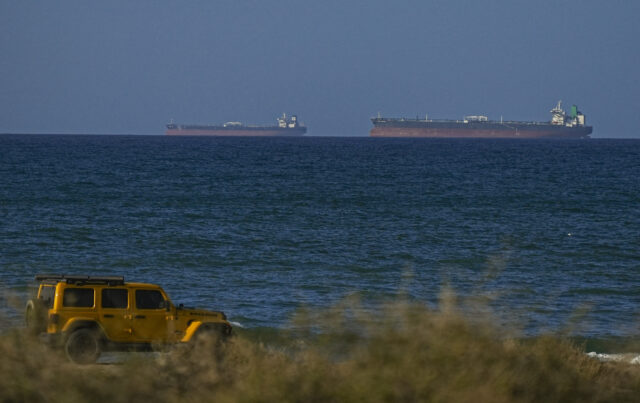

President Donald Trump warned Iran on Thursday against charging fees on tanker traffic through the Strait of Hormuz, writing on Truth Social: “There are reports that Iran is charging fees to tankers going through the Hormuz Strait — They better not be and, if they are, they better stop now!”
The statement follows reports that Iranian authorities and forces linked to the Islamic Revolutionary Guard Corps (IRGC) have demanded up to approximately $2 million from large tankers for safe passage through the narrow 22-mile waterway connecting the Persian Gulf to the Indian Ocean. Some payments have reportedly been discussed or accepted in Chinese yuan or cryptocurrencies, including dollar-pegged stablecoins.
On Wednesday, ABC News correspondent Jonathan Karl reported asking Trump about the alleged tolls. According to Karl, the president responded by describing a possible U.S.-Iran “joint venture” to help secure the strait as “a beautiful thing.”
In March, President Trump was asked by Bloomberg’s Annmarie Hordern if Iran should be able to charge ships a fee to go through the strait. “Should they be able to? They shouldn’t be able to. They’re doing it a little bit,” Trump said.
Earlier this month, Iran notified the International Maritime Organization (IMO) — the UN body responsible for global shipping safety — that vessels from non-hostile countries could receive safe transit through the strait if they coordinate with Iranian authorities and do not support actions against Iran. The communication stressed that, as a coastal state, Iran was restricting passage for ships it considered linked to aggressors, claiming consistency with international legal principles.
Separately, Iran’s parliamentary National Security Committee has approved a bill that would formally authorize fees on vessels transiting the strait, according to the semi-official Fars news agency. The legislation is still awaiting full parliamentary approval, according to Fars.
The moves have sparked objections from U.S. allies including Britain, Japan, and European governments, as well as from Persian Gulf states such as Saudi Arabia, the United Arab Emirates, and Oman, which shares control of the strait with Iran.
Under standard international maritime rules, coastal nations exercise sovereignty over waters extending 12 nautical miles (roughly 14 miles or 22 kilometers) from their shores, where they may board or inspect vessels. The Strait of Hormuz lies within waters claimed by both Iran and Oman.
The International Maritime Organization stated on Thursday that imposing a toll on the strait would set a “dangerous precedent,” noting that the law of the sea guarantees transit passage through international straits and does not permit coastal states to levy such charges. Although Iran has not ratified the United Nations Convention on the Law of the Sea (the main legal foundation for opposition to the tolls), the IMO and many Western governments regard the principle of free transit as binding. The U.S. has also not ratified the treaty.
The White House has insisted that the recent two-week ceasefire with Iran requires the strait to reopen without restrictions. Nevertheless, maritime traffic remains severely reduced. Several news outlets have reported that less than a dozen ships crossed the strait in the latest 24-hour period, compared with roughly 140 on a typical day before the conflict.
COMMENTS
Please let us know if you're having issues with commenting.