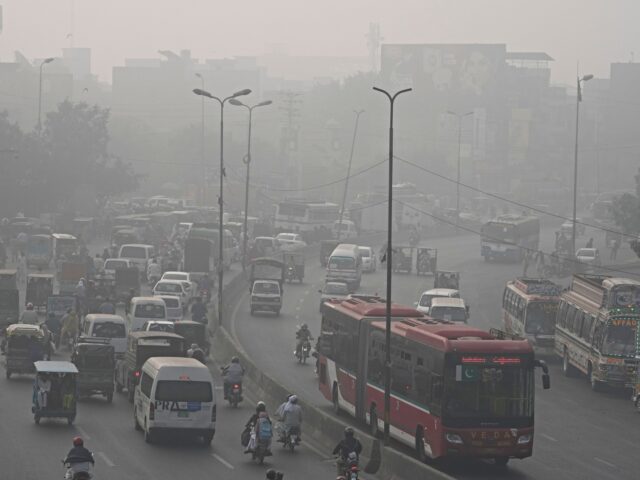

The latest annual review from Swiss-based air quality company IQAir found that Pakistan was the most polluted country in the world, beating out last year’s champion Chad, up-and-coming contender Bangladesh, and perennial smog heavyweight India.
The 2025 World Air Quality Report found that India could claim the single most polluted city on Earth, Loni, which boasts a level of fine particulate matter (PM2.5) that is about 22 times the safe level recommended by the World Health Organization (W.H.O.).
The five most polluted countries, in order, were Pakistan, Bangladesh, Tajikistan, Chad, and the Democratic Republic of the Congo (DRC). All of the world’s 25 most polluted cities were located in India, Pakistan, or China. Not a single major city in East Asia met the W.H.O. guidelines for air pollution in either 2024 or 2025.
AirIQ noted that roughly 91 percent of countries and territories in the world fail to meet the W.H.O. standard. Only 13 countries and territories do, and most of them are either islands or fairly remote territory, like Iceland.
The particulate matter levels measured by the World Air Quality Report include emissions from wildfires, which gave Canada an exceptionally poor ranking last year, and caused the PM2.5 averages for cities in the northern United States to increase due to drifting smoke.
The five most polluted countries in the 2024 edition of the report were Chad, Bangladesh, Pakistan, the DRC, and India.
India fell to Number Six in 2025, a modest improvement credited to efforts by the Indian government to reduce sulphur emissions from diesel fuel, employ cleaner industrial fuels, and improve compliance with air quality regulations in the most polluted cities.
Bangladesh is dealing with massive population growth and industrial expansion across a very small land mass. IQAir researchers attributed much of the poor overall air quality ranking for Bangladesh to the intense pollution hanging over its capital city, Dhaka.
IQAir said some fluctuations in air quality levels were errors due to lost data. The company was particularly critical of the U.S. government for discontinuing a global monitoring program that collected data from American embassies and consulate buildings around the world.
The U.S. program was launched in 2008 and canceled by the State Department last March due to budgetary concerns. Critics of the cancellation noted that in some countries, the measurements taken by American embassies was the only reliable air quality data available to researchers.
COMMENTS
Please let us know if you're having issues with commenting.